PUBLISHER: Mordor Intelligence | PRODUCT CODE: 2117974

PUBLISHER: Mordor Intelligence | PRODUCT CODE: 2117974
United States-Mexico Industrial Rail Freight Transport - Market Share Analysis, Industry Trends & Statistics, Growth Forecasts (2026 - 2031)
According to Mordor Intelligence, the United States-Mexico industrial rail freight transport market size was valued at USD 3.65 billion in 2025 and is projected to reach USD 3.92 billion in 2026 and to USD 5.50 billion by 2031, growing at a CAGR of 7.01% during 2026-2031.
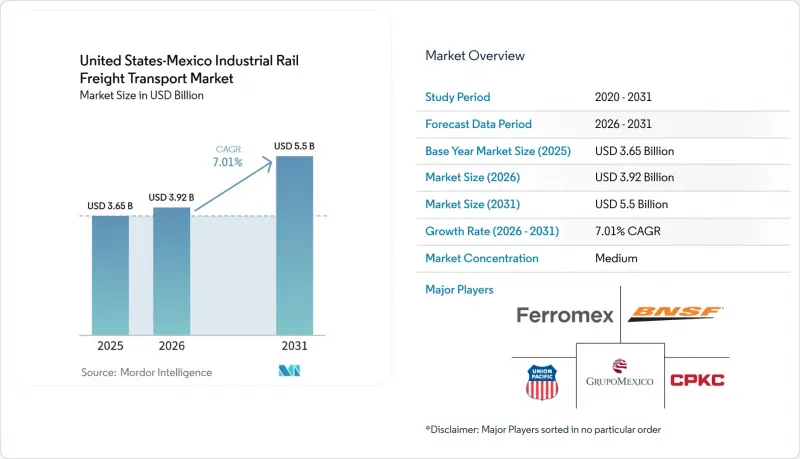
The United States-Mexico industrial rail freight market is performing steadily, driven by strong cross-border movement of industrial goods, auto parts, appliances, and other manufacturing-linked cargo across key trade corridors. This report is Segmented by Cargo Type (Bulk Industrial Freight, Wagonload, Breakbulk Freight, and More), by Shipment Distance (Long, Medium, Short Haul), by Trade Flow Direction (United States To Mexico, Mexico To United States), and by End User (Automotive, Metal and Steel, Chemicals and Petrochemicals, and More). The Market Forecasts are Provided in Terms of Value (USD).
United States-Mexico Industrial Rail Freight Transport Market Trends and Insights
Nearshoring of Industrial Supply Chains
Nearshoring remains the clearest growth engine for the United States-Mexico industrial rail freight market, as new factories continue to add freight origins on both sides of the border. Mexico attracted a record USD 40.87 billion in foreign direct investment during 2025, representing a 10.8% year-on-year increase and reinforcing investor confidence in the country's manufacturing base. As production clusters deepen in Nuevo Leon, Queretaro, and Guanajuato, rail-linked industrial parks are seeing greater terminal utilization and stronger demand for regular component flows. In 2026, Plan Mexico has activated 20 industrial parks across 10 states, adding more production nodes that need rail access to ports, border gateways, and inland hubs. This shifts the focus from simply adding track to improving yards, terminals, and border transfer capacity. The United States-Mexico industrial rail freight transport market is likely to benefit most when rail operators align service design with the geography of new industrial investment.
USMCA Rules of Origin Reinforcing Regional Sourcing
USMCA rules continue to support the United States-Mexico industrial rail freight market by making regional sourcing more important for manufacturers serving North America. The automotive content rule under USMCA requires 75% regional value content, up from 62.5% under NAFTA, which has pushed more sourcing toward the United States and Mexican suppliers. Mexico also sources a large share of its intermediate goods imports from the United States, which means northbound finished goods often create matching southbound flows of inputs and components. This two-way structure supports steadier rail demand than one-direction trade models. The scheduled USMCA review in July 2026 introduces uncertainty because stricter treatment of steel and aluminum documentation could slow movements or change sourcing patterns. A favorable review outcome would reinforce another investment cycle for the United States-Mexico industrial rail freight transport market, while a tougher outcome would raise planning risk for shippers.
Border Infrastructure Congestion and Crossing Delays
Border congestion remains one of the clearest operational restraints on the United States-Mexico industrial rail freight transport market because rail and truck systems depend on the same gateway ecosystem. The Laredo-Nuevo Laredo corridor processes an average of 12,000 trailers per day and can reach 21,000 on peak days, keeping pressure high on customs, drayage, and interchange capacity. Rail loses part of its time advantage when inspection queues and terminal congestion spill over into the border-handling process. In February 2025, Mexico's VUCEM digital customs outage caused delays of up to 3 days at major crossings, which showed that digital systems can also become failure points when backups are weak. In April 2026, CBP revised commercial crossing hours at Eagle Pass to more tightly manage flows, but this was a traffic management step rather than a full-capacity solution. Until border infrastructure expands more broadly, the United States-Mexico industrial rail freight transport market will continue to face service friction at its busiest nodes.
Other drivers and restraints analyzed in the detailed report include:
- Digital Customs Clearance and Pre-Arrival Data Integration
- Growth of Cross-Border Intermodal and Bonded Cross-Dock Networks
- Tariff Volatility and Trade Policy Uncertainty
For complete list of drivers and restraints, kindly check the Table Of Contents.
Segment Analysis
Bulk industrial freight accounted for 38.71% of the United States-Mexico industrial rail freight transport market share in 2025, while containerized industrial freight is projected to grow at a 10.06% CAGR through 2031. Bulk remains important because metals, minerals, steel products, and construction inputs are still well matched to rail economics on long cross-border lanes. These shipments usually move in larger lot sizes and fit the established carload and unit-train structure that rail operators have built over decades. Containerized freight is growing faster as manufacturers move more automotive parts, electronics, and industrial assemblies in standardized containers. That shift makes it easier to connect plants, border terminals, and inland distribution centers without adding as much manual handling.
The cargo mix is changing the commercial profile of the United States-Mexico industrial rail freight transport industry, as rail is becoming more relevant for freight that once defaulted to truck. In March 2025, intermodal container movements reached 81,598 units, which supports the view that containerized flows are becoming a structural part of the corridor rather than a temporary spike. Breakbulk, wagonload, and less-than-trainload freight still play a clear role in energy projects, chemicals, machinery, and oversized industrial equipment. Those smaller segments may not lead to growth, but they broaden the revenue base and keep rail relevant across many industrial shipping patterns. Equipment standards and cross-border interchange rules also matter more as carriers handle a wider range of container and wagon configurations within the United States-Mexico industrial rail freight transport market.
Long-haul represented 46.08% of the United States-Mexico industrial rail freight transport market size in 2025, while medium-haul is forecast to expand at a 10.26% CAGR through 2031. Long-haul lanes remain the largest part of the market because rail has long held a cost and capacity advantage on routes such as Chicago to Monterrey and Los Angeles to Mexico City. These corridors support dense industrial volumes and justify the fixed handling steps that rail requires. Medium-haul growth is stronger because the Bajio manufacturing cluster sits within a range that is becoming more workable for intermodal rail. As truck costs rise and capacity tightens, rail is becoming more competitive in lanes that were once considered too short for reliable conversion.
This shift is gradually redefining the service boundary of the United States-Mexico industrial rail freight transport market. C.H. Robinson noted in February 2026 that rail spot prices were moving close to truck prices and that the gap should widen again as truckload conditions tightened later in the year. That creates a better opening for rail in the 300-700 km and 550-1,500 mile bands where shippers balance time, cost, and reliability very carefully. Short-Haul remains the smallest segment because terminal handling and drayage costs are still too high for many sub-300 km moves. Even so, the United States-Mexico industrial rail freight transport industry is becoming less dependent on only the longest lanes as network design improves and medium-haul economics strengthen.
Complete Report Scope:
- By Cargo Type
- Containerized Industrial Freight
- Bulk Industrial Freight
- Breakbulk Freight
- Wagonload Freight
- Less-than-Trainload Freight
- By Shipment Distance
- Short-Haul (Less than 300 km)
- Medium-Haul (300-700 km)
- Long-Haul (more than 700 km)
- By Trade Flow Direction
- United States to Mexico
- Mexico to United States
- By End User
- Automotive
- Metals and Steel
- Machinery and Industrial Equipment
- Chemicals and Petrochemicals
- Construction and Building Materials
- Paper, Pulp, and Packaging Materials
- Consumer and Industrial Manufactured Goods
- Other Agricultural Processors
List of Companies Covered in this Report:
- Canadian Pacific Kansas City Ltd. (CPKC)
- Union Pacific Railroad Co.
- BNSF Railway Co.
- Grupo Mexico Transportes, S.A.B. de C.V. (GMXT)
- Ferromex
- Ferrovalle
- Canadian National Railway
- CSX Transportation
- Norfolk Southern Railway
- C.H. Robinson Worldwide, Inc.
- J.B. Hunt Transport Services, Inc.
- Schneider National, Inc.
- DHL Supply Chain & Global Forwarding
- DSV A/S
- Ryder System, Inc.
- Hub Group
- STG Logistics
- UPS
- NFI Industries, Inc.
- Werner Enterprises, Inc.
- Landstar System, Inc.
- RXO, Inc.
Additional Benefits:
- The market estimate (ME) sheet in Excel format
- 3 months of analyst support
TABLE OF CONTENTS
1 Introduction
- 1.1 Study Assumptions and Market Definition
- 1.2 Scope of the Study
2 Research Methodology
3 Executive Summary
4 Market Landscape
- 4.1 Market Overview and Importance of United States-Mexico Rail Connectivity
- 4.2 Role of Rail in United States-Mexico Industrial Supply Chains
- 4.3 Market Drivers
- 4.3.1 Nearshoring of Industrial Supply Chains
- 4.3.2 USMCA Rules of Origin Reinforcing Regional Sourcing
- 4.3.3 Digital Customs Clearance and Pre-Arrival Data Integration
- 4.3.4 Growth of Cross-Border Intermodal and Bonded Cross-Dock Networks
- 4.3.5 Rail Capacity Expansion at Key Border Corridors
- 4.3.6 Short-Haul Intermodal Share Gains from Truck Capacity Tightness
- 4.4 Market Restraints
- 4.4.1 Border Infrastructure Congestion and Crossing Delays
- 4.4.2 Tariff Volatility and Trade Policy Uncertainty
- 4.4.3 Security Risks and Cargo Theft Corridors in Mexico
- 4.4.4 Cross-Border Driver Shortages and Equipment Imbalances
- 4.5 Regulatory Framework
- 4.6 Value Chain and Distribution Channel Architecture Analysis
- 4.7 Technology Innovations Outlook
- 4.8 Porter's Five Forces Analysis
- 4.8.1 Threat of New Entrants
- 4.8.2 Bargaining Power of Suppliers
- 4.8.3 Bargaining Power of Buyers
- 4.8.4 Threat of Substitutes
- 4.8.5 Rivalry Among Competitors
- 4.9 Comparison of Rail Freight versus Other Transportation Modes
- 4.10 United States-Mexico Trade Overview
- 4.11 Port Connectivity Analysis and Rail Infrastructure Analysis
- 4.12 Sustainability and ESG Analysis
- 4.13 Evolution of the Industrial Rail Freight Transport
- 4.14 Impact of Geo-Political Events on Supply Chain Shifts
5 Market Size and Growth Forecasts (Value, 2026-2031)
- 5.1 By Cargo Type
- 5.1.1 Containerized Industrial Freight
- 5.1.2 Bulk Industrial Freight
- 5.1.3 Breakbulk Freight
- 5.1.4 Wagonload Freight
- 5.1.5 Less-than-Trainload Freight
- 5.2 By Shipment Distance
- 5.2.1 Short-Haul (Less than 300 km)
- 5.2.2 Medium-Haul (300-700 km)
- 5.2.3 Long-Haul (more than 700 km)
- 5.3 By Trade Flow Direction
- 5.3.1 United States to Mexico
- 5.3.2 Mexico to United States
- 5.4 By End User
- 5.4.1 Automotive
- 5.4.2 Metals and Steel
- 5.4.3 Machinery and Industrial Equipment
- 5.4.4 Chemicals and Petrochemicals
- 5.4.5 Construction and Building Materials
- 5.4.6 Paper, Pulp, and Packaging Materials
- 5.4.7 Consumer and Industrial Manufactured Goods
- 5.4.8 Other Agricultural Processors
6 Competitive Landscape
- 6.1 Market Concentration
- 6.2 Key Strategic Moves
- 6.3 Market Share Analysis
- 6.4 Company Profiles (includes Global level Overview, Market level overview, Core Segments, Financials as available, Strategic Information, Market Rank/Share for key companies, Products & Services, and Recent Developments)
- 6.4.1 Canadian Pacific Kansas City Ltd. (CPKC)
- 6.4.2 Union Pacific Railroad Co.
- 6.4.3 BNSF Railway Co.
- 6.4.4 Grupo Mexico Transportes, S.A.B. de C.V. (GMXT)
- 6.4.5 Ferromex
- 6.4.6 Ferrovalle
- 6.4.7 Canadian National Railway
- 6.4.8 CSX Transportation
- 6.4.9 Norfolk Southern Railway
- 6.4.10 C.H. Robinson Worldwide, Inc.
- 6.4.11 J.B. Hunt Transport Services, Inc.
- 6.4.12 Schneider National, Inc.
- 6.4.13 DHL Supply Chain & Global Forwarding
- 6.4.14 DSV A/S
- 6.4.15 Ryder System, Inc.
- 6.4.16 Hub Group
- 6.4.17 STG Logistics
- 6.4.18 UPS
- 6.4.19 NFI Industries, Inc.
- 6.4.20 Werner Enterprises, Inc.
- 6.4.21 Landstar System, Inc.
- 6.4.22 RXO, Inc.
7 Market Opportunities and Future Outlook
- 7.1 White-space and Unmet-Need Assessment

