PUBLISHER: Mordor Intelligence | PRODUCT CODE: 2117224

PUBLISHER: Mordor Intelligence | PRODUCT CODE: 2117224
United States Rail Freight Transport - Market Share Analysis, Industry Trends & Statistics, Growth Forecasts (2026 - 2031)
According to Mordor Intelligence, the United States rail freight transport market size market size in 2026 is estimated at USD 74.17 billion, growing from 2025 value of USD 71.77 billion with 2031 projections showing USD 87.42 billion, growing at 3.34% CAGR over 2026-2031.
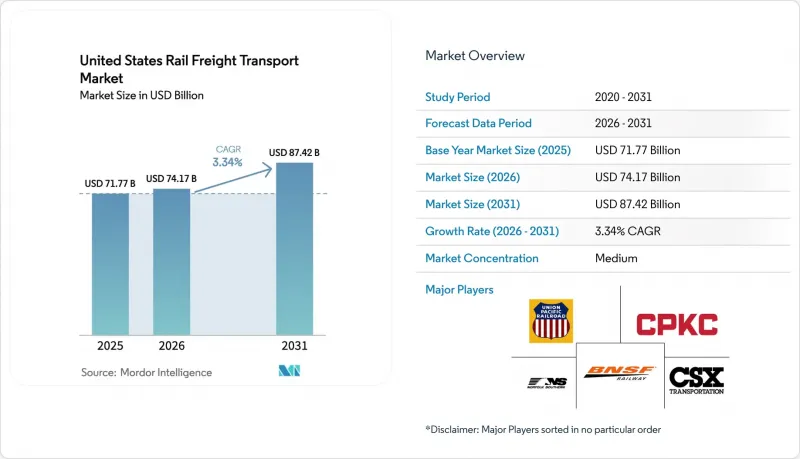
This report is Segmented by Cargo Type (Containerised / Intermodal, Dry Bulk (Coal, Ores, Grains) and More), Service Type (Transportation and Services Allied To Transportation), End User (Mining & Minerals, Oil, Gas & Chemicals, and More), Traction Type (Diesel and More) and Domestic (Domestic and International / Cross-Border). The Market Forecasts are Provided in Terms of Value (USD).
United States Rail Freight Transport Market Trends and Insights
Surge in E-commerce-Led Intermodal Volumes
Containerised freight remains the United States rail freight transport market's growth engine, with total intermodal units up 8.5 % year over year in 2024. Class I carriers have accelerated pop-up ramp initiatives and inland-port developments to capture e-commerce imports flowing through West Coast and Southwest gateways. Because omnichannel retailers schedule inventory replenishment in daily windows, on-time performance is becoming as vital as price. A clear outgrowth is the placement of new distribution centres on rail-served sites in secondary urban rings, which lengthens the dray leg and tilts the cost equation toward rail line-haul.
Gulf Coast Petrochemical Boom Boosting Tank-Car Traffic
Petrochemical complexes along the Texas-Louisiana coastline recorded a 4.2 % production increase in 2024, and rail shipments of chemicals rose roughly 3.5 % year over year, outpacing overall freight growth. ExxonMobil's USD 2 billion Baytown expansion alone is raising specialty-chemical output by 40 %, driving additional inbound feedstock and outbound product moves. The planned deep-water Sea Port Oil Terminal at Freeport, Texas, approved by the Maritime Administration, will further reshape tank-car corridors by adding capacity to load 2 million barrels of crude daily. Growing traffic density is prompting carriers to invest in double-tracking and yard expansions to avoid pinch points.
Structural Decline in U.S. Coal-Fired Power
Coal shipments fell 13.6 % in 2024, reaching their lowest volume since 1988, and the Energy Information Administration sees coal's share of generation sliding to 15 % by 2030. Class I carriers manage the downturn by allowing specialised coal cars to retire through attrition while redirecting capital toward diversified bulk and intermodal projects. Because coal routes historically subsidised network maintenance, their decline requires rate adjustments across other commodities, subtly affecting overall pricing power.
Other drivers and restraints analyzed in the detailed report include:
- Cross-Border Grain Flows from Canada to the United States
- Resurgence of Domestic Coal under High Gas Prices
- Service Reliability Issues Driving Mode Shift to Trucking
For complete list of drivers and restraints, kindly check the Table Of Contents.
Segment Analysis
Intermodal holds a 47.20 % market share of the United States rail freight transport market size in 2025, reflecting the segment's dominance as e-commerce and global sourcing reshape supply chains. Volume growth of 8.5 % in 2024 confirms that container traffic remains the primary engine of car-load expansion. Terminal productivity, rather than mainline speed, is emerging as the constraint; BNSF and Union Pacific have therefore prioritised new ramp capacity in Chicago and Phoenix to keep stack-train velocity intact.
Dry bulk is the next-largest segment, yet coal's 13.6 % decline has shifted its internal mix toward grains and aggregates. Grain carloads rose year over year, cushioning revenue loss from coal and highlighting the importance of agricultural flows reported by the Agricultural Marketing Service . Liquid bulk benefits from petrochemical output gains, while break-bulk and project cargo, though the smallest, show the fastest forecast CAGR at 6.82 % as renewable-energy components move by rail. The evolving commodity mix signals that railroads must maintain a flexible wagon fleet to manage diverse loading needs across cargo types.
Transportation services account for roughly 88.40 % of 2025 market size, but allied services are forecast to grow at a 7.02 % CAGR through 2031. Growth in storage, transloading, and wagon maintenance reflects shippers' demand for one-stop logistics solutions that reduce hand-offs. By bundling these services, carriers create stickier revenue streams and improve car utilisation, indirectly lifting margins.
BNSF's Shortline Select partnership with Genesee & Wyoming demonstrates how main-line carriers leverage network reach to support smaller railroads and expand transload offerings. Railroads are also investing in predictive-maintenance software to cut repair cycle-time, freeing assets for higher-yield traffic. Together, these trends imply that allied services will outpace core haulage in revenue growth, enhancing overall industry resilience.
Complete Report Scope:
- By Cargo Type
- Containerised / Intermodal
- Dry Bulk (Coal, Ores, Grains)
- Liquid Bulk (Crude, Chemicals)
- Break-bulk & Project Cargo
- By Service Type
- Transportation
- Services Allied to Transportation (Maintenance of Railcars and Rail Tracks, Switching of Cargo, and Storage)
- By End-user Industry
- Mining & Minerals
- Oil, Gas & Chemicals
- Agriculture & Food
- Manufacturing & Automotive
- Retail & FMCG
- Construction Materials & Others
- By Traction Type
- Diesel
- Electric
- Hybrid / Hydrogen & LNG
- By Destination
- Domestic
- International / Cross-border
List of Companies Covered in this Report:
- Union Pacific Railroad
- BNSF Railway
- CSX Transportation
- Norfolk Southern Railway
- Canadian Pacific Kansas City
- Canadian National Railway (U.S. Ops)
- Genesee & Wyoming Inc.
- Patriot Rail Company
- Florida East Coast Railway
- Watco Companies
- Montana Rail Link
- Iowa Interstate Railroad
- OmniTRAX Inc.
- Wisconsin & Southern Railroad
- Anacostia Rail Holdings
- TrinityRail (Trinity Industries)
- GATX Corporation
- TTX Company
- Greenbrier Companies
- CaterParrott Railnet*
Additional Benefits:
- The market estimate (ME) sheet in Excel format
- 3 months of analyst support
TABLE OF CONTENTS
1 Introduction
- 1.1 Study Assumptions & Market Definition
- 1.2 Scope of the Study
2 Research Methodology
3 Executive Summary
4 Market Landscape
- 4.1 Market Overview
- 4.2 Market Drivers
- 4.2.1 Surge in e-commerce-led Intermodal Volumes
- 4.2.2 Gulf Coast Petrochemical Boom Boosting Tank-Car Traffic
- 4.2.3 IIJA-Funded Corridor Upgrades Enhancing Capacity
- 4.2.4 Cross-border Grain Flows from Canada to U.S.
- 4.2.5 Resurgence of Domestic Coal under High Gas Prices
- 4.2.6 Precision Scheduled Railroading (PSR) Cost Efficiencies
- 4.3 Market Restraints
- 4.3.1 Structural Decline in U.S. Coal-Fired Power
- 4.3.2 Service Reliability Issues Driving Mode Shift to Trucking
- 4.3.3 Labor Contract Disputes & Wage Inflation
- 4.3.4 Tightened Hazmat Regulations on Flammable Liquids
- 4.4 Value / Supply-Chain Analysis
- 4.5 Regulatory Outlook
- 4.6 Technological Outlook
- 4.7 Porter's Five Forces
- 4.7.1 Threat of New Entrants
- 4.7.2 Bargaining Power of Buyers
- 4.7.3 Bargaining Power of Suppliers
- 4.7.4 Threat of Substitutes
- 4.7.5 Intensity of Competitive Rivalry
- 4.8 Transport Corridors & Logistics Hubs Analysis
- 4.9 Impact of China's Belt & Road Initiative
- 4.10 Freight Cost Benchmarking
- 4.11 Trade Agreements Influencing Rail Flows
- 4.12 Key End-User Industry Insights
- 4.13 Impact of COVID-19 and Geo-Political Events on the Market
5 Market Size & Growth Forecasts (Value)
- 5.1 By Cargo Type
- 5.1.1 Containerised / Intermodal
- 5.1.2 Dry Bulk (Coal, Ores, Grains)
- 5.1.3 Liquid Bulk (Crude, Chemicals)
- 5.1.4 Break-bulk & Project Cargo
- 5.2 By Service Type
- 5.2.1 Transportation
- 5.2.2 Services Allied to Transportation (Maintenance of Railcars and Rail Tracks, Switching of Cargo, and Storage)
- 5.3 By End-user Industry
- 5.3.1 Mining & Minerals
- 5.3.2 Oil, Gas & Chemicals
- 5.3.3 Agriculture & Food
- 5.3.4 Manufacturing & Automotive
- 5.3.5 Retail & FMCG
- 5.3.6 Construction Materials & Others
- 5.4 By Traction Type
- 5.4.1 Diesel
- 5.4.2 Electric
- 5.4.3 Hybrid / Hydrogen & LNG
- 5.5 By Destination
- 5.5.1 Domestic
- 5.5.2 International / Cross-border
6 Competitive Landscape
- 6.1 Market Concentration
- 6.2 Strategic Moves
- 6.3 Market Share Analysis
- 6.4 Company Profiles {(includes Global level Overview, Market level overview, Core Segments, Financials, Strategic Information, Market Rank/Share, Products & Services, Recent Developments)}
- 6.4.1 Union Pacific Railroad
- 6.4.2 BNSF Railway
- 6.4.3 CSX Transportation
- 6.4.4 Norfolk Southern Railway
- 6.4.5 Canadian Pacific Kansas City
- 6.4.6 Canadian National Railway (U.S. Ops)
- 6.4.7 Genesee & Wyoming Inc.
- 6.4.8 Patriot Rail Company
- 6.4.9 Florida East Coast Railway
- 6.4.10 Watco Companies
- 6.4.11 Montana Rail Link
- 6.4.12 Iowa Interstate Railroad
- 6.4.13 OmniTRAX Inc.
- 6.4.14 Wisconsin & Southern Railroad
- 6.4.15 Anacostia Rail Holdings
- 6.4.16 TrinityRail (Trinity Industries)
- 6.4.17 GATX Corporation
- 6.4.18 TTX Company
- 6.4.19 Greenbrier Companies
- 6.4.20 CaterParrott Railnet*
7 Market Opportunities & Future Outlook

