PUBLISHER: Mordor Intelligence | PRODUCT CODE: 2117381

PUBLISHER: Mordor Intelligence | PRODUCT CODE: 2117381
Africa Mining Equipment - Market Share Analysis, Industry Trends & Statistics, Growth Forecasts (2026 - 2031)
According to Mordor Intelligence, the Africa mining equipment market size was valued at USD 3.13 billion in 2025 and is projected to expand from USD 3.26 billion in 2026 to USD 4.02 billion by 2031, registering a CAGR of 4.24% between 2026 and 2031.
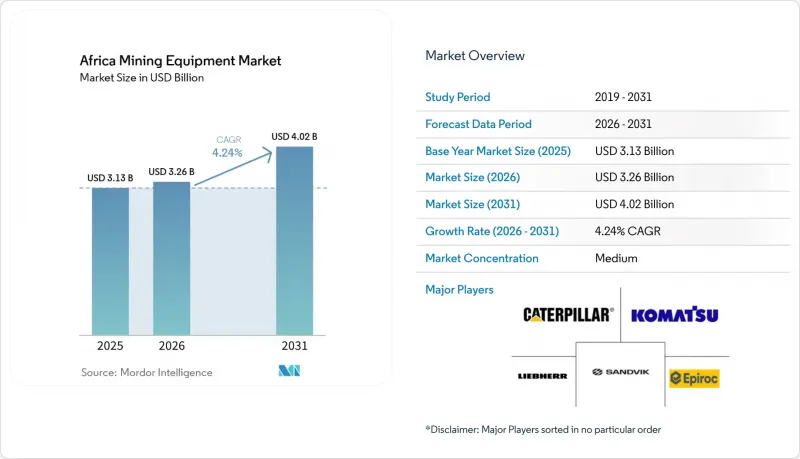
This report is Segmented by Equipment Type (Surface Mining Equipment, Underground Mining Equipment, and More), Automation Level (Manual Equipment, Semi-Autonomous Equipment, and More), Powertrain Type (Internal-Combustion Engine Vehicles, Battery-Electric Vehicles, and More), Power Output, Application, and Country. The Market Forecasts are Provided in Terms of Value (USD) and Volume (Units).
Africa Mining Equipment Market Trends and Insights
Rapid Expansion of Surface Mining Projects in Africa
Open-pit mega-projects such as Guinea's Simandou iron ore complex and the DRC's USD 28.9 billion MIFOR development are fueling orders for ultra-class haul trucks, high-capacity rope shovels, and crushing circuits . Komatsu announced a major contract to deliver five PC5500-11 excavators to Simandou in February 2025, illustrating how 400-tonne-class machinery lowers haulage costs and boosts productivity. Local rebuild hubs, for example, Tractafric Equipment's facility in Morocco, now refurbish key components to shorten lead times and strengthen after-sales offerings. Surface fleets, therefore, anchor replacement demand and underpin nearly half of the African mining equipment market through 2031.
Government-Led Infrastructure Programs Boosting Iron-Ore and Aggregates Demand
Multilateral financing of the 1,300 km Lobito Corridor compresses transport costs for copper and iron ore, stimulating procurement of rail-loading hoppers and mobile crushers. Guinea's commitment to complete a 670 km rail line by 2028 likewise requires track-laying and aggregate-processing machinery. South Africa's National Development Plan allocates nearly one-fifth of its infrastructure budget to mining-linked logistics upgrades, sustaining demand for graders and pavers. Public-sector infrastructure agendas, therefore, reinforce steady equipment orders despite commodity-price cycles.
Commodity-Price Volatility Affecting CAPEX Cycles
In recent times, copper prices have declined sharply, prompting producers in regions such as the DRC and Zambia to delay planned expansions and scale back equipment orders. This trend reflects a broader downturn in the commodity market, with key materials such as iron ore, coal, and base metals also facing price pressures. These fluctuations force OEMs to remain agile, adjusting production schedules and maintaining inventories of critical spare parts to ensure uninterrupted service delivery and contract fulfillment.
Other drivers and restraints analyzed in the detailed report include:
- Rising Investments in Battery-Electric Mining Trucks
- Growth in Rare-Earth Exploration Driving Specialized Drilling Demand
- High Upfront Cost of Autonomous and Electric Equipment
For complete list of drivers and restraints, kindly check the Table Of Contents.
Segment Analysis
Surface machinery accounted for 46.65% of the African mining equipment market in 2025. The adoption of 400-tonne rope shovels and 220-tonne haul trucks enhances economies of scale in iron ore and copper operations. The segment benefits from tax incentives that favor zero-emission loaders, spurring pilot deployments of battery-electric units at platinum sites. At the same time, loaders and haul trucks are forecasted to expand at a 5.17% CAGR through 2031. Underground equipment trails as reserves in deep-level South African gold mines deplete, yet electrified loaders reduce heat load and improve ventilation efficiency, moderating the decline in demand.
Crushing, screening, and mineral-processing lines serve both open-pit and infrastructure pipelines, where quarry aggregates underpin rail and road corridors. Local beneficiation mandates in Nigeria and Algeria stimulate purchases of flotation cells and thickeners, reshaping procurement toward processing circuits. Drills and breakers benefit from rare-earth exploration. At the same time, loaders and haul trucks lead the substitution cycle toward higher-capacity, lower-emission fleets, driving the African mining equipment market forward.
Manual fleets accounted for 66.73% of the African mining equipment market in 2025, as labor costs remain comparatively low and connectivity gaps persist. Nevertheless, fully autonomous systems are projected to post a 18.38% CAGR to 2031 as mines prioritize safety in deep-level stopes. Retrofits are gaining popularity, allowing operators to amortize the cost of existing trucks while capturing collision-avoidance and productivity benefits. Chinese OEMs undercut Western rivals with lower-priced autonomy kits, widening access for mid-tier miners.
Semi-autonomous solutions, including tele-operated drills, bridge capability gaps in operations where connectivity is intermittent but improving through satellite services. Regulatory frameworks now require risk assessments, yet approvals are accelerating as authorities observe lower accident rates in pilot projects. This policy evolution supports the long-term transition toward autonomy across the African mining equipment market.
Complete Report Scope:
- By Equipment Type
- Surface Mining Equipment
- Underground Mining Equipment
- Mineral Processing Equipment
- Drills and Breakers
- Crushing, Pulverizing and Screening
- Loaders and Haul Trucks
- By Automation Level
- Manual Equipment
- Semi-Autonomous Equipment
- Fully Autonomous Equipment
- By Powertrain Type
- Internal-Combustion Engine Vehicles
- Battery-Electric Vehicles
- Hybrid Vehicles
- By Power Output
- Less than 500 HP
- 500 - 1,000 HP
- Above 1,000 HP
- By Application
- Metal Mining
- Mineral Mining
- Coal Mining
- By Country
- South Africa
- Nigeria
- Algeria
- Democratic Republic of Congo (DRC)
- Libya
- Rest of Africa
List of Companies Covered in this Report:
- Caterpillar Inc.
- Komatsu Ltd.
- Liebherr-International AG
- Sandvik AB
- Epiroc AB
- Hitachi Construction Machinery Co., Ltd.
- Volvo Construction Equipment
- Doosan Infracore
- XCMG Group
- Sany Group
- Bell Equipment
- Manitou Group
- Wirtgen Group
- Terex Corporation
- JCB
- Metso Outotec
- FLSmidth
- Astec Industries
- Hyundai Construction Equipment
Additional Benefits:
- The market estimate (ME) sheet in Excel format
- 3 months of analyst support
TABLE OF CONTENTS
1 Introduction
- 1.1 Study Assumptions & Market Definition
- 1.2 Scope of the Study
2 Research Methodology
3 Executive Summary
4 Market Landscape
- 4.1 Market Overview
- 4.2 Market Drivers
- 4.2.1 Rapid Expansion of Surface Mining Projects in Africa
- 4.2.2 Government-Led Infrastructure Programs Boosting Iron-Ore and Aggregates Demand
- 4.2.3 Rising Investments in Battery-Electric Mining Trucks
- 4.2.4 Growth in Rare-Earth Exploration Driving Specialized Drilling Demand
- 4.2.5 Uptake of Predictive Maintenance via Satellite Connectivity
- 4.2.6 Localization of OEM Assembly and Rebuild Centers Across Africa
- 4.3 Market Restraints
- 4.3.1 Commodity-Price Volatility Affecting CAPEX Cycles
- 4.3.2 High Upfront Cost of Autonomous and Electric Equipment
- 4.3.3 Persistent Supply-Chain Disruptions for Critical Components
- 4.3.4 Counterfeit Spare-Parts Proliferation Eroding OEM Trust
- 4.4 Value / Supply-Chain Analysis
- 4.5 Regulatory Landscape
- 4.6 Technological Outlook
- 4.7 Porter's Five Forces
- 4.7.1 Threat of New Entrants
- 4.7.2 Bargaining Power of Suppliers
- 4.7.3 Bargaining Power of Buyers
- 4.7.4 Threat of Substitutes
- 4.7.5 Industry Rivalry
5 Market Size & Growth Forecasts (Value (USD) & Volume (Units))
- 5.1 By Equipment Type
- 5.1.1 Surface Mining Equipment
- 5.1.2 Underground Mining Equipment
- 5.1.3 Mineral Processing Equipment
- 5.1.4 Drills and Breakers
- 5.1.5 Crushing, Pulverizing and Screening
- 5.1.6 Loaders and Haul Trucks
- 5.2 By Automation Level
- 5.2.1 Manual Equipment
- 5.2.2 Semi-Autonomous Equipment
- 5.2.3 Fully Autonomous Equipment
- 5.3 By Powertrain Type
- 5.3.1 Internal-Combustion Engine Vehicles
- 5.3.2 Battery-Electric Vehicles
- 5.3.3 Hybrid Vehicles
- 5.4 By Power Output
- 5.4.1 Less than 500 HP
- 5.4.2 500 - 1,000 HP
- 5.4.3 Above 1,000 HP
- 5.5 By Application
- 5.5.1 Metal Mining
- 5.5.2 Mineral Mining
- 5.5.3 Coal Mining
- 5.6 By Country
- 5.6.1 South Africa
- 5.6.2 Nigeria
- 5.6.3 Algeria
- 5.6.4 Democratic Republic of Congo (DRC)
- 5.6.5 Libya
- 5.6.6 Rest of Africa
6 Competitive Landscape
- 6.1 Market Concentration
- 6.2 Strategic Moves
- 6.3 Market Share Analysis
- 6.4 Company Profiles (Includes Global Level Overview, Market Level Overview, Core Segments, Financials as Available, Strategic Information, Market Rank/Share for Key Companies, Products and Services, SWOT Analysis, and Recent Developments)
- 6.4.1 Caterpillar Inc.
- 6.4.2 Komatsu Ltd.
- 6.4.3 Liebherr-International AG
- 6.4.4 Sandvik AB
- 6.4.5 Epiroc AB
- 6.4.6 Hitachi Construction Machinery Co., Ltd.
- 6.4.7 Volvo Construction Equipment
- 6.4.8 Doosan Infracore
- 6.4.9 XCMG Group
- 6.4.10 Sany Group
- 6.4.11 Bell Equipment
- 6.4.12 Manitou Group
- 6.4.13 Wirtgen Group
- 6.4.14 Terex Corporation
- 6.4.15 JCB
- 6.4.16 Metso Outotec
- 6.4.17 FLSmidth
- 6.4.18 Astec Industries
- 6.4.19 Hyundai Construction Equipment
7 Market Opportunities & Future Outlook
- 7.1 White-space & Unmet-Need Assessment

