PUBLISHER: Mordor Intelligence | PRODUCT CODE: 2154260

PUBLISHER: Mordor Intelligence | PRODUCT CODE: 2154260
Europe Mining Equipment - Market Share Analysis, Industry Trends & Statistics, Growth Forecasts (2026 - 2031)
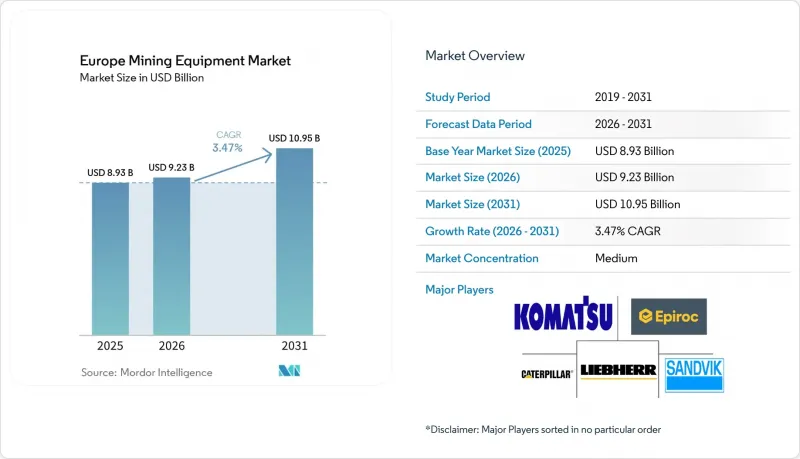
According to Mordor Intelligence, the European mining equipment market size was valued at USD 8.93 billion in 2025, is estimated at USD 9.23 billion in 2026, and is projected to reach USD 10.95 billion by 2031 at a 3.47% CAGR over 2026-2031.
Europe Mining Equipment Market Trends and Insights
Surge in Critical Raw Material Demand for EU Battery and Wind Supply Chains
Gigafactory capacity exceeding 1 TWh by 2030 compels miners to secure lithium, nickel, and rare-earth feedstock, lifting orders for high-tonnage loaders, electric haul trucks, and automated mills. The Imerys EMILI lithium project alone allocates EUR 1.8 billion (USD 2.10 billion) to battery-ready equipment packages, while Spain's EUR 414 million (USD 483.51 million) strategy funds seven strategic deposits. Poland's shaft program expands drill-jumbo demand, and wind-turbine magnet suppliers widen the call for domestic rare-earth extraction .
Rapid Adoption of Battery-Electric and Trolley-Assist Haulage
Boliden's Aitik mine operates Epiroc battery-electric loaders and ABB trolley-assist trucks, reducing ventilation costs and regenerating power during downhill hauls. Although capital expenditure premiums apply, lower electricity costs offset these investments over time, as electricity costs less than diesel energy. Rental Group AS operates a fleet of battery-electric vehicles (BEVs), providing small and medium-sized enterprises (SMEs) with access to zero-emission equipment trials without placing strain on their balance sheets.
Lengthy Environmental-Permit Lead-Times Post-2025 CRMA
Although the Act targets a 24-month approval cycle, France's EMILI project required three years to obtain consent, highlighting the gap between the proposed regulatory timeline and actual permitting processes. In Spain, regional veto powers can add up to 18 months to approval timelines, creating additional uncertainty for project developers. Italy's multi-level approval process further extends project timelines by requiring sign-offs from multiple administrative authorities. As a result, only seven of the 34 strategic projects have secured final permits, delaying downstream investment decisions and the procurement of essential mining equipment, including crushers and haul trucks .
Other drivers and restraints analyzed in the detailed report include:
- Automation to Offset Skilled-Labor Shortages in Nordic Mines
- EU Green Deal Grants and EIB Green-Asset Financing
- Capex Premium for Next-Gen BEV Loaders and Trucks
For complete list of drivers and restraints, kindly check the Table Of Contents.
Segment Analysis
Surface equipment secured 43.18% of the European mining equipment market share in 2025 as open-pit lignite and copper pits relied on haul trucks and excavators. Loaders and haul trucks now post a 3.49% CAGR, fueled by BEV variants that slash ventilation outlays and meet Stage V norms. Underground fleets grow on deeper Nordic copper shafts, while mineral-processing lines scale to handle lower-grade ore, boosting demand for higher-capacity crushers.
Loaders lead growth because articulated frames cut tire costs on 8% gradients and battery packs remove diesel particulate matter underground. A secondary market for refurbished surface units lengthens replacement cycles, yet greenfield lithium and tungsten sites prioritize electric models bundled with digital twins that raise throughput by 8% and lift residual values.
Manual machines still hold 67.71% of the European mining equipment market size, but semi-autonomous features are becoming mandatory as the updated EU Machinery Directive enforces collision avoidance from 2025. Fully autonomous fleets advance at a 3.53% CAGR, validated by 1.2 billion tonnes hauled driver-free at Aitik.
Retrofit costs of USD 150,000 per decade-old loader deter upgrades, steering purchases toward factory-integrated autonomy. Control-room oversight of 20 units magnifies labor savings, and telematics subscriptions of USD 50,000 per truck create recurring OEM revenue while shrinking labor arbitrage gaps.
Complete Report Scope:
- By Equipment Type
- Surface Mining Equipment
- Underground Mining Equipment
- Mineral Processing Equipment
- Drills and Breakers
- Crushing, Pulverizing and Screening
- Loaders and Haul Trucks
- By Automation Level
- Manual Equipment
- Semi-Autonomous Equipment
- Fully Autonomous Equipment
- By Powertrain Type
- Internal-Combustion Engine Vehicles
- Battery-Electric Vehicles
- Hybrid Vehicles
- By Power Output
- Less than 500 HP
- 500 to 1 000 HP
- Above 1 000 HP
- By Application
- Metal Mining
- Mineral Mining
- Coal Mining
- By Country
- Germany
- Italy
- France
- Netherlands
- Spain
- Poland
- Rest of Europe
List of Companies Covered in this Report:
- Aramine
- Atlas Copco
- Bauer Maschinen
- Bell Equipment
- Caterpillar Inc.
- CNH Industrial
- Epiroc AB
- FLSmidth
- Getman Corporation
- Hitachi Construction Machinery
- Komatsu Europe International
- Liebherr Corporation
- Metso Corporation
- Normet Group
- Sandvik AB
- SMT Scharf
- Takraf GmbH
- Tenova S.p.A.
- Terex Corporation
- Volvo Construction Equipment
Additional Benefits:
- The market estimate (ME) sheet in Excel format
- 3 months of analyst support
TABLE OF CONTENTS
1 Introduction
- 1.1 Study Assumptions and Market Definition
- 1.2 Scope of the Study
2 Research Methodology
3 Executive Summary
4 Market Landscape
- 4.1 Market Overview
- 4.2 Market Drivers
- 4.2.1 Surge in Critical-Raw-Material Demand For EU Battery and Wind Supply Chains
- 4.2.2 Rapid Adoption of Battery-Electric and Trolley-Assist Haulage
- 4.2.3 Automation To Offset Skilled-Labor Shortages in Nordic Mines
- 4.2.4 EU Green Deal Grants and EIB Green-Asset Financing
- 4.2.5 Mine-To-Mill Digital Twins Cutting OPEX More Than 12 %
- 4.2.6 Rental-As-A-Service Models Boosting SME Equipment Access
- 4.3 Market Restraints
- 4.3.1 Lengthy Environmental-Permit Lead-Times Post-2025 CRMA
- 4.3.2 Capex Premium (More Than 35 %) For Next-Gen BEV Loaders and Trucks
- 4.3.3 Power-Grid Constraints at Remote Mine Sites
- 4.3.4 Volatile Nickel And Copper Prices Denting Investment Planning
- 4.4 Value / Supply-Chain Analysis
- 4.5 Regulatory Landscape
- 4.6 Technological Outlook
- 4.7 Porter's Five Forces Analysis
- 4.7.1 Threat of New Entrants
- 4.7.2 Bargaining Power of Suppliers
- 4.7.3 Bargaining Power of Buyers
- 4.7.4 Threat of Substitutes
- 4.7.5 Competitive Rivalry
5 Market Size and Growth Forecasts (Value (USD) and Volume (Units))
- 5.1 By Equipment Type
- 5.1.1 Surface Mining Equipment
- 5.1.2 Underground Mining Equipment
- 5.1.3 Mineral Processing Equipment
- 5.1.4 Drills and Breakers
- 5.1.5 Crushing, Pulverizing and Screening
- 5.1.6 Loaders and Haul Trucks
- 5.2 By Automation Level
- 5.2.1 Manual Equipment
- 5.2.2 Semi-Autonomous Equipment
- 5.2.3 Fully Autonomous Equipment
- 5.3 By Powertrain Type
- 5.3.1 Internal-Combustion Engine Vehicles
- 5.3.2 Battery-Electric Vehicles
- 5.3.3 Hybrid Vehicles
- 5.4 By Power Output
- 5.4.1 Less than 500 HP
- 5.4.2 500 to 1 000 HP
- 5.4.3 Above 1 000 HP
- 5.5 By Application
- 5.5.1 Metal Mining
- 5.5.2 Mineral Mining
- 5.5.3 Coal Mining
- 5.6 By Country
- 5.6.1 Germany
- 5.6.2 Italy
- 5.6.3 France
- 5.6.4 Netherlands
- 5.6.5 Spain
- 5.6.6 Poland
- 5.6.7 Rest of Europe
6 Competitive Landscape
- 6.1 Market Concentration
- 6.2 Strategic Moves
- 6.3 Market Share Analysis
- 6.4 Company Profiles (Includes Global Level Overview, Market Level Overview, Core Segments, Financials as Available, Strategic Information, Market Rank/Share for Key Companies, Products and Services, SWOT Analysis, and Recent Developments)
- 6.4.1 Aramine
- 6.4.2 Atlas Copco
- 6.4.3 Bauer Maschinen
- 6.4.4 Bell Equipment
- 6.4.5 Caterpillar Inc.
- 6.4.6 CNH Industrial
- 6.4.7 Epiroc AB
- 6.4.8 FLSmidth
- 6.4.9 Getman Corporation
- 6.4.10 Hitachi Construction Machinery
- 6.4.11 Komatsu Europe International
- 6.4.12 Liebherr Corporation
- 6.4.13 Metso Corporation
- 6.4.14 Normet Group
- 6.4.15 Sandvik AB
- 6.4.16 SMT Scharf
- 6.4.17 Takraf GmbH
- 6.4.18 Tenova S.p.A.
- 6.4.19 Terex Corporation
- 6.4.20 Volvo Construction Equipment
7 Market Opportunities and Future Outlook
- 7.1 White-space and Unmet-Need Assessment

