PUBLISHER: Mordor Intelligence | PRODUCT CODE: 2154289

PUBLISHER: Mordor Intelligence | PRODUCT CODE: 2154289
Thailand Mining Equipment - Market Share Analysis, Industry Trends & Statistics, Growth Forecasts (2026 - 2031)
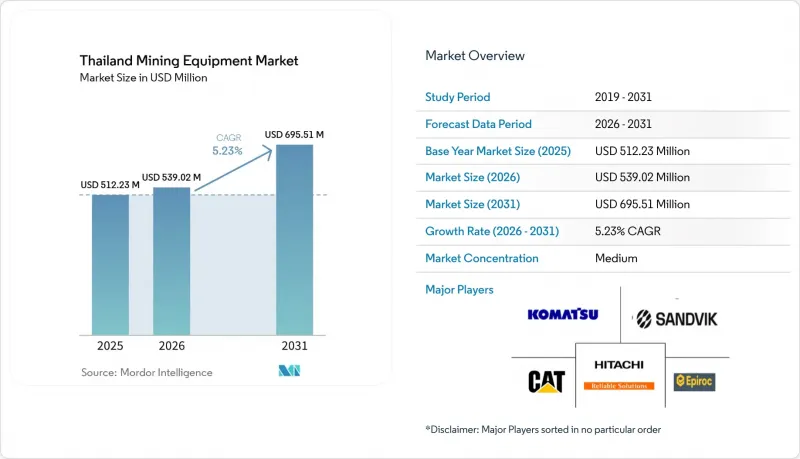
According to Mordor Intelligence, the Thailand mining equipment market is expected to grow from USD 512.23 million in 2025 to USD 539.02 million in 2026 and reach USD 695.51 million by 2031, at a CAGR of 5.23% during the forecast period (2026-2031).
Thailand Mining Equipment Market Trends and Insights
Expansion of Limestone and Quarry Operations for Domestic Construction
Megaprojects such as the land bridge corridor and high-speed rail network elevate aggregate demand, prompting Siam City Cement and Southern Group to add 36-tonne excavators, wheel loaders, and jaw crushers. Compliance with ISO 14001 accelerates fleet renewal because public-sector bids now require certified environmental management . Notice to Proceed for the U-Tapao Airport upgrade on April 2026 guarantees multi-year material off-take.
Surging Investment in Potash Projects in Northeast Thailand
With a significant annual output target, ASEAN Potash, Asia Pacific Potash, and Thai Kali concessions are placing substantial orders for continuous miners, roof bolters, and conveyor systems, with a total value estimated to be in the hundreds of millions of dollars. The pipeline is further validated by government-approved funding for Udon Thani in a previous year and a major subcontract for Chaiyaphum infrastructure scheduled for late 2024, even as community consultations continue to extend critical-path schedules.
Ban on Gold Mining Limiting Equipment Demand
A March 2026 court ruling that held Chatree operators liable for environmental damage heightened scrutiny on cyanide leach processes, curbing new hard-rock gold exploration. Drilling-rig and crusher suppliers are redeploying assets to limestone and potash clients while awaiting clearer permitting guidance.
Other drivers and restraints analyzed in the detailed report include:
- Rising Demand for Metal Ores from Electronics and EV Supply Chains
- Adoption of Semi-Autonomous Haulage for Safety & Cost Reduction
- Volatile Thermal-Coal Royalties Dampening Projects
For complete list of drivers and restraints, kindly check the Table Of Contents.
Segment Analysis
Surface machinery captured 43.48% of 2025 revenue, confirming the Thailand mining equipment market as quarry centric. Loaders are on pace for a 5.27% CAGR through 2031 as modular crushing spreads across mid-size pits. Underground demand remains limited until potash shafts reach full construction phases, yet purchase orders for continuous miners and roof bolters are tied to 2027-2028 delivery windows. Mineral-processing lines support both granite aggregate and potassium chloride beneficiation, with OEMs offering turnkey crusher-screen packages that comply with ISO 14001 dust-emission limits.
The Thailand mining equipment market continues to favor drill rigs rated for 2,000-4,000 m exploration depths, even though most domestic holes remain shallow. Loader OEM portfolios now include 120-480 kW battery-electric variants that appeal to limestone operators with grid access. Large rigid trucks above 100 tonnes are scarce, reflecting an absence of ultra-class open pits, yet sales teams keep demonstrator units on standby should potash ramp-ups warrant higher payload capacity.
Manual fleets still predominate with 67.71% share in 2025 because Thailand hosts numerous small quarries employing skilled operators. Fully autonomous adoption is forecast at a 5.29% CAGR as safety regulations tighten and labor costs climb in remote regions. Tele-remote loaders bridge the gap by lowering exposure in confined headings without full ICT infrastructure. The Thailand mining equipment market now counts at least three pilot potash headings where operators run loaders from surface control rooms. Ongoing standard-setting by DPIM will cement confidence in remote protocols and unlock broader financing for autonomy retrofits.
Semi-autonomous kits provide collision avoidance and operator-assist features that raise productivity 8-12% in limestone quarries. Financing models include per-hour subscription packages that lower entry barriers for family-owned pits. ESG reporting by publicly traded cement producers is also nudging adoption because autonomous systems cut incident rates, a material risk metric for investors.
Complete Report Scope:
- By Equipment Type
- Surface Mining Equipment
- Underground Mining Equipment
- Mineral Processing Equipment
- Drills & Breakers
- Crushing, Pulverizing & Screening
- Loaders
- Mining Trucks
- By Automation Level
- Manual Equipment
- Semi-Autonomous Equipment
- Fully Autonomous Equipment
- By Powertrain Type
- Internal-Combustion Engine Vehicles
- Battery-Electric Vehicles
- Hybrid Vehicles
- By Power Output
- Less than 500 HP
- 500 - 1,000 HP
- Above 1,000 HP
- By Application
- Metal Mining
- Mineral Mining
- Coal Mining
List of Companies Covered in this Report:
- Caterpillar Inc.
- Komatsu Ltd.
- Hitachi Construction Machinery
- Sandvik AB
- Epiroc AB
- Volvo Construction Equipment
- Liebherr-International AG
- Sany Heavy Equipment
- Doosan Infracore
- XCMG Group
- Terex Corporation
- Kobelco Construction Machinery
- DOVE Equipment & Machinery (Thailand)
- Thai Kobelco Construction Machinery
- Sumitomo Construction Machinery Co. Ltd.
- Wirtgen Group
- Astec Industries, Inc.
- Atlas Copco (Power Technique)
- Sany Heavy Industry Co., Ltd
- FLSmidth A/S
Additional Benefits:
- The market estimate (ME) sheet in Excel format
- 3 months of analyst support
TABLE OF CONTENTS
1 Introduction
- 1.1 Study Assumptions & Market Definition
- 1.2 Scope of the Study
2 Research Methodology
3 Executive Summary
4 Market Landscape
- 4.1 Market Overview
- 4.2 Market Drivers
- 4.2.1 Expansion Of Limestone and Quarry Operations for Domestic Construction
- 4.2.2 Surging Investment in Potash Projects in Northeast Thailand
- 4.2.3 Rising Demand for Metal Ores From Electronics and EV Supply Chains
- 4.2.4 Adoption Of Semi-Autonomous Haulage for Safety & Cost Reduction
- 4.2.5 Government Incentives for Battery-Electric Mining Equipment
- 4.2.6 ASEAN Trade Integration: Reducing Import Duties On Capital Equipment
- 4.3 Market Restraints
- 4.3.1 Ban On Gold Mining Limiting Equipment Demand.
- 4.3.2 Volatile Thermal-Coal Royalties Dampening Projects
- 4.3.3 High Grid-Power Tariffs Slowing Electrification in Remote Pits.
- 4.3.4 Community Opposition to New Rare-Earth Exploration Blocks
- 4.4 Value / Supply-Chain Analysis
- 4.5 Regulatory Landscape
- 4.6 Technological Outlook
- 4.7 Porter's Five Forces
- 4.7.1 Threat of New Entrants
- 4.7.2 Bargaining Power of Suppliers
- 4.7.3 Bargaining Power of Buyers
- 4.7.4 Threat of Substitutes
- 4.7.5 Competitive Rivalry
5 Market Size & Growth Forecasts (Value (USD) and Volume (Units))
- 5.1 By Equipment Type
- 5.1.1 Surface Mining Equipment
- 5.1.2 Underground Mining Equipment
- 5.1.3 Mineral Processing Equipment
- 5.1.4 Drills & Breakers
- 5.1.5 Crushing, Pulverizing & Screening
- 5.1.6 Loaders
- 5.1.7 Mining Trucks
- 5.2 By Automation Level
- 5.2.1 Manual Equipment
- 5.2.2 Semi-Autonomous Equipment
- 5.2.3 Fully Autonomous Equipment
- 5.3 By Powertrain Type
- 5.3.1 Internal-Combustion Engine Vehicles
- 5.3.2 Battery-Electric Vehicles
- 5.3.3 Hybrid Vehicles
- 5.4 By Power Output
- 5.4.1 Less than 500 HP
- 5.4.2 500 - 1,000 HP
- 5.4.3 Above 1,000 HP
- 5.5 By Application
- 5.5.1 Metal Mining
- 5.5.2 Mineral Mining
- 5.5.3 Coal Mining
6 Competitive Landscape
- 6.1 Market Concentration
- 6.2 Strategic Moves
- 6.3 Market Share Analysis
- 6.4 Company Profiles (includes Global Level Overview, Market Level Overview, Core Segments, Financials as Available, Strategic Information, Market Rank/Share for Key Companies, Products and Services, SWOT Analysis, and Recent Developments)
- 6.4.1 Caterpillar Inc.
- 6.4.2 Komatsu Ltd.
- 6.4.3 Hitachi Construction Machinery
- 6.4.4 Sandvik AB
- 6.4.5 Epiroc AB
- 6.4.6 Volvo Construction Equipment
- 6.4.7 Liebherr-International AG
- 6.4.8 Sany Heavy Equipment
- 6.4.9 Doosan Infracore
- 6.4.10 XCMG Group
- 6.4.11 Terex Corporation
- 6.4.12 Kobelco Construction Machinery
- 6.4.13 DOVE Equipment & Machinery (Thailand)
- 6.4.14 Thai Kobelco Construction Machinery
- 6.4.15 Sumitomo Construction Machinery Co. Ltd.
- 6.4.16 Wirtgen Group
- 6.4.17 Astec Industries, Inc.
- 6.4.18 Atlas Copco (Power Technique)
- 6.4.19 Sany Heavy Industry Co., Ltd
- 6.4.20 FLSmidth A/S
7 Market Opportunities & Future Outlook
- 7.1 White-space & Unmet-Need Assessment

