PUBLISHER: Mordor Intelligence | PRODUCT CODE: 2117384

PUBLISHER: Mordor Intelligence | PRODUCT CODE: 2117384
Germany Mining Equipment - Market Share Analysis, Industry Trends & Statistics, Growth Forecasts (2026 - 2031)
According to Mordor Intelligence, the Germany mining equipment market size was valued at USD 1.56 billion in 2025, and is projected to grow from USD 1.62 billion in 2026 to USD 1.93 billion by 2031, growing at a CAGR of 3.58% over 2026-2031.
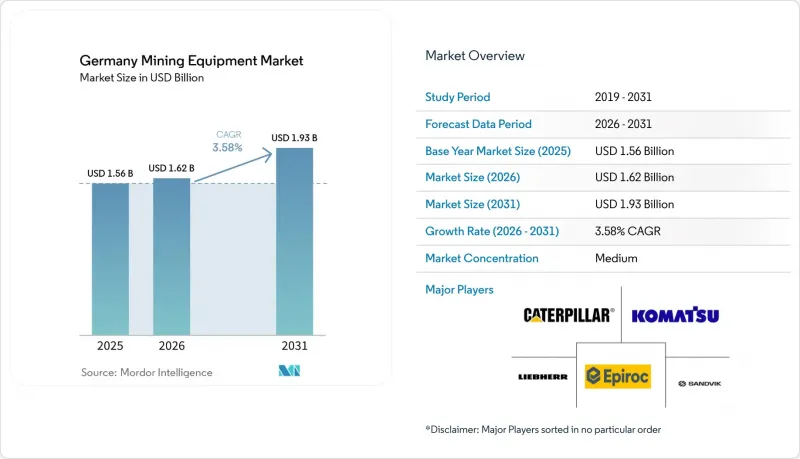
This report is Segmented by Equipment Type (Surface Mining Equipment, Underground Mining Equipment, and More), Automation Level (Manual Equipment, Semi-Autonomous Equipment, and More), Powertrain Type (Internal-Combustion Engine Vehicles, Battery-Electric Vehicles, and More), Power Output, and Application. The Market Forecasts are Provided in Terms of Value (USD) and Volume (Units).
Germany Mining Equipment Market Trends and Insights
Surge in Demand for Critical Minerals for EU Battery Supply Chain
Federal geology data place Germany's lithium resources among the world's top ten, underpinning domestic ambitions to meet EU sourcing targets. Public financing secured in 2026 demonstrates investor confidence in integrated geothermal-lithium ventures that prioritize zero-carbon extraction processes. Flowsheets favor modular crushers, flotation cells, and conveyors that already comply with Stage V limits. Cross-border projects in Saxony-Bohemia promote shared infrastructure and spur demand for mobile processing equipment. Pilot plants adopting direct-lithium-extraction pumps and heat-exchanger arrays also reshape supplier requirements toward corrosion-resistant materials.
Automation and Digitalization to Mitigate Skilled-Labor Crunch
Quarry operators cite workforce scarcity as a top productivity risk, accelerating trials of retrofitted autonomous haul trucks and loaders. Early deployments rely on 3D fleet-orchestration software that prevents traffic deadlocks in narrow drifts, important for Germany's potash and salt caverns. University-led digital-twin programs report double-digit uptime gains, validating cloud-based maintenance alerts. OEM telematics now bundles predictive analytics, enabling a single supervisor to monitor multiple sites from a central hub. As safety directives tighten, remote-operation readiness becomes a procurement prerequisite.
Stricter EU Emissions and Noise Limits Raising Equipment Costs
Stage V engine rules and updated outdoor-noise directives force OEMs to integrate after-treatment hardware and acoustic enclosures, raising sticker prices. Small operators grapple with retrofit kits that often cost more than the machine's residual value, nudging them toward electric or hybrid options. Funding partially offsets premiums, yet capital hurdles persist for family-owned quarries. Suppliers that bundle compliance, financing, and maintenance into a single contract gain a competitive edge. Long-term benefits include lower ventilation expenses and higher resale value for compliant fleets.
Other drivers and restraints analyzed in the detailed report include:
- Federal R&D Incentives for Battery-Electric Mining Equipment
- Expansion of Underground Salt and Potash Projects for Hydrogen Storage
- Commodity-Price Volatility Delaying CAPEX
For complete list of drivers and restraints, kindly check the Table Of Contents.
Segment Analysis
Surface equipment held the largest share, at 47.55%, in Germany's mining equipment market in 2025, yet underground units are projected to post the fastest CAGR, at 5.35%, through 2031. Underground demand benefits from salt-cavern hydrogen storage and narrow-vein lithium activity, both of which require compact loaders, drilling jumbos, and ventilation packages. Operators favor modular utility vehicles that can switch cassettes between service, scaling, and rock-haul functions within a single shift. Such flexibility maximizes machine utilization in tight headings and reduces fleet size requirements. OEMs embed autonomous-ready sensors so customers can enable driverless features via software upgrades rather than purchasing new iron. Given strict noise ceilings, battery-electric loaders find early adoption underground where reduced ventilation offsets higher acquisition costs.
Meanwhile, surface-mine operators invest selectively in fleet upgrades that pair diesel haul trucks with trolley-assist lines to curb fuel burn on uphill hauls. Mid-sized quarries adopt digital payload monitoring that links shovels, crushers, and conveyor belts, trimming idle times. Lifecycle service contracts replace one-off machine sales, ensuring OEM involvement throughout rebuild cycles. German engineering firms that specialize in high-pressure grinding rolls and in-pit crushing-and-conveying systems gain traction as customers seek lower emissions and smaller footprints.
Manual machines retained 65.33% of the German mining equipment market share in 2025, yet fully autonomous systems are forecast to expand at an 18.89% CAGR through 2031. Autonomy addresses Germany's labor shortage and stringent safety expectations. Retrofit kits allow existing haul trucks and loaders to navigate predefined routes using lidar and AI-enhanced perception. Early adopters report improved cycle-time consistency and reduced shift-change downtime-regulations such as ISO 17757 mandate functional-safety redundancies, steering buyers toward vendors with long operating records.
Semi-autonomous features, collision avoidance, and operator-assist dig cycles act as a bridge for conservative fleets while delivering immediate productivity gains without a full infrastructure overhaul. Tele-operation hubs located off-site create new job profiles that appeal to tech-oriented workers, partially offsetting disadvantages associated with rural locations. Data collected by autonomous fleets feeds into predictive maintenance algorithms, reducing unplanned outages. In response, equipment suppliers bundle software licenses, analytics dashboards, and cybersecurity updates into multiyear service packages that smooth revenue visibility.
Complete Report Scope:
- By Equipment Type
- Surface Mining Equipment
- Underground Mining Equipment
- Mineral Processing Equipment
- Drills and Breakers
- Crushing, Pulverizing and Screening
- Loaders and Haul Trucks
- By Automation Level
- Manual Equipment
- Semi-Autonomous Equipment
- Fully Autonomous Equipment
- By Powertrain Type
- Internal-Combustion Engine Vehicles
- Battery-Electric Vehicles
- Hybrid Vehicles
- By Power Output
- Less than 500 HP
- 500 - 1,000 HP
- Above 1,000 HP
- By Application
- Metal Mining
- Mineral Mining
- Coal Mining
List of Companies Covered in this Report:
- Caterpillar Inc.
- Komatsu Ltd.
- Liebherr-International AG
- Epiroc AB
- Sandvik AB
- Hitachi Construction Machinery Co., Ltd.
- Volvo Construction Equipment
- Herrenknecht AG
- Thyssenkrupp Mining Technologies GmbH (FLSmidth)
- TAKRAF GmbH
- FAM Mineral Processing Systems GmbH
- Paus Maschinenfabrik GmbH
- Wirtgen GmbH (John Deere)
- Atlas Copco AB
- Sany Germany GmbH
- Terex Corporation
Additional Benefits:
- The market estimate (ME) sheet in Excel format
- 3 months of analyst support
TABLE OF CONTENTS
1 Introduction
- 1.1 Study Assumptions & Market Definition
- 1.2 Scope of the Study
2 Research Methodology
3 Executive Summary
4 Market Landscape
- 4.1 Market Overview
- 4.2 Market Drivers
- 4.2.1 Surge in Demand for Critical Minerals for EU Battery Supply Chain
- 4.2.2 Automation and Digitalization to Mitigate Skilled-Labor Crunch
- 4.2.3 Federal R&D Incentives for Battery-Electric Mining Equipment
- 4.2.4 Expansion of Underground Salt and Potash Projects for Hydrogen Storage
- 4.2.5 Modernization of Lignite and Hard-Coal Mines for Emissions Compliance
- 4.2.6 Geothermal Shaft Repurposing Requiring Retrofit Drilling Systems
- 4.3 Market Restraints
- 4.3.1 Stricter EU Emissions and Noise Limits Raising Equipment Costs
- 4.3.2 Commodity-Price Volatility Delaying CAPEX
- 4.3.3 Influx of Refurbished Eastern-European Machines
- 4.3.4 Stringent Permitting and Community Opposition
- 4.4 Value / Supply-Chain Analysis
- 4.5 Regulatory Landscape
- 4.6 Technological Outlook
- 4.7 Porter's Five Forces
- 4.7.1 Threat of New Entrants
- 4.7.2 Bargaining Power of Suppliers
- 4.7.3 Bargaining Power of Buyers
- 4.7.4 Threat of Substitutes
- 4.7.5 Competitive Rivalry
5 Market Size & Growth Forecasts (Value (USD) & Volume (Units))
- 5.1 By Equipment Type
- 5.1.1 Surface Mining Equipment
- 5.1.2 Underground Mining Equipment
- 5.1.3 Mineral Processing Equipment
- 5.1.4 Drills and Breakers
- 5.1.5 Crushing, Pulverizing and Screening
- 5.1.6 Loaders and Haul Trucks
- 5.2 By Automation Level
- 5.2.1 Manual Equipment
- 5.2.2 Semi-Autonomous Equipment
- 5.2.3 Fully Autonomous Equipment
- 5.3 By Powertrain Type
- 5.3.1 Internal-Combustion Engine Vehicles
- 5.3.2 Battery-Electric Vehicles
- 5.3.3 Hybrid Vehicles
- 5.4 By Power Output
- 5.4.1 Less than 500 HP
- 5.4.2 500 - 1,000 HP
- 5.4.3 Above 1,000 HP
- 5.5 By Application
- 5.5.1 Metal Mining
- 5.5.2 Mineral Mining
- 5.5.3 Coal Mining
6 Competitive Landscape
- 6.1 Market Concentration
- 6.2 Strategic Moves
- 6.3 Market Share Analysis
- 6.4 Company Profiles (Includes Global Level Overview, Market Level Overview, Core Segments, Financials as Available, Strategic Information, Market Rank/Share for Key Companies, Products and Services, SWOT Analysis, and Recent Developments)
- 6.4.1 Caterpillar Inc.
- 6.4.2 Komatsu Ltd.
- 6.4.3 Liebherr-International AG
- 6.4.4 Epiroc AB
- 6.4.5 Sandvik AB
- 6.4.6 Hitachi Construction Machinery Co., Ltd.
- 6.4.7 Volvo Construction Equipment
- 6.4.8 Herrenknecht AG
- 6.4.9 Thyssenkrupp Mining Technologies GmbH (FLSmidth)
- 6.4.10 TAKRAF GmbH
- 6.4.11 FAM Mineral Processing Systems GmbH
- 6.4.12 Paus Maschinenfabrik GmbH
- 6.4.13 Wirtgen GmbH (John Deere)
- 6.4.14 Atlas Copco AB
- 6.4.15 Sany Germany GmbH
- 6.4.16 Terex Corporation
7 Market Opportunities & Future Outlook
- 7.1 White-space & Unmet-Need Assessment

