PUBLISHER: Mordor Intelligence | PRODUCT CODE: 2117382

PUBLISHER: Mordor Intelligence | PRODUCT CODE: 2117382
China Mining Equipment - Market Share Analysis, Industry Trends & Statistics, Growth Forecasts (2026 - 2031)
According to Mordor Intelligence, the China mining equipment market size was valued at USD 33.78 billion in 2025, and is projected to grow from USD 35.52 billion in 2026 to USD 45.63 billion by 2031, growing at a CAGR of 5.14% over 2026-2031.
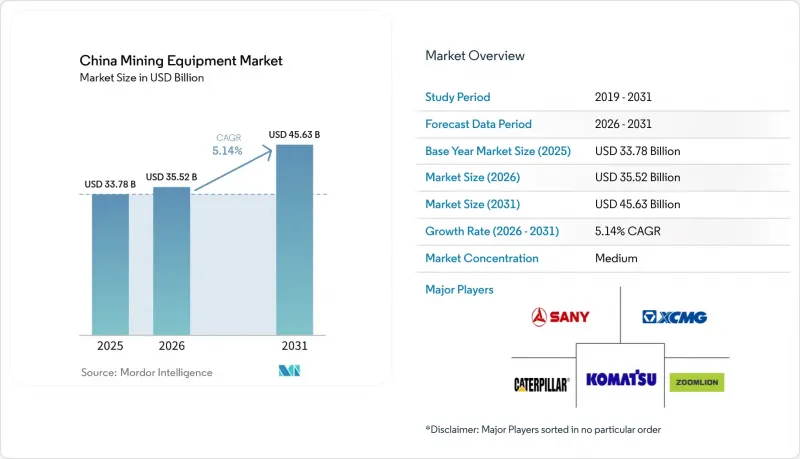
This report is Segmented by Equipment Type (Surface Mining Equipment, Underground Mining Equipment, and More), Automation Level (Manual Equipment, Semi-Autonomous Equipment, and More), Powertrain Type (Internal-Combustion Engine Vehicles, Battery-Electric Vehicles, and More), Power Output, Application, and Region. The Market Forecasts are Provided in Terms of Value (USD) and Volume (Units).
China Mining Equipment Market Trends and Insights
Government Infrastructure Spend on Strategic Metals
Beijing's latest five-year plan earmarks targeted spending to expand domestic supplies of lithium, rare earths, and tungsten. Public funding supports mine power-supply upgrades, access roads, and digital command centers, lowering execution risks for greenfield projects. Equipment suppliers serving these deposits benefit from predictable tenders aligned with national stockpiling objectives. The intensified hunt for strategic metals, therefore, provides a durable floor for demand and a testing ground for advanced crushing, grinding, and flotation technologies.
Shift Toward Battery-Electric Mine Fleets
Battery-electric haulage is reshaping fleet economics as operators pursue carbon-peaking commitments and comply with provincial emission caps. Subsidies under the intelligent-mine program reduce upfront costs, prompting large open-pit coal and rare-earth projects to pilot electric trucks en masse. Improvements in lithium-iron-phosphate chemistry have brought energy-density gains that extend duty cycles and cut charging downtime. On-board analytics also enable real-time route optimization, further lowering operating costs. As a result, the Chinese mining equipment market is seeing a surge in orders for purpose-built electric models and modular conversion kits that repurpose existing diesel assets.
Commodity-Price Volatility Dampening CAPEX
Sharp swings in iron ore and thermal coal prices make cash flow planning difficult, particularly for privately owned mines with limited hedging tools. Delayed project sanctions ripple through the supply chain, slowing original-equipment orders and stretching overhaul intervals. To cope, vendors emphasize pay-per-ton contracts and flexible rental fleets that defer ownership decisions. This service shift cushions the Chinese mining equipment market against abrupt procurement freezes while preserving upgrade momentum when prices recover.
Other drivers and restraints analyzed in the detailed report include:
- Automation Push for Safety and Productivity
- Rare-Earth Expansion for Clean-Tech Supply Chains
- Stringent Environmental Compliance Costs
For complete list of drivers and restraints, kindly check the Table Of Contents.
Segment Analysis
Surface mining equipment captured 48.33% of China's mining equipment market share in 2025, underscoring the prevalence of shallow coal and iron ore deposits. Second-generation electric excavators, draglines, and high-capacity dumpers now enter production as operators target zero-diesel benches. Integrated payload-monitoring and collision-avoidance systems further boost utilization. Meanwhile, OEMs bundle training and predictive-maintenance software, anchoring customers to long-term service plans.
Loaders and haul trucks are slated to grow at a 6.43% CAGR through 2031, the quickest within this category. Growth stems from favorable duty cycles for battery packs and ready access to grid power in major basins. Provincial tenders increasingly specify emissions ceilings that only electric or hybrid platforms can meet. Local firms co-develop driveline and thermal-management components, hastening time-to-market and protecting intellectual property within the China mining equipment market ecosystems.
Manual fleets accounted for 61.09% of China's mining equipment market share in 2025, as legacy diesel assets remain serviceable and amortized. Supervisory control retrofits, however, allow operators to phase in autonomy while retaining familiar cab designs. Standardized data buses support over-the-air updates that gradually expand automation functionality. At many sites, the first touchpoint is remote drilling or dozing, providing early wins without disrupting production.
Fully autonomous units are projected to post an 8.33% CAGR, the fastest across automation tiers. Their appeal lies in predictable shift scheduling, reduced liability for accidents, and alignment with China's national AI strategy. In-house operating systems trained on domestic road and geotechnical data deliver highly localized performance. Supply-chain bottlenecks in lidar and high-end GPUs remain a headwind, yet state-backed consortia aim to scale domestic production, safeguarding the Chinese mining equipment market from external shocks.
Complete Report Scope:
- By Equipment Type
- Surface Mining Equipment
- Underground Mining Equipment
- Mineral Processing Equipment
- Drills and Breakers
- Crushing, Pulverizing and Screening Machines
- Loaders and Haul Trucks
- By Automation Level
- Manual Equipment
- Semi-Autonomous Equipment
- Fully Autonomous Equipment
- By Powertrain Type
- Internal-Combustion Engine Vehicles
- Battery-Electric Vehicles
- Hybrid Vehicles
- By Power Output (HP)
- Below 500 HP
- 500 to 1,000 HP
- Above 1,000 HP
- By Application
- Metal Mining
- Mineral Mining (Non-metallic)
- Coal Mining
- By Region (China)
- East China
- North China
- South-Central China
- Northeast China
- Southwest China
- Northwest China
List of Companies Covered in this Report:
- Sany Heavy Equipment
- Xuzhou Construction Machinery Group Co., Ltd. (XCMG)
- Zoomlion Heavy Industry
- CITIC Heavy Industries
- Taiyuan Heavy Industry (TZ)
- China National Coal Mining Equipment
- North Hauler Joint Stock Co.
- Shandong Energy Heavy Equipment
- Komatsu Ltd.
- Caterpillar Inc.
- Sandvik AB
- Epiroc AB
- Liebherr-International
- Hitachi Construction Machinery
- Terex Corporation
- Metso Outotec
- FLSmidth & Co.
- Weir Group PLC
Additional Benefits:
- The market estimate (ME) sheet in Excel format
- 3 months of analyst support
TABLE OF CONTENTS
1 Introduction
- 1.1 Study Assumptions & Market Definition
- 1.2 Scope of the Study
2 Research Methodology
3 Executive Summary
4 Market Landscape
- 4.1 Market Overview
- 4.2 Market Drivers
- 4.2.1 Government Infrastructure Spend on Strategic Metals
- 4.2.2 Shift Toward Battery-Electric Mine Fleets
- 4.2.3 Automation Push for Safety and Productivity
- 4.2.4 Rare-Earth Expansion for Clean-Tech Supply Chains
- 4.2.5 Government-Funded "Intelligent Mine" Pilot Subsidies
- 4.2.6 LFP Battery-Recycling Demand for Specialized Processing Lines
- 4.3 Market Restraints
- 4.3.1 Commodity-Price Volatility Dampening CAPEX
- 4.3.2 Stringent Environmental Compliance Costs
- 4.3.3 Chip Shortages for Autonomy Sensors and Controls
- 4.3.4 Provincial Carbon-Pricing Elevating OPEX
- 4.4 Value / Supply-Chain Analysis
- 4.5 Regulatory Landscape
- 4.6 Technological Outlook
- 4.7 Porter's Five Forces
- 4.7.1 Competitive Rivalry
- 4.7.2 Threat of New Entrants
- 4.7.3 Threat of Substitutes
- 4.7.4 Bargaining Power of Suppliers
- 4.7.5 Bargaining Power of Buyers
5 Market Size & Growth Forecasts (Value (USD) & Volume (Units))
- 5.1 By Equipment Type
- 5.1.1 Surface Mining Equipment
- 5.1.2 Underground Mining Equipment
- 5.1.3 Mineral Processing Equipment
- 5.1.4 Drills and Breakers
- 5.1.5 Crushing, Pulverizing and Screening Machines
- 5.1.6 Loaders and Haul Trucks
- 5.2 By Automation Level
- 5.2.1 Manual Equipment
- 5.2.2 Semi-Autonomous Equipment
- 5.2.3 Fully Autonomous Equipment
- 5.3 By Powertrain Type
- 5.3.1 Internal-Combustion Engine Vehicles
- 5.3.2 Battery-Electric Vehicles
- 5.3.3 Hybrid Vehicles
- 5.4 By Power Output (HP)
- 5.4.1 Below 500 HP
- 5.4.2 500 to 1,000 HP
- 5.4.3 Above 1,000 HP
- 5.5 By Application
- 5.5.1 Metal Mining
- 5.5.2 Mineral Mining (Non-metallic)
- 5.5.3 Coal Mining
- 5.6 By Region (China)
- 5.6.1 East China
- 5.6.2 North China
- 5.6.3 South-Central China
- 5.6.4 Northeast China
- 5.6.5 Southwest China
- 5.6.6 Northwest China
6 Competitive Landscape
- 6.1 Market Concentration
- 6.2 Strategic Moves
- 6.3 Market Share Analysis
- 6.4 Company Profiles (Includes Global Level Overview, Market Level Overview, Core Segments, Financials as Available, Strategic Information, Market Rank/Share for Key Companies, Products and Services, SWOT Analysis, and Recent Developments)
- 6.4.1 Sany Heavy Equipment
- 6.4.2 Xuzhou Construction Machinery Group Co., Ltd. (XCMG)
- 6.4.3 Zoomlion Heavy Industry
- 6.4.4 CITIC Heavy Industries
- 6.4.5 Taiyuan Heavy Industry (TZ)
- 6.4.6 China National Coal Mining Equipment
- 6.4.7 North Hauler Joint Stock Co.
- 6.4.8 Shandong Energy Heavy Equipment
- 6.4.9 Komatsu Ltd.
- 6.4.10 Caterpillar Inc.
- 6.4.11 Sandvik AB
- 6.4.12 Epiroc AB
- 6.4.13 Liebherr-International
- 6.4.14 Hitachi Construction Machinery
- 6.4.15 Terex Corporation
- 6.4.16 Metso Outotec
- 6.4.17 FLSmidth & Co.
- 6.4.18 Weir Group PLC
7 Market Opportunities & Future Outlook
- 7.1 White-space & Unmet-Need Assessment

