PUBLISHER: Mordor Intelligence | PRODUCT CODE: 2117421

PUBLISHER: Mordor Intelligence | PRODUCT CODE: 2117421
Spain Mining Equipment - Market Share Analysis, Industry Trends & Statistics, Growth Forecasts (2026 - 2031)
According to Mordor Intelligence, the Spain mining equipment market size was valued at USD 345.21 million in 2025 and is estimated to grow from USD 359.43 million in 2026 to reach USD 439.83 million by 2031, at a CAGR of 4.12% during the forecast period (2026-2031).
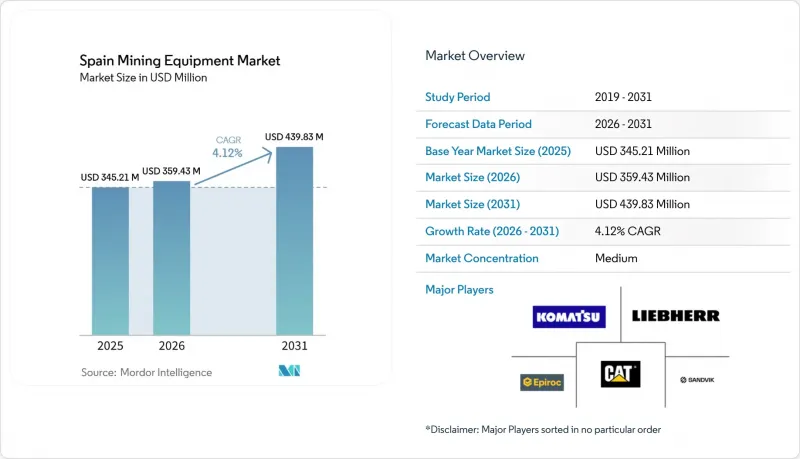
This report is Segmented by Equipment Type (Surface Mining Equipment, Underground Mining Equipment and More), Automation Level (Manual, Semi-Autonomous and More), Powertrain Type (ICE, Battery-Electric and More), Power Output (Less Than 500 HP, 500-1, 000 HP and Above 1, 000 HP), Application (Metal Mining, Mineral Mining and Coal Mining). The Market Forecasts are Provided in Terms of Value (USD).
Spain Mining Equipment Market Trends and Insights
EU Critical Raw Materials Push Revives Domestic Mining Investments
Spain's elevation to strategic supplier status inside the EU has ignited spending on surface drills, haulage fleets, and on-site processing plants. Seven Spanish projects are now named "Strategic" under the Critical Raw Materials Act, a designation that cuts permitting lead times and channels EU capital toward equipment-intensive developments. Campo de Montiel and El Moto headline the pipeline, each demanding high-capacity excavators, 100-t trucks, and modular concentrators capable of rapid redeployment across adjacent deposits. Ministries have embedded geological mapping funds into the national budget, guiding investors to lithium-rich pegmatites and tungsten skarns that previously lay idle. The resulting alignment between EU autonomy targets and domestic economic policy has restored industry credibility, boosting lender appetite and compressing financing spreads for high-specification equipment acquisitions.
Renewables-Led Metals Boom (Lithium, Copper, Tin) Expanding Equipment Demand
Rooftop-solar installs, grid-scale batteries, and offshore wind arrays lock in multi-decade demand for copper and lithium, funneling investment toward Spain's Iberian Pyrite Belt and Valdeflores Valley. Contractors mobilize high-reach electric shovels and Tier 4-compliant loaders to strip saprolite horizons above lithium pegmatites without breaching local particulate matter limits. New concentrators integrate dry-stack tailings and ore-sorting modules, significantly curbing water use-a decisive procurement attribute in drought-prone Andalusia. International Energy Agency scenarios projecting a tenfold spike in lithium by 2050 underpin forward contracts for advanced reels of medium-voltage cable and on-board inverter cabinets, stimulating the Spain mining equipment market.
Lengthy Permitting and Strong Local Environmental Opposition
Complex multi-tier authorizations and vocal activist groups delay project timelines, extending supplier lead-times and elevating inventory-carry costs. The Boliden spill legacy still shapes public sentiment, driving rigorous baseline studies and multi-agency reviews. Municipal councils wield discretionary powers that can override national approvals, prompting miners to run protracted community-engagement campaigns before equipment orders gain board sign-off. Suppliers respond by staging long-lead components-such as mill shells and shovel car-bodies-in European hubs to compress delivery once permits clear. Even with recent Critical Raw Materials Act fast-track provisions, procedural appeals remain frequent, tempering immediate upside for the Spain mining equipment market.
Other drivers and restraints analyzed in the detailed report include:
- Surge in Automation and Remote-Operation Demand to Improve Safety / Productivity
- Government Incentives for Low-Emission Powertrains in Heavy Mobile Machinery
- Water-Stress Restrictions on Andalusian and Extremaduran Mine Expansions
For complete list of drivers and restraints, kindly check the Table Of Contents.
Segment Analysis
Surface units retained 45.27% of 2025 revenue, yet loaders and haul trucks are on track for a 7.46% CAGR to 2031 as lithium pits in Caceres and polymetallic cut-backs in Huelva scale up. As deposits shift from open-pit to deeper levels, the demand for ventilation, narrow-vein loaders, and paste-fill rigs has surged, leading to a growing share for underground fleets. Nationwide, several TOMRA machines have already enabled Barruecopardo to boost its feed to gravity circuits by a significant percentage, thanks to sensor-based sorters. Epiroc's HB 4100, sold in Gran Canaria, underscores the stability of drills and breakers, benefiting from cross-ordering trends in quarrying.
Equipment design is increasingly favoring integrated fleets. For instance, the Cat 6015 shovel is now optimized to work in tandem with Cat 773-777 trucks, ensuring efficient cycle times. Meanwhile, Komatsu's HM460-6, equipped with traction control and hydro-pneumatic suspension, effectively mitigates tire spin on Spain's softer overburden. In the Spanish mining equipment market, open telematics systems such as MineStar, Smart Quarry, and Micromine Pitram have outpaced standalone horsepower solutions, underscoring the growing emphasis on interoperability as a key purchasing criterion.
Manual units still accounted for 68.28% of 2025 turnover, but autonomy is expanding at an 8.43% CAGR, driven by labor scarcity and successful pilots at MATSA. Transitional technologies like semi-autonomous tramming and teleremote mucking are reducing operator exposure while still valuing legacy iron. The X MINERGY explosives-loading prototype is progressing toward field validation, heralding a wider embrace of teleoperated surface equipment. Infrastructure investment plays a pivotal role: MATSA's comprehensive fiber WiFi network bolsters its interoperability strategy, a model now being adopted by other operators in the Iberian Pyrite Belt within Spain's mining equipment market.
Complete Report Scope:
- By Equipment Type
- Surface Mining Equipment
- Underground Mining Equipment
- Mineral Processing Equipment
- Drills & Breakers
- Crushing, Pulverizing & Screening
- Loaders & Haul Trucks
- By Automation Level
- Manual Equipment
- Semi-Autonomous Equipment
- Fully Autonomous Equipment
- By Powertrain Type
- Internal-Combustion Engine Vehicles
- Battery-Electric Vehicles
- Hybrid Vehicles
- By Power Output
- Less than 500 HP
- 500 - 1,000 HP
- Above 1,000 HP
- By Application
- Metal Mining
- Mineral Mining
- Coal Mining
List of Companies Covered in this Report:
- Caterpillar Inc.
- Komatsu Ltd.
- Liebherr-International AG
- Sandvik AB
- Epiroc AB
- Volvo Construction Equipment
- Hitachi Construction Machinery
- Atlas Copco AB
- Metso Corporation
- Terex Corporation
- Doosan Infracore
- Sany Heavy Industry
- XCMG Group
- JCB Ltd.
- CNH Industrial (Case CE)
- Aramine ( Groupe Melkonian SAS)
Additional Benefits:
- The market estimate (ME) sheet in Excel format
- 3 months of analyst support
TABLE OF CONTENTS
1 Introduction
- 1.1 Study Assumptions & Market Definition
- 1.2 Scope of the Study
2 Research Methodology
3 Executive Summary
4 Market Landscape
- 4.1 Market Overview
- 4.2 Market Drivers
- 4.2.1 EU Critical Raw Materials Push Revives Domestic Mining Investments
- 4.2.2 Surge In Automation and Remote-Operation Demand to Improve Safety / Productivity
- 4.2.3 Renewables-Led Metals Boom (Lithium, Copper, Tin) Expanding Equipment Demand
- 4.2.4 Government Incentives for Low-Emission Powertrains in Heavy Mobile Machinery
- 4.2.5 Modular Micro-Mine Robotics Pilots (ROBOMINERS, OMEE Projects) Accelerating Capex
- 4.2.6 Performance-Based Maintenance Contracts Boosting Equipment Replacement Cycles
- 4.3 Market Restraints
- 4.3.1 Lengthy Permitting and Strong Local Environmental Opposition
- 4.3.2 Cap-Ex Inflation and Component Supply-Chain Disruption Post-COVID
- 4.3.3 Water-Stress Restrictions on Andalusian and Extremaduran Mine Expansions
- 4.3.4 Shortage of Autonomy-Skilled Technicians Raising OPEX for Mines
- 4.4 Value / Supply-Chain Analysis
- 4.5 Regulatory Landscape
- 4.6 Technological Outlook
- 4.7 Porter's Five Forces
- 4.7.1 Bargaining Power of Suppliers
- 4.7.2 Bargaining Power of Buyers
- 4.7.3 Threat of New Entrants
- 4.7.4 Threat of Substitutes
- 4.7.5 Competitive Rivalry
5 Market Size & Growth Forecasts (Value (USD))
- 5.1 By Equipment Type
- 5.1.1 Surface Mining Equipment
- 5.1.2 Underground Mining Equipment
- 5.1.3 Mineral Processing Equipment
- 5.1.4 Drills & Breakers
- 5.1.5 Crushing, Pulverizing & Screening
- 5.1.6 Loaders & Haul Trucks
- 5.2 By Automation Level
- 5.2.1 Manual Equipment
- 5.2.2 Semi-Autonomous Equipment
- 5.2.3 Fully Autonomous Equipment
- 5.3 By Powertrain Type
- 5.3.1 Internal-Combustion Engine Vehicles
- 5.3.2 Battery-Electric Vehicles
- 5.3.3 Hybrid Vehicles
- 5.4 By Power Output
- 5.4.1 Less than 500 HP
- 5.4.2 500 - 1,000 HP
- 5.4.3 Above 1,000 HP
- 5.5 By Application
- 5.5.1 Metal Mining
- 5.5.2 Mineral Mining
- 5.5.3 Coal Mining
6 Competitive Landscape
- 6.1 Market Concentration
- 6.2 Strategic Moves
- 6.3 Market Share Analysis
- 6.4 Company Profiles (Includes Global level Overview, Market level overview, Core Segments, Financials as available, Strategic Information, Market Rank/Share for key companies, Products & Services, and Recent Developments)
- 6.4.1 Caterpillar Inc.
- 6.4.2 Komatsu Ltd.
- 6.4.3 Liebherr-International AG
- 6.4.4 Sandvik AB
- 6.4.5 Epiroc AB
- 6.4.6 Volvo Construction Equipment
- 6.4.7 Hitachi Construction Machinery
- 6.4.8 Atlas Copco AB
- 6.4.9 Metso Corporation
- 6.4.10 Terex Corporation
- 6.4.11 Doosan Infracore
- 6.4.12 Sany Heavy Industry
- 6.4.13 XCMG Group
- 6.4.14 JCB Ltd.
- 6.4.15 CNH Industrial (Case CE)
- 6.4.16 Aramine ( Groupe Melkonian SAS)
7 Market Opportunities & Future Outlook

