PUBLISHER: Mordor Intelligence | PRODUCT CODE: 2117989

PUBLISHER: Mordor Intelligence | PRODUCT CODE: 2117989
South America Roads and Highways Infrastructure Construction - Market Share Analysis, Industry Trends & Statistics, Growth Forecasts (2026 - 2031)
According to Mordor Intelligence, the South America roads and highways infrastructure construction market size is expected to increase from USD 78.84 billion in 2025 to USD 85.33 billion in 2026 and reach USD 121.21 billion by 2031, growing at a CAGR of 7.27% over 2026-2031.
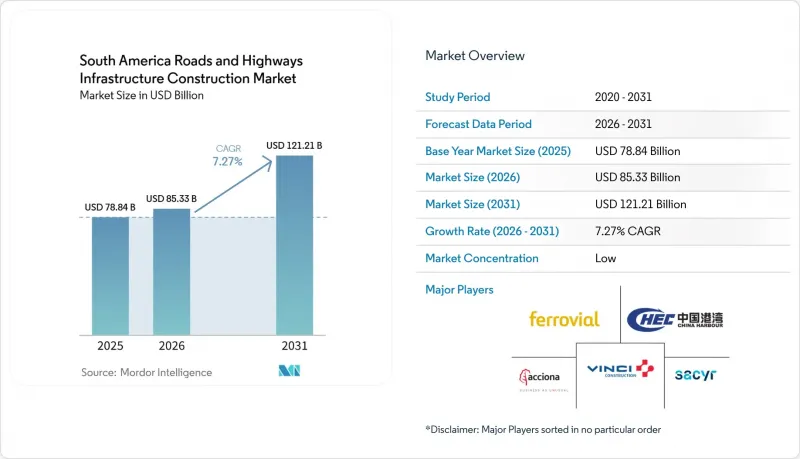
This report is Segmented by Component (Road, Bridges/Overpass, Tunnels, and Others), Construction Type (New Construction and Renovation), Investment Source (Public, Private, and Public-Private Partnership), Type (National, State, and Local), and Geography (Brazil, Argentina, Colombia, and More). The Market Forecasts are Provided in Terms of Value (USD).
South America Roads and Highways Infrastructure Construction Market Trends and Insights
Highway Concession Auctions Accelerate Road Infrastructure Investment
The South America roads and highways infrastructure construction market is receiving its strongest near-term support from concession auctions that convert policy decisions into funded construction commitments. Brazil's transport pipeline includes 14 federal highway concession contracts in 2026, covering 7,295 km and carrying projected investments above USD 57.4 billion across the wider four-year program. Argentina is also moving more than 9,000 km of national routes into its Red Federal de Concesiones program across 14 provinces with full private financing, and Stages I and II-A were already contracted by July 2026. These awards matter because they do not stop at operations and maintenance; the contracts require widening, duplication, and other capital works that keep construction activity going long after the auctions close. The South America roads and highways infrastructure construction market, therefore, gains both immediate project starts and a longer stream of mandated follow-on works from the same concession cycle.
Freight Corridor Expansion Strengthens Regional Logistics Networks
The South America roads and highways infrastructure construction market is also being shaped by trade corridors intended to shorten routes to Pacific and Atlantic gateways. The Capricorn Bioceanic Corridor stretches 3,800 km across Brazil, Paraguay, Argentina, and Chile, and is supported by major regional and multilateral financing institutions through the South Connection framework. The Inter-American Development Bank also approved a USD 200 million loan for Paraguay's Route PY15 segment, which is expected to help facilitate USD 220 million in annual exports once completed. Mainline corridor work creates additional demand for port connectors, border approaches, logistics access roads, and provincial links that are often outside the headline project value. This keeps the South America roads and highways infrastructure construction market tied not only to national budgets, but also to regional logistics planning that extends construction demand across multiple asset classes.
Fiscal Volatility and Budget Revisions Delay Infrastructure Investments
Fiscal instability remains the most visible constraint on the South America roads and highways infrastructure construction market, especially where public works still depend on direct state execution. Argentina's private concession model cannot cover the entire national network, particularly the large share of roads that are not commercially viable under tolling. This leaves a gap for maintenance and rehabilitation on routes that still need public support, even while the concession program moves ahead on stronger corridors. Colombia also experienced slower-than-target execution in its fifth-generation concession portfolio because financing strength alone did not eliminate licensing and implementation delays. The South America roads and highways infrastructure construction market, therefore, remains exposed whenever fiscal pressure, administrative disruption, or payment delays interrupt works that private operators cannot absorb.
Other drivers and restraints analyzed in the detailed report include:
- Multilateral Funding Improves Development of Strategic Transport Corridors
- Climate-Resilient Road Standards Support Infrastructure Modernization
- Toll Acceptance Challenges Limit Revenue Generation for Road Projects
For complete list of drivers and restraints, kindly check the Table Of Contents.
Segment Analysis
Road construction accounted for 72.80% of the South America roads and highways infrastructure construction market in 2025, confirming that surface transport remains the core of regional mobility and freight movement. This lead position reflects how most current concession pipelines are centered on widening, duplication, pavement improvement, and capacity upgrades along existing highway corridors. The South America roads and highways infrastructure construction market still relies on roads as the primary asset because highways carry the highest traffic volumes and connect directly to ports, cities, and agricultural zones. That keeps road packages larger in number and more broadly distributed than more specialized structures. At the same time, the strongest growth is shifting toward bridges and overpasses, which are forecast to rise at 8.20% CAGR through 2031.
That faster pace reflects a higher share of grade separations, river crossings, and access structures written into new corridor programs. The South America roads and highways infrastructure construction market is therefore not moving away from roads, but toward more engineering-intensive road systems that require structural additions at multiple points. This is especially visible in trade corridors where basic carriageway works alone cannot meet logistics goals. Support from the Bi-Oceanic Corridor in Paraguay shows how corridor investment can raise demand for structural works beyond standard road surfaces. Major corridor sections require bridge packages and other heavy civil elements to keep freight routes continuous across difficult terrain and water crossings. Tunnel activity remains smaller in share, but it has strategic weight in Colombia, Chile, and Peru, where alignment constraints make underground works necessary on selected sections. The supporting category, which includes drainage, retaining walls, and service facilities, also grows with overall contract volume because resilience standards increasingly require more than basic road surfacing.
New construction accounted for 69.70% of the South America roads and highways infrastructure construction market in 2025, reflecting the continued importance of greenfield alignments, route extensions, and large-scale corridor duplication. Many of the highest-value projects in Brazil, Chile, and Colombia still focus on new capacity or major reconfiguration rather than limited repair. The South America roads and highways infrastructure construction market is benefiting from this, as new routes and expanded corridors remain central to concession economics and regional export planning. These projects also attract greater private participation because traffic growth and toll potential are easier to structure around expanded assets. Renovation is the fastest-growing construction type and is forecast to grow at a 7.80% CAGR through 2031.
That higher growth shows that maintenance neglect has moved beyond routine repair in several markets. Rehabilitation now includes resurfacing, base reconstruction, drainage correction, and structural renewal that can be large enough to resemble new-build packages. This makes renovation a more meaningful source of contract value than a simple maintenance line item. Delayed intervention can raise rehabilitation costs to 3 to 4 times the cost of preventive work. Brazil's SIGICOR monitoring system also strengthens renovation execution by requiring visible, trackable reporting on work progress under concession agreements. That is important in brownfield work, where scope disputes have historically slowed delivery and raised costs. The South American roads and highways infrastructure construction industry is therefore moving into a phase in which renovation plays a stronger contractual and financial role than before.
Complete Report Scope:
- By Component
- Road
- Bridges/Overpass
- Tunnels
- Others
- By Construction Type
- New Construction
- Renovation
- By Investment Source
- Public
- Private
- Public-Private Partnership
- By Type
- National
- State
- Local
- By Country
- Brazil
- Argentina
- Colombia
- Chile
- Rest of South America
List of Companies Covered in this Report:
- Ferrovial SE
- China Harbour Engineering Company Limited (CHEC)
- Acciona S.A.
- VINCI Construction
- Sacyr Ingenieria e Infraestructuras
- Webuild S.p.A.
- OHLA
- Grupo Sacyr Chile
- Conasa S.A.
- Construtora Queiroz Galvao S.A.
- Andrade Gutierrez S.A.
- Odebrecht Engenharia & Construcao (OEC)
- China Railway Construction Corporation (CRCC)
- China Communications Construction Company (CCCC)
- Besalco S.A.
- Mota-Engil Engenharia
- Aenza (formerly Grana y Montero)
- Salfacorp S.A.
- OAS Engenharia
- Constructora ISA
Additional Benefits:
- The market estimate (ME) sheet in Excel format
- 3 months of analyst support
TABLE OF CONTENTS
1 Introduction
- 1.1 Study Assumptions and Market Definition
- 1.2 Scope of the Study
2 Research Methodology
3 Executive Summary
4 Market Landscape
- 4.1 Market Overview
- 4.2 Market Drivers
- 4.2.1 Highway Concession Auctions Accelerate Road Infrastructure Investment
- 4.2.2 Freight Corridor Expansion Strengthens Regional Logistics Networks
- 4.2.3 Climate-Resilient Road Standards Support Infrastructure Modernization
- 4.2.4 Multilateral Funding Improves Development of Strategic Transport Corridors
- 4.2.5 Digital Permitting and Right-of-Way Tracking Enhance Project Delivery Efficiency
- 4.2.6 Deferred Road Rehabilitation Needs Increase Infrastructure Construction Activity
- 4.3 Market Restraints
- 4.3.1 Fiscal Volatility and Budget Revisions Delay Infrastructure Investments
- 4.3.2 Toll Acceptance Challenges Limit Revenue Generation for Road Projects
- 4.3.3 Geotechnical Complexity Increases Construction Costs and Project Risks
- 4.3.4 Fragmented Permitting Across Subnational Authorities Delays Project Execution
- 4.4 Value / Supply-Chain Analysis
- 4.5 Regulatory Landscape
- 4.6 Government Initiatives and National Development Priorities
- 4.7 Technological Outlook
- 4.8 Porter's Five Forces Analysis
- 4.8.1 Bargaining Power of Suppliers
- 4.8.2 Bargaining Power of Consumers
- 4.8.3 Threat of New Entrants
- 4.8.4 Threat of Substitutes
- 4.8.5 Intensity of Competitive Rivalry
- 4.9 Pricing and Construction Cost Analysis
- 4.10 Key Upcoming and Ongoing Projects
- 4.11 Insights on Technological Innovations
5 Market Size & Growth Forecasts (Value, USD)
- 5.1 By Component
- 5.1.1 Road
- 5.1.2 Bridges/Overpass
- 5.1.3 Tunnels
- 5.1.4 Others
- 5.2 By Construction Type
- 5.2.1 New Construction
- 5.2.2 Renovation
- 5.3 By Investment Source
- 5.3.1 Public
- 5.3.2 Private
- 5.3.3 Public-Private Partnership
- 5.4 By Type
- 5.4.1 National
- 5.4.2 State
- 5.4.3 Local
- 5.5 By Country
- 5.5.1 Brazil
- 5.5.2 Argentina
- 5.5.3 Colombia
- 5.5.4 Chile
- 5.5.5 Rest of South America
6 Competitive Landscape
- 6.1 Market Concentration
- 6.2 Strategic Moves
- 6.3 Market Share Analysis
- 6.4 Company Profiles (Includes Global Level Overview, Market Level Overview, Core Segments, Financials as Available, Strategic Information, Products & Services, and Recent Developments)
- 6.4.1 Ferrovial SE
- 6.4.2 China Harbour Engineering Company Limited (CHEC)
- 6.4.3 Acciona S.A.
- 6.4.4 VINCI Construction
- 6.4.5 Sacyr Ingenieria e Infraestructuras
- 6.4.6 Webuild S.p.A.
- 6.4.7 OHLA
- 6.4.8 Grupo Sacyr Chile
- 6.4.9 Conasa S.A.
- 6.4.10 Construtora Queiroz Galvao S.A.
- 6.4.11 Andrade Gutierrez S.A.
- 6.4.12 Odebrecht Engenharia & Construcao (OEC)
- 6.4.13 China Railway Construction Corporation (CRCC)
- 6.4.14 China Communications Construction Company (CCCC)
- 6.4.15 Besalco S.A.
- 6.4.16 Mota-Engil Engenharia
- 6.4.17 Aenza (formerly Grana y Montero)
- 6.4.18 Salfacorp S.A.
- 6.4.19 OAS Engenharia
- 6.4.20 Constructora ISA
7 Market Opportunities & Future Outlook
- 7.1 White-Space and Unmet-Need Assessment

