PUBLISHER: Mordor Intelligence | PRODUCT CODE: 2118167

PUBLISHER: Mordor Intelligence | PRODUCT CODE: 2118167
South America 3D Construction - Market Share Analysis, Industry Trends & Statistics, Growth Forecasts (2026 - 2031)
According to Mordor Intelligence, South America 3D construction market size is projected to be USD 0.22 billion in 2025, USD 0.29 billion in 2026, and reach USD 1.24 billion by 2031, growing at a CAGR of 33.80% from 2026 to 2031.
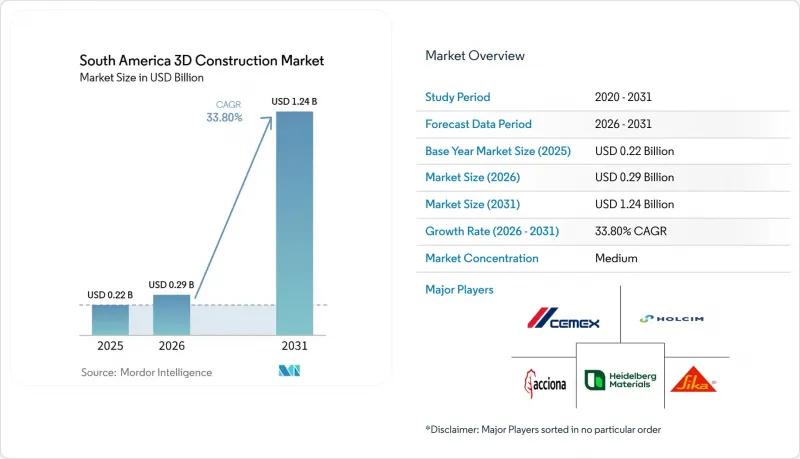
This report is Segmented by Construction Method (Extrusion, Powder Bonding, Others), Material Type (Concrete, Metal, Composite, Other Material Types), End Use (Residential, Commercial, Infrastructure), Construction Setting (On-Site Printing, Off-Site Printing), and Geography (Brazil, Chile, Colombia, Argentina, Peru, Rest of South America). The Market Forecasts are Provided in Terms of Value (USD).
South America 3D Construction Market Trends and Insights
Government Housing Programs for Affordable Printed Construction
Government housing programs provide a practical route into the South America 3D construction market because they can group enough units to support printer transport, setup, and material planning. Brazil authorized 4,063 new Minha Casa, Minha Vida units across 12 states in January 2025, supported by BRL 646.1 million (USD 118 million) at the stated 2025 average exchange rate. Sao Paulo state's CDHU tender covered 15,000 off-site modular units and identified 3D printing as an eligible construction method.
These programs often serve peri-urban and rural areas where labor availability and material transport add cost to conventional masonry work. In Colombia, Cementos Argos and COBOD completed social housing projects under Casa Para Mi, reporting printing rates of 6 m2 per hour, 30% faster construction, and 20% lower material costs than traditional methods. As more agencies accept printed construction in tenders, contractors can plan equipment use across a clearer project pipeline.
Shorter Build Cycles and Lower Labor Intensity in Urban Corridors
The South America 3D construction market benefits when contractors can reduce the time needed to create walls for standard housing designs. A masonry team can require 30 to 45 days to complete the wall structure for a 60 m2 home, while concrete printing systems can complete comparable wall work in less than 48 hours. Sika Brasil completed a printed concrete house in Rio Grande do Sul in 60 hours using SikaCrete-732 3D and reported a cost 30% lower than comparable masonry construction. Faster shell construction can reduce the period during which capital remains tied up in an unfinished project. It can also reduce the effect of skilled-trade shortages in high-density corridors, where project schedules often depend on specialist availability. The South America 3D construction market benefits from this approach in social housing and repetitive infrastructure work, where firms can reuse designs and coordinate pumps, crews, and materials across multiple sites.
High Printer Capital Cost, Currency Exposure, and Import Costs
Large-format equipment remains difficult for mid-sized contractors to purchase because printers are generally priced in USD while construction revenue is earned in local currencies. The COBOD BOD2 used in regional projects must be transported in modular units and assembled on site, which adds cost in remote or mountainous locations. The La Union project in Antioquia required five truckloads for equipment transport. Techint E&C installed a COBOD BOD2 unit in Argentina with a 12 m by 12 m working area and a 6 m print height, demonstrating the scale of equipment required for industrial applications. Capital recovery depends on a stable flow of repetitive projects, rather than a single housing demonstration. Leasing and distributor arrangements can shift part of the upfront cost to specialized intermediaries, although import classifications, tariffs, taxes, and foreign exchange movements still make budgets less predictable.
Other drivers and restraints analyzed in the detailed report include:
- Reliable Mix Designs for Seismic and Flood-Prone Areas
- Post-Disaster Reconstruction Demand
- Fragmented Building Codes and Uneven Approval Cycles
For complete list of drivers and restraints, kindly check the Table Of Contents.
Segment Analysis
Extrusion held 64.3% of the South America 3D construction market share in 2025 because it fits established ready-mix supply and pumping equipment. Current housing projects use continuous-layer wall printing with gantry-based systems and locally calibrated printable mortars. Public programs also favor repeatable wall layouts, which reduce the transition burden for procurement teams familiar with concrete. Digital monitoring of adhesion and flow can improve confidence in layer quality during printing. These factors make extrusion practical where project scale and straightforward logistics matter most.
Powder bonding is forecast to grow at a 44.1% CAGR through 2031 from a smaller base. It can serve complex components, urban furniture, and specialized infrastructure shapes where custom formwork is expensive. It is less suited to large social housing programs that prioritize the rapid production of standard walls. Other methods include contour-crafting variants and hybrid systems, while research in Peru continues to examine the seismic resistance of printed social housing. The South America 3D construction industry is likely to retain extrusion for core projects while powder bonding serves specialized applications.
Concrete accounted for 56.9% of the South America 3D construction market share in 2025 because regional producers, contractors, and public buyers already use it widely. Cement, aggregates, pumps, and ready-mix facilities support printed wall systems and familiar procurement practices. Suppliers can tailor mortars for humidity, aggregate quality, and structural needs. Cementos Argos has used a calcined-clay formulation for conditions in Antioquia, Colombia. Concrete will remain central because it connects additive methods with established construction practice.
Composite materials are forecast to record the highest material CAGR at 48.6% through 2031. They include fiber-reinforced geopolymers, calcined-clay binders, and systems intended to improve performance or reduce cement content. A 2025 study found that geopolymer systems using recycled construction and demolition waste can support the construction of low-rise printed buildings. Research in Peru also tested PET waste and coconut fibers in printable concrete. Metal remains limited to specialist components, while composite adoption will depend on printability, curing, structural evidence, and cost.
Complete Report Scope:
- By Construction Method
- Extrusion
- Powder Bonding
- Others
- By Material Type
- Concrete
- Metal
- Composite
- Other Material Types
- By End Use
- Residential
- Commercial
- Infrastructure
- By Construction Setting
- On-site (In-situ) Printing
- Off-site (Factory / Precast) Printing
- By Country
- Brazil
- Chile
- Colombia
- Argentina
- Peru
- Rest of South America
List of Companies Covered in this Report:
- Sika AG
- Acciona S.A.
- Heidelberg Materials AG
- COBOD International A/S
- ICON Technology, Inc.
- Apis Cor Inc.
- CyBe Construction B.V.
- PERI SE
- Putzmeister Group
- Skanska AB
- WASP (World's Advanced Saving Project)
- Contour Crafting Corporation
- Black Buffalo 3D Corporation
- Mighty Buildings, Inc.
- XtreeE
- Branch Technology
Additional Benefits:
- The market estimate (ME) sheet in Excel format
- 3 months of analyst support
TABLE OF CONTENTS
1 INTRODUCTION
- 1.1 Study Assumptions and Market Definition
- 1.2 Scope of the Study
2 RESEARCH METHODOLOGY
3 EXECUTIVE SUMMARY
4 MARKET LANDSCAPE
- 4.1 Market Overview
- 4.2 Market Drivers
- 4.2.1 Government Housing Programs for Affordable Printed Construction
- 4.2.2 Shorter Build Cycles and Lower Labor Intensity in Urban Corridors
- 4.2.3 Reliable Mix Designs for Seismic and Flood-Prone Areas
- 4.2.4 Post-Disaster Reconstruction Demand
- 4.2.5 Lower-Carbon Binders and Reduced Waste
- 4.2.6 Digital Quality Control and Lower Rework
- 4.3 Market Restraints
- 4.3.1 High Printer Capital Cost, Currency Exposure, and Import Costs
- 4.3.2 Fragmented Building Codes and Uneven Approval Cycles
- 4.3.3 Insurance and Warranty Acceptance Gaps
- 4.3.4 Feedstock Quality and Additive Supply Constraints
- 4.4 Value Chain Analysis
- 4.5 Regulatory Landscape
- 4.6 Technological Outlook
- 4.7 Porter's Five Forces Analysis
- 4.7.1 Bargaining Power of Suppliers
- 4.7.2 Bargaining Power of Buyers
- 4.7.3 Threat of New Entrants
- 4.7.4 Threat of Substitutes
- 4.7.5 Competitive Rivalry
5 MARKET SIZE AND GROWTH FORECASTS
- 5.1 By Construction Method
- 5.1.1 Extrusion
- 5.1.2 Powder Bonding
- 5.1.3 Others
- 5.2 By Material Type
- 5.2.1 Concrete
- 5.2.2 Metal
- 5.2.3 Composite
- 5.2.4 Other Material Types
- 5.3 By End Use
- 5.3.1 Residential
- 5.3.2 Commercial
- 5.3.3 Infrastructure
- 5.4 By Construction Setting
- 5.4.1 On-site (In-situ) Printing
- 5.4.2 Off-site (Factory / Precast) Printing
- 5.5 By Country
- 5.5.1 Brazil
- 5.5.2 Chile
- 5.5.3 Colombia
- 5.5.4 Argentina
- 5.5.5 Peru
- 5.5.6 Rest of South America
6 Competitive Landscape
- 6.1 Market Concentration
- 6.2 Strategic Moves
- 6.3 Market Share Analysis
- 6.4 Company Profiles (Includes Global Level Overview, Market Level Overview, Core Segments, Financials as Available, Strategic Information, Products & Services, and Recent Developments)
- 6.4.1 Sika AG
- 6.4.2 Acciona S.A.
- 6.4.3 Heidelberg Materials AG
- 6.4.4 COBOD International A/S
- 6.4.5 ICON Technology, Inc.
- 6.4.6 Apis Cor Inc.
- 6.4.7 CyBe Construction B.V.
- 6.4.8 PERI SE
- 6.4.9 Putzmeister Group
- 6.4.10 Skanska AB
- 6.4.11 WASP (World's Advanced Saving Project)
- 6.4.12 Contour Crafting Corporation
- 6.4.13 Black Buffalo 3D Corporation
- 6.4.14 Mighty Buildings, Inc.
- 6.4.15 XtreeE
- 6.4.16 Branch Technology
7 MARKET OPPORTUNITIES AND FUTURE OUTLOOK
- 7.1 White-space and Unmet-Need Assessment

