PUBLISHER: Mordor Intelligence | PRODUCT CODE: 2118874

PUBLISHER: Mordor Intelligence | PRODUCT CODE: 2118874
Vietnam Bottled Water - Market Share Analysis, Industry Trends & Statistics, Growth Forecasts (2026 - 2031)
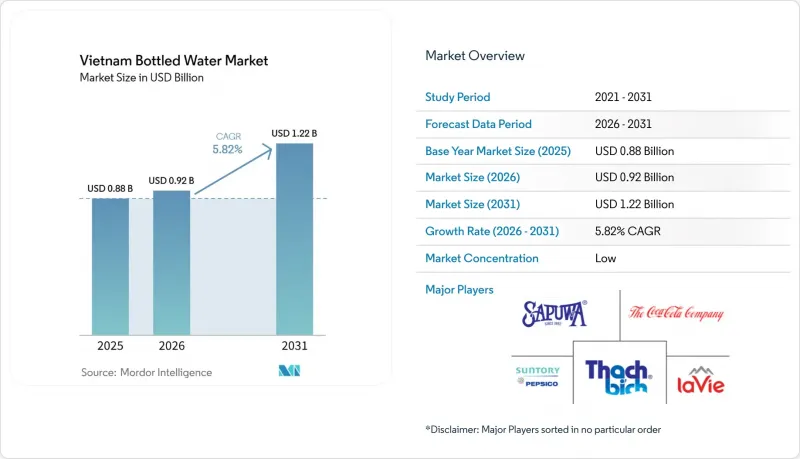
According to Mordor Intelligence, the Vietnam bottled water market size is expected to grow from USD 0.88 billion in 2025 to USD 0.92 billion in 2026, and is forecast to reach USD 1.22 billion by 2031 at a 5.82% CAGR over 2026-2031.
This report is Segmented by Product Type (Still Water, Sparkling Water, and Functional/Flavored Water), Packaging Material (PET Bottles, Glass Bottles, and More), Pricing (Mass, Premium/Luxury), and Distribution Channel (On-Trade and Off-Trade). The Market Forecasts are Provided in Terms of Value (USD) and Volume (Liters).
Vietnam Bottled Water Market Trends and Insights
Urbanization and packaged water use
According to the World Bank, Vietnam's urbanization rate reached 39.47% in 2025, with secondary cities, including Binh Duong, Dong Nai, and Can Tho, continuing to absorb migration. This shift places more consumers near convenience stores, supermarkets, workplaces, and food service outlets where packaged water is readily available. The Vietnam bottled water market benefits as water purchases become part of commuting, work, and daily hydration routines. Urban households often require single-serve water outside the home, even when they have access to household water treatment. This trend gives manufacturers with broad distribution networks in secondary cities a practical advantage as these cities develop.
Health awareness and lower sugary drink intake
Health-focused beverage choices are strengthening bottled water's role in daily consumption. Urban consumers increasingly prefer beverages without added sugar and products that demonstrate safety and quality credentials. This trend supports the Vietnam bottled water market, particularly mineral, alkaline, and functional offerings that clearly communicate their ingredients and positioning. Food safety systems, such as ISO 22000:2018 and Hazard Analysis Critical Control Point (HACCP), help brands demonstrate operational discipline to customers who cannot independently assess water chemistry. This shows that distribution expansion and premium positioning can support revenue growth within health-oriented beverage portfolios.
Price competition from local manufacturers
Regional and local manufacturers offer similar purified water at aggressive prices, particularly in rural and semi-urban markets. In the Vietnam bottled water market, this limits suppliers' ability to recover higher packaging, energy, and logistics costs. Premium and functional brands have more room to defend pricing because they compete on source origin, mineral content, or product benefits. Smaller companies without broad distribution networks or established brand recognition face the greatest pressure. Over the forecast period, this trend may encourage consolidation in mass purified water while leaving differentiated formats less exposed.
Other drivers and restraints analyzed in the detailed report include:
- Tourism and hospitality demand for premium water
- Functional and alkaline water demand is emerging as a distinct value pool
- Plastic-waste concerns and packaging costs
For complete list of drivers and restraints, kindly check the Table Of Contents.
Segment Analysis
Still water accounted for 68.83% of the market value in 2025, confirming its role as the standard option for household use, work, travel, and institutional purchases. Its broad demand base supports the Vietnam bottled water market across all income groups and retail formats. Sparkling water remains a smaller niche, with stronger visibility in hotels, restaurants, and urban dining venues. Functional/flavored water is the fastest-growing product group, with a forecast CAGR of 7.01% from 2026 to 2031. This growth reflects rising demand for alkaline, electrolyte, vitamin-enhanced, and botanical or fruit-infused water. The category gives consumers options for exercise, wellness, and social occasions beyond routine hydration.
Vitamin-enhanced, electrolyte/sports, and botanical/fruit-infused options serve different consumption occasions and price points. Electrolyte products align with sports and outdoor activities, while botanical products occupy a position between premium water and wellness beverages. Hoang Minh Water JSC's i-on Life uses Japanese electrolysis technology to produce alkaline ionized water with a pH of 8.5 to 9.5 and no added salt. This positioning allows domestic producers to highlight product attributes rather than compete only on retail price. Functional water does not need the same volume as still water to be commercially significant because it commands higher pricing. The Vietnam bottled water industry uses these products to improve margins and bring consumers into more specialized water consumption occasions.
PET bottles accounted for 86.12% of market value in 2025, supported by their cost efficiency, familiarity among manufacturers, and wide availability across the supply chain. The Vietnam bottled water market size for PET remains closely tied to demand from mass retail, delivery, and single-serve consumption. Glass bottles are forecast to record the fastest growth among packaging formats, at a CAGR of 7.24% through 2031. Hotels and fine-dining venues use glass bottles to support premium service standards and reduce the visibility of single-use plastic. Aluminum cans and bottles are also gaining relevance where functional positioning aligns with environmental concerns. Packaging decisions increasingly influence both compliance costs and brand presentation to customers.
Vietnam's recycling conditions complicate the shift away from PET. The Asia Pacific International Spirits and Wines Alliance reported glass recycling at 15% in Vietnam, compared with 70% for aluminum cans and 32% to 45% for PET bottles, as of 2024. Glass may have a stronger sustainability perception in premium hospitality, but Vietnam's collection and processing system for glass remains less developed. As recycling responsibilities become more demanding, packaging investments will increasingly differentiate companies with established systems from those that need to retrofit their operations.
Complete Report Scope:
- By Product Type
- Still Water
- Sparkling Water
- Functional/Flavoured Water
- Vitamin-Enhanced
- Electrolyte/Sports
- Botanical/Fruit-Infused
- By Packaging Material
- PET Bottles
- Glass Bottles
- Aluminium Cans and Bottles
- Others
- By Pricing
- Mass
- Premium/Luxury
- By Distribution Channel
- On-Trade
- Off-Trade
- Supermarkets/Hypermarkets
- Convenience/Grocery Stores
- Home and Office Space
- Online Retail
- Other Off-Trade Channels
List of Companies Covered in this Report:
- Suntory PepsiCo.
- The Coca-Cola Company
- La Vie Limited
- Vinh Hao
- HOANG MINH WATER JSC
- SAIGON PURE WATER LIMITED
- THACH BICH MINERAL WATER
- Vital
- Kim Bio Water Limited
- Fujiwa Vietnam
- Masan Consumer
- Origin Water Phu Quoc Co. Ltd.
- TH Group
- Bidrico
- Thanh Tan Mineral Water JSC
- Tan Vinh Cuu Service Company Limited
- Miocen
- Vittel
- RITA Food & Drink Co.,Ltd
- Pavico
Additional Benefits:
- The market estimate (ME) sheet in Excel format
- 3 months of analyst support
TABLE OF CONTENTS
1 INTRODUCTION
- 1.1 Study Assumptions and Market Definition
- 1.2 Scope of the Study
2 RESEARCH METHODOLOGY
3 EXECUTIVE SUMMARY
4 MARKET LANDSCAPE
- 4.1 Market Overview
- 4.2 Market Drivers
- 4.2.1 Urbanization accelerating packaged water consumption
- 4.2.2 Rising health awareness reducing sugary beverage intake
- 4.2.3 Tourism and hospitality sector driving premium water demand
- 4.2.4 Increasing demand for functional and alkaline bottled water
- 4.2.5 On the go lifestyle boosting single serve bottled water sales
- 4.2.6 Increasing consumer focus on product purity, source transparency, and certified water quality
- 4.3 Market Restraints
- 4.3.1 Stringent bottled water quality compliance requirements
- 4.3.2 Intense price competition from local manufacturers
- 4.3.3 Consumer shift toward reusable water filtration solutions
- 4.3.4 Increasing Environmental Concerns Regarding Plastic Waste
- 4.4 Consumer Behaviour Analysis
- 4.5 Regulatory Outlook
- 4.6 Porter's Five Forces
- 4.6.1 Threat of New Entrants
- 4.6.2 Bargaining Power of Buyers/Consumers
- 4.6.3 Bargaining Power of Suppliers
- 4.6.4 Threat of Substitute Products
- 4.6.5 Intensity of Competitive Rivalry
5 MARKET SIZE AND GROWTH FORECASTS (VALUE AND VOLUME)
- 5.1 By Product Type
- 5.1.1 Still Water
- 5.1.2 Sparkling Water
- 5.1.3 Functional/Flavoured Water
- 5.1.3.1 Vitamin-Enhanced
- 5.1.3.2 Electrolyte/Sports
- 5.1.3.3 Botanical/Fruit-Infused
- 5.2 By Packaging Material
- 5.2.1 PET Bottles
- 5.2.2 Glass Bottles
- 5.2.3 Aluminium Cans and Bottles
- 5.2.4 Others
- 5.3 By Pricing
- 5.3.1 Mass
- 5.3.2 Premium/Luxury
- 5.4 By Distribution Channel
- 5.4.1 On-Trade
- 5.4.2 Off-Trade
- 5.4.2.1 Supermarkets/Hypermarkets
- 5.4.2.2 Convenience/Grocery Stores
- 5.4.2.3 Home and Office Space
- 5.4.2.4 Online Retail
- 5.4.2.5 Other Off-Trade Channels
6 COMPETITIVE LANDSCAPE
- 6.1 Market Concentration
- 6.2 Strategic Moves
- 6.3 Market Share Analysis
- 6.4 Company Profiles (includes Global-level Overview, Market-level Overview, Core Segments, Financials (if available), Strategic Information, Market Rank/Share, Products and Services, Recent Developments)
- 6.4.1 Suntory PepsiCo.
- 6.4.2 The Coca-Cola Company
- 6.4.3 La Vie Limited
- 6.4.4 Vinh Hao
- 6.4.5 HOANG MINH WATER JSC
- 6.4.6 SAIGON PURE WATER LIMITED
- 6.4.7 THACH BICH MINERAL WATER
- 6.4.8 Vital
- 6.4.9 Kim Bio Water Limited
- 6.4.10 Fujiwa Vietnam
- 6.4.11 Masan Consumer
- 6.4.12 Origin Water Phu Quoc Co. Ltd.
- 6.4.13 TH Group
- 6.4.14 Bidrico
- 6.4.15 Thanh Tan Mineral Water JSC
- 6.4.16 Tan Vinh Cuu Service Company Limited
- 6.4.17 Miocen
- 6.4.18 Vittel
- 6.4.19 RITA Food & Drink Co.,Ltd
- 6.4.20 Pavico
7 MARKET OPPORTUNITIES AND FUTURE OUTLOOK

