PUBLISHER: Mordor Intelligence | PRODUCT CODE: 2119832

PUBLISHER: Mordor Intelligence | PRODUCT CODE: 2119832
Europe Bottled Water Processing - Market Share Analysis, Industry Trends & Statistics, Growth Forecasts (2026 - 2031)
According to Mordor Intelligence, the European bottled water processing market size in 2026 is estimated at USD 41.06 billion, growing from 2025 value of USD 38.98 billion with 2031 projections showing USD 53.25 billion, growing at 5.33% CAGR over 2026-2031.
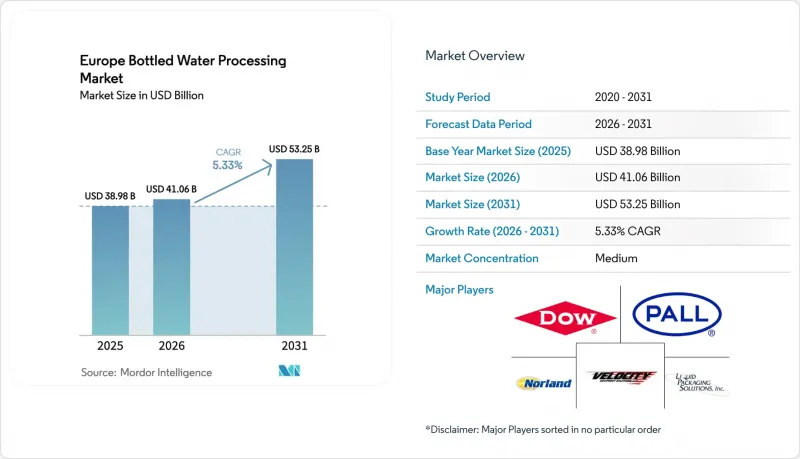
This report is Segmented by Equipment Type (Filter, Filler and Capper, and More), Technology (Reverse Osmosis, Microfiltration, Ultrafiltration, and More), Application (Still Water, Sparkling Water, and More), Packaging Material (PET, Glass, and More), End User (Integrated Bottled Water Brands, and More), and Geography. The Market Forecasts are Provided in Terms of Value (USD).
Europe Bottled Water Processing Market Trends and Insights
Heightened Stringency of EU Drinking Water Directive
The revised directive tightens PFAS thresholds to 0.10 µg/L from January 2026, prompting bottlers to retrofit their ultrafiltration and activated-carbon stages, which increases greenfield line costs by 15-20%. Early enforcement in Germany favors vertically integrated brands that own protected spring sources over contract packagers reliant on municipal feedwater. Capital-expenditure pressure is therefore tilting the European bottled water processing market toward players capable of absorbing compliance spend. Material-contact clauses within the directive also accelerate the transition from legacy PVC tubing to stainless steel and FDA-grade polymers, thereby extending equipment replacement cycles.
Shift Toward rPET Content Mandates
The Packaging and Packaging Waste Regulation requires 30% recycled PET by 2030 and 65% by 2040, backed by extended producer responsibility fees that penalize virgin resin usage. Spot rPET shortages already push prices to parity with virgin resin, motivating Coca-Cola Europacific Partners to invest EUR 250 million (USD 275 million) in a Netherlands recycling facility that is set to come online in 2027. Secure rPET offtake is becoming a strategic differentiator across the European bottled water processing market, altering long-term supply contracts and favoring brands with closed-loop agreements.
Volatile Virgin PET Resin Prices
European virgin PET traded between EUR 1,100 and EUR 1,500 per ton in 2024, with 25% intra-year swings tied to energy and feedstock shocks. Still-water bottlers with quarterly retailer contracts have limited pass-through flexibility, so margin compression frequently erodes operating leverage. Italian mineral-water players experienced sharp Q3 2024 hits when Brent crude oil reached USD 95 per barrel, underscoring the raw-material exposure in the European bottled water processing market.
Other drivers and restraints analyzed in the detailed report include:
- Growing Private-Label Penetration in Discount Retail
- Accelerated Adoption of AI-Enabled Inline Quality Control
- High CAPEX for Aseptic Filling Lines
For complete list of drivers and restraints, kindly check the Table Of Contents.
Segment Analysis
Filters held the largest 31.94% share in the European bottled water processing market in 2025, reflecting the universal demand for particulate and microbial control. Both reverse-osmosis and ultrafiltration modules sustain recurring replacement revenue for suppliers, with membrane life cycles of 18-24 months ensuring stable aftermarket sales. Lightweighting pressures and retailer sustainability targets are, however, driving the acceleration of blow-molded installations. The Sidel Matrix platform reduces preform weight by 12% while maintaining 10 N top-load strength, resulting in material savings of approximately EUR 0.008 per bottle and a fast two-to-three-year payback. Integrated majors often couple blow-molders with high-speed fillers to optimize line balance, whereas contract packagers seek standalone modular units for multi-SKU runs.
The blow-molded CAGR of 6.28% through 2031 surpasses filters as brands pursue in-house preform-to-bottle control, a critical requirement for managing 30%-50% rPET blends. Fillers and capers remain essential, yet their growth tracks overall line buildouts rather than outpacing niche equipment. Bottle washers retain a limited share, mostly inside German glass-returnable operations. Secondary equipment, such as labelers, palletizers, and conveyors, adheres to price-competitive procurement, opening the door for Asian vendors in Southern and Eastern Europe. Technology suppliers respond with end-to-end service bundles, promising up-time guarantees that ease staffing gaps across the European bottled water processing market.
Reverse osmosis accounted for a 40.83% share in 2025, driven by its ability to remove dissolved solids and PFAS below detection limits. Energy draw, at 0.4-0.6 kWh per m3, and 20%-30% reject water, nevertheless drives operating cost debates. UV disinfection, which is expanding at a 7.1% CAGR, uses 70% less electricity than ozone and avoids the residual chlorine taste, appealing to premium still and flavored SKUs seeking clean-label cues. Pentair's Sanitron units, with a throughput of 150 m3 per hour, deliver a 4-log Cryptosporidium reduction without forming disinfection byproducts, aligning with the European bottled water processing market's pivot toward taste integrity.
Support microfiltration, ultrafiltration, and chlorination, maintain midpoint shares, competing on plant-specific water chemistry and regulatory context. Ozone retains a role in sparkling-water lines for concurrent carbon dioxide scavenging, yet its share declines as UV systems integrate with AI-based quality monitoring. As energy tariffs climb and EU carbon-pricing deepens, ROI on UV retrofits strengthens, particularly in Spain and Italy, where kilowatt-hour costs outpace the EU average.
Complete Report Scope:
- By Equipment Type
- Filter
- Filler and Capper
- Blow Molder
- Bottle Washer
- Other Equipment Types
- By Technology
- Reverse Osmosis
- Microfiltration
- Ultrafiltration
- Chlorination
- UV Disinfection
- Other Technologies
- By Application
- Still Water
- Sparkling Water
- Flavoured Water
- By Packaging Material
- Polyethylene Terephthalate (PET)
- Glass
- High-Density Polyethylene (HDPE)
- Other Packaging Materials
- By End User
- Integrated Bottled Water Brands
- Contract Packagers
- Private Label Producers
- By Geography
- United Kingdom
- Germany
- France
- Italy
- Spain
- Rest of Europe
List of Companies Covered in this Report:
- Dow Inc.
- Pall Corporation
- Veolia Environnement SA
- Pentair Plc
- Alfa Laval AB
- GEA Group AG
- Krones AG
- Tetra Pak International SA
- Suez SA
- SPX Flow Inc.
- Norland International Inc.
- Velocity Equipment Solutions Inc.
- Liquid Packaging Solutions Inc.
Additional Benefits:
- The market estimate (ME) sheet in Excel format
- 3 months of analyst support
TABLE OF CONTENTS
1 INTRODUCTION
- 1.1 Study Assumptions and Market Definition
- 1.2 Scope of the Study
2 RESEARCH METHODOLOGY
3 EXECUTIVE SUMMARY
4 MARKET LANDSCAPE
- 4.1 Market Overview
- 4.2 Market Drivers
- 4.2.1 Rising Health-Conscious Consumer Base
- 4.2.2 Heightened Stringency of EU Drinking Water Directive
- 4.2.3 Growing Private Label Penetration in Discount Retail
- 4.2.4 Rapid Proliferation of On-the-Go Pack Sizes
- 4.2.5 Shift Toward rPET Content Mandates
- 4.2.6 Accelerated Adoption of AI-Enabled Inline Quality Control
- 4.3 Market Restraints
- 4.3.1 Volatile Virgin PET Resin Prices
- 4.3.2 Rising Municipal Tap Water Campaigns
- 4.3.3 High CAPEX for Aseptic Filling Lines
- 4.3.4 Scarcity of Qualified Maintenance Personnel
- 4.4 Industry Value Chain Analysis
- 4.5 Impact of Macroeconomic Factors on the Market
- 4.6 Regulatory Landscape
- 4.7 Technological Outlook
- 4.8 Porter's Five Forces Analysis
- 4.8.1 Bargaining Power of Suppliers
- 4.8.2 Bargaining Power of Buyers
- 4.8.3 Threat of New Entrants
- 4.8.4 Threat of Substitutes
- 4.8.5 Intensity of Competitive Rivalry
5 MARKET SIZE AND GROWTH FORECASTS (VALUE)
- 5.1 By Equipment Type
- 5.1.1 Filter
- 5.1.2 Filler and Capper
- 5.1.3 Blow Molder
- 5.1.4 Bottle Washer
- 5.1.5 Other Equipment Types
- 5.2 By Technology
- 5.2.1 Reverse Osmosis
- 5.2.2 Microfiltration
- 5.2.3 Ultrafiltration
- 5.2.4 Chlorination
- 5.2.5 UV Disinfection
- 5.2.6 Other Technologies
- 5.3 By Application
- 5.3.1 Still Water
- 5.3.2 Sparkling Water
- 5.3.3 Flavoured Water
- 5.4 By Packaging Material
- 5.4.1 Polyethylene Terephthalate (PET)
- 5.4.2 Glass
- 5.4.3 High-Density Polyethylene (HDPE)
- 5.4.4 Other Packaging Materials
- 5.5 By End User
- 5.5.1 Integrated Bottled Water Brands
- 5.5.2 Contract Packagers
- 5.5.3 Private Label Producers
- 5.6 By Geography
- 5.6.1 United Kingdom
- 5.6.2 Germany
- 5.6.3 France
- 5.6.4 Italy
- 5.6.5 Spain
- 5.6.6 Rest of Europe
6 COMPETITIVE LANDSCAPE
- 6.1 Market Concentration
- 6.2 Strategic Moves
- 6.3 Market Share Analysis
- 6.4 Company Profiles (includes Global level Overview, Market level Overview, Core Segments, Financials as available, Strategic Information, Market Rank/Share for key companies, Products and Services, and Recent Developments)
- 6.4.1 Dow Inc.
- 6.4.2 Pall Corporation
- 6.4.3 Veolia Environnement SA
- 6.4.4 Pentair Plc
- 6.4.5 Alfa Laval AB
- 6.4.6 GEA Group AG
- 6.4.7 Krones AG
- 6.4.8 Tetra Pak International SA
- 6.4.9 Suez SA
- 6.4.10 SPX Flow Inc.
- 6.4.11 Norland International Inc.
- 6.4.12 Velocity Equipment Solutions Inc.
- 6.4.13 Liquid Packaging Solutions Inc.
7 MARKET OPPORTUNITIES AND FUTURE OUTLOOK
- 7.1 White-Space and Unmet-Need Assessment

