PUBLISHER: Mordor Intelligence | PRODUCT CODE: 2118911

PUBLISHER: Mordor Intelligence | PRODUCT CODE: 2118911
United Kingdom Bottled Water - Market Share Analysis, Industry Trends & Statistics, Growth Forecasts (2026 - 2031)
According to Mordor Intelligence, the United Kingdom bottled water market size is expected to grow from USD 9.62 billion in 2025 to USD 10.14 billion in 2026, and is forecast to reach USD 14.13 billion by 2031 at a 6.87% CAGR over 2026-2031.
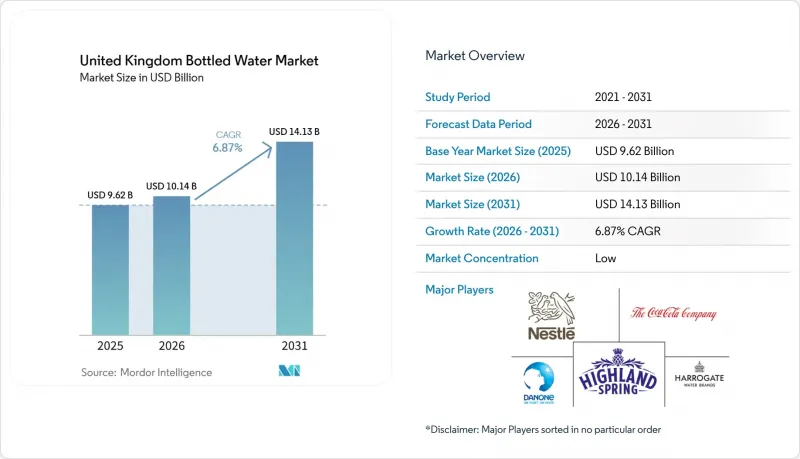
This report is Segmented by Product Type (Still Water, Sparkling Water, and Functional/Flavored Water), Packaging Material (PET Bottles, Glass Bottles, and More), Pricing (Mass, Premium/Luxury), and Distribution Channel (On-Trade and Off-Trade). The Market Forecasts are Provided in Terms of Value (USD) and Volume (Liters).
United Kingdom Bottled Water Market Trends and Insights
Rising consumer preference for healthy hydration
Growing health consciousness and initiatives to reduce sugar intake are encouraging consumers in the United Kingdom to replace carbonated soft drinks with bottled water. Increasing awareness of lifestyle-related health issues and growing demand for clean-label, low-calorie beverages are further supporting category growth. Manufacturers are also expanding their product portfolios with functional and flavored water to address evolving consumer preferences and premium hydration trends. Reflecting this shift, Danone Waters Europe is expected to report 9% value growth in the United Kingdom in 2025, driven by consumers substituting bottled water for sugary soft drinks. In addition, the United Kingdom Soft Drinks Industry Levy (Sugar Tax) continues to encourage consumers to choose low- and no-sugar beverages, further supporting bottled water consumption as a healthier hydration option.
Expansion of on-the-go consumption
Commuting, travel, leisure activities, and convenience shopping create frequent single-serve purchase occasions in the bottled water market in the United Kingdom. Transit corridors and high-footfall locations favor smaller packs that consumers can carry easily and consume immediately. In January 2026, Boost launched Boost Water+, a three-variant, zero-sugar electrolyte range priced at GBP 1 per 500 ml in convenience stores. The product is launched in three varieties: Citrus, Strawberry and Peach, and Cherry. This shift toward electrolyte and value-added products can improve revenue per purchase, but brands without convenience distribution may lose visibility in high-frequency locations.
Stringent plastic packaging regulations increase compliance costs
Extended producer responsibility rules create a direct cost challenge for polyethylene terephthalate (PET)-intensive businesses in the United Kingdom bottled water market. Large producers face a plastic disposal fee of GBP 423 per tonne, while the plastic recycling obligation will rise from 57% in 2026 to 59% in 2027, according to the government of the United Kingdom. In addition, the Deposit Scheme for Drinks Containers, scheduled to begin in October 2027, will apply to PET bottles , aluminum containers, and steel containers ranging from 150 ml to 3 liters. The scheme will introduce requirements for registration, labeling, deposits, and producer fees. Mid-sized producers may find these investments harder to absorb than larger companies with established recycling partnerships and recycled-material supply chains. In May 2025, Anglian Water will face a record GBP 1.42 million fine at Northampton Crown Court following a prosecution by the Drinking Water Inspectorate (DWI) over drinking water failures that affected around 1.3 million people .
Other drivers and restraints analyzed in the detailed report include:
- Expanding foodservice and premium hospitality recovery
- Sustainability driving packaging innovation
- High consumer confidence in tap water
For complete list of drivers and restraints, kindly check the Table Of Contents.
Segment Analysis
Still water accounted for 62.83% of the category value in 2025, maintaining its position as the largest product category. Its broad presence reflects private-label ranges, entry-price packs, supermarket distribution, and convenience formats. Sparkling water occupies a position between mass-market still water and higher-value imported mineral products. Premium imported waters in glass bottles and domestic branded sparkling products support this category across restaurants and retail channels. Functional and flavored water is forecast to grow at a CAGR of 8.68% from 2026 to 2031, making it the fastest-growing product type. This growth provides the United Kingdom bottled water market with an opportunity to serve hydration occasions that extend beyond basic thirst.
The functional and flavored category is gaining shelf space through fruit-infused, botanical, vitamin-enhanced, and electrolyte products. Brands position these formats for morning routines, gym visits, commutes, and post-exercise consumption. In July 2026, Highland Spring expanded its flavored still water portfolio by introducing Orange and Passion Fruit and Summer Berries flavors in the United Kingdom market, supported with a GBP 3.6 million campaign. As a result, established spring water brands in the United Kingdom bottled water industry are treating flavor as a central portfolio priority.
PET bottles accounted for 73.21% of category value in 2025, as they remain affordable, lightweight, and convenient. The format is well suited for supermarket, convenience, travel, and immediate-consumption purchases. However, disposal fees, recycling obligations, and rising demand for more visible sustainability credentials are affecting its position. Glass bottles are forecast to grow at a CAGR of 8.45% through 2031. Premium table service and the lower GBP 192-per-tonne disposal fee compared to plastic support the United Kingdom bottled water market size for glass.
Glass fits well in applications where product presentation, local provenance, and perceptions of returnable quality matter. Belu's Parliament contract and Hildon's presence in luxury hotels highlight its relevance in high-service settings. Aluminum cans and bottles are also gaining traction in functional and flavored formats, as these packs align naturally with energy drinks and soft drinks. The recyclability assessment approach could reduce fees for green-rated glass formats from the second year of the system. However, the higher weight of glass remains a transport and handling challenge. Producers must therefore balance fee exposure, material recovery, retail use, and the cost of supplying each format.
Complete Report Scope:
- By Product Type
- Still Water
- Sparkling Water
- Functional/Flavoured Water
- Vitamin-Enhanced
- Electrolyte/Sports
- Botanical/Fruit-Infused
- By Packaging Material
- PET Bottles
- Glass Bottles
- Aluminium Cans and Bottles
- Others
- By Pricing
- Mass
- Premium/Luxury
- By Distribution Channel
- On-Trade
- Off-Trade
- Supermarkets/Hypermarkets
- Convenience/Grocery Stores
- Home and Office Space
- Online Retail
- Other Off-Trade Channels
List of Companies Covered in this Report:
- Nestle
- PepsiCo
- The Coca-Cola Company
- Danone
- Primo
- FIJI Water Company LLC.
- Highland Spring Limited
- Shepley Spring
- Harrogate Water Brands
- Avalis Glacier Water Ltd.
- British Bottled Water Producers
- Belu Water Limited
- Volvic
- FineWaters Media, LLC
- Chorq Ltd
- Crag Spring Water
- Hildon Limited
- Antrim Hills
- Roxane
- Elsenham Water
Additional Benefits:
- The market estimate (ME) sheet in Excel format
- 3 months of analyst support
TABLE OF CONTENTS
1 INTRODUCTION
- 1.1 Study Assumptions and Market Definition
- 1.2 Scope of the Study
2 RESEARCH METHODOLOGY
3 EXECUTIVE SUMMARY
4 MARKET LANDSCAPE
- 4.1 Market Overview
- 4.2 Market Drivers
- 4.2.1 Rising consumer preferences for healthy hydration over sugary beverages
- 4.2.2 Expansion of on-the-go consumption across urban commuting, travel, and leisure activities
- 4.2.3 Expanding foodservice and premium hospitality recovery
- 4.2.4 Sustainability driving packaging innovation
- 4.2.5 Premiumization of natural mineral, spring, and functional bottled water offerings
- 4.2.6 Increasing consumer focus on product purity, source transparency, and certified water quality
- 4.3 Market Restraints
- 4.3.1 Stringent plastic packaging regulations increase compliance costs
- 4.3.2 High consumer confidence in tap water
- 4.3.3 Competition from refillable water bottles and hydration systems
- 4.3.4 Increasing environmental concerns regarding plastic waste
- 4.4 Consumer Behaviour Analysis
- 4.5 Regulatory Outlook
- 4.6 Porter's Five Forces
- 4.6.1 Threat of New Entrants
- 4.6.2 Bargaining Power of Buyers/Consumers
- 4.6.3 Bargaining Power of Suppliers
- 4.6.4 Threat of Substitute Products
- 4.6.5 Intensity of Competitive Rivalry
5 MARKET SIZE AND GROWTH FORECASTS (VALUE AND VOLUME)
- 5.1 By Product Type
- 5.1.1 Still Water
- 5.1.2 Sparkling Water
- 5.1.3 Functional/Flavoured Water
- 5.1.3.1 Vitamin-Enhanced
- 5.1.3.2 Electrolyte/Sports
- 5.1.3.3 Botanical/Fruit-Infused
- 5.2 By Packaging Material
- 5.2.1 PET Bottles
- 5.2.2 Glass Bottles
- 5.2.3 Aluminium Cans and Bottles
- 5.2.4 Others
- 5.3 By Pricing
- 5.3.1 Mass
- 5.3.2 Premium/Luxury
- 5.4 By Distribution Channel
- 5.4.1 On-Trade
- 5.4.2 Off-Trade
- 5.4.2.1 Supermarkets/Hypermarkets
- 5.4.2.2 Convenience/Grocery Stores
- 5.4.2.3 Home and Office Space
- 5.4.2.4 Online Retail
- 5.4.2.5 Other Off-Trade Channels
6 COMPETITIVE LANDSCAPE
- 6.1 Market Concentration
- 6.2 Strategic Moves
- 6.3 Market Share Analysis
- 6.4 Company Profiles (includes Global-level Overview, Market-level Overview, Core Segments, Financials (if available), Strategic Information, Market Rank/Share, Products and Services, Recent Developments)
- 6.4.1 Nestle
- 6.4.2 PepsiCo
- 6.4.3 The Coca-Cola Company
- 6.4.4 Danone
- 6.4.5 Primo
- 6.4.6 FIJI Water Company LLC.
- 6.4.7 Highland Spring Limited
- 6.4.8 Shepley Spring
- 6.4.9 Harrogate Water Brands
- 6.4.10 Avalis Glacier Water Ltd.
- 6.4.11 British Bottled Water Producers
- 6.4.12 Belu Water Limited
- 6.4.13 Volvic
- 6.4.14 FineWaters Media, LLC
- 6.4.15 Chorq Ltd
- 6.4.16 Crag Spring Water
- 6.4.17 Hildon Limited
- 6.4.18 Antrim Hills
- 6.4.19 Roxane
- 6.4.20 Elsenham Water
7 MARKET OPPORTUNITIES AND FUTURE OUTLOOK

