PUBLISHER: Mordor Intelligence | PRODUCT CODE: 2121538

PUBLISHER: Mordor Intelligence | PRODUCT CODE: 2121538
Asia-Pacific Bottled Water - Market Share Analysis, Industry Trends & Statistics, Growth Forecasts (2026 - 2031)
According to Mordor Intelligence, the Asia-Pacific bottled water market size is expected to grow from USD 91.22 billion in 2025 to USD 96.44 billion in 2026 and is forecast to reach USD 127.36 billion by 2031 at 5.7% CAGR over 2026-2031.
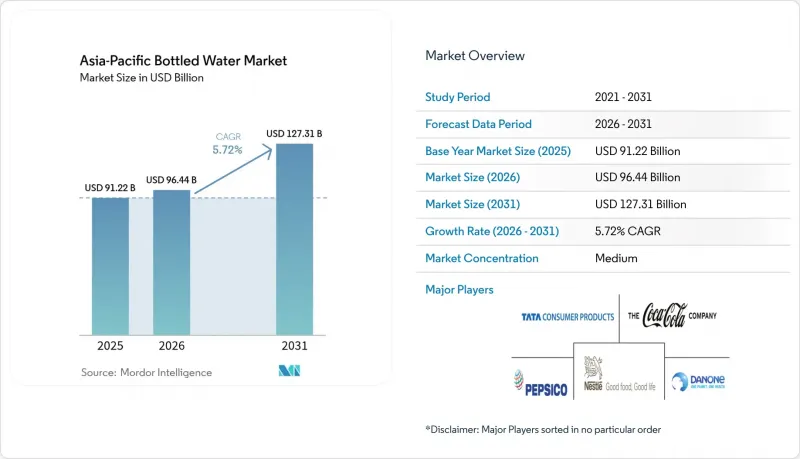
This report is Segmented by Product Type (Still Water, Sparkling Water, Functional Water, Flavored Water, and Others), Packaging Type (PET Bottles, Glass Bottles, Aluminum Cans, and Others), Distribution Channel (On-Trade, and Off-Trade), and Geography. The Market Forecasts are Provided in Terms of Value (USD).
Asia-Pacific Bottled Water Market Trends and Insights
Growing health and wellness awareness
As clinical evidence increasingly underscores the link between hydration and metabolic and renal health, bottled water is transitioning from a simple commodity to a recognized functional beverage. In India and Southeast Asia, public campaigns emphasize the significance of safe drinking water in the fight against waterborne illnesses, leading to a heightened preference for branded water over tap alternatives. Concurrently, Japan's aging population is showing a preference for mineral-rich, low-sodium labels, especially those marketed for cardiovascular advantages. Brands are not just making claims; they're backing them with third-party trials, a strategy that not only boosts their shelf value but also paves the way for profitable institutional contracts. This shift highlights the bottled water market's growing significance in the realm of preventive healthcare. Further bolstering this trend, the Australian Beverages Council reveals that in line with the non-alcoholic beverage industry's voluntary Sugar Reduction Pledge, a significant 222,530 tonnes of sugar were purged from Australian diets. This notable reduction underscores the industry's responsiveness to both consumer health trends and regulatory mandates, further solidifying bottled water's status as a preferred healthy beverage.
Urbanization-led on-the-go hydration demand
As cities in India, Indonesia, Vietnam, and the Philippines expand rapidly, residents find themselves spending more time commuting and seeking convenient drinking options. With municipal networks struggling to keep pace with rising populations, many commuters have turned to grab-and-go formats, particularly PET bottles. In China, instant-retail super-apps are making waves, handling tens of millions of deliveries within the same hour, and bottled water consistently emerges as a top-selling category. Meanwhile, Japan and Singapore are witnessing a proliferation of smart vending units, streamlining the purchasing process. As a result, the bottled water market sees significant volume growth, driven largely by on-the-go consumption. The increasing urbanization in these regions further amplifies the demand for portable drinking solutions. Additionally, advancements in packaging technology are enhancing the convenience and appeal of bottled water products.
Stringent plastic-waste and water-extraction regulations
China's EPR law mandates beverage companies to finance nationwide collection and recycling efforts. This move has led to inflated compliance budgets, putting pressure on smaller operators. In India, updated plastic regulations emphasize stringent inspections, sidelining unorganized players and bolstering the dominance of certified brands. Japan has increased deposit fees on PET bottles and has introduced clearer labeling requirements to facilitate sorting. Meanwhile, Singapore is testing a redemption scheme, aiming for a 70% return rate by 2027. These diverse regulations necessitate capital-intensive circular systems, predominantly benefiting vertically integrated industry leaders. As a result, smaller players in the bottled water market grapple with escalating costs and a shrinking geographic footprint. The global bottled water market is witnessing a shift toward sustainability-driven policies. Governments are increasingly focusing on extended producer responsibility to address environmental concerns.
Other drivers and restraints analyzed in the detailed report include:
- Product and packaging innovation
- Rising disposable incomes and premiumization
- Rapid uptake of in-home water purifiers
For complete list of drivers and restraints, kindly check the Table Of Contents.
Segment Analysis
In 2025, still water dominated the bottled water market, capturing a commanding 45.22% share by volume. Its widespread distribution, operational efficiency, and the unwavering consumer trust in its purity and hydration benefits bolster its profitability. Both multinational and regional producers lean on this segment, using its revenues to fuel research and development, innovate packaging, and forge channel partnerships. Regional players, with their price leadership and deep penetration into rural markets, have ensured that still water remains a staple choice, even as premium alternatives gain traction. The segment's resilience is further supported by its affordability, making it accessible to a broad consumer base. Additionally, the increasing focus on sustainable packaging solutions is expected to enhance its appeal among environmentally conscious consumers.
Sparkling water has emerged as the market's fastest-growing segment, with projections indicating a robust 7.41% CAGR through 2031. This surge is largely attributed to its growing popularity in cafe culture, urban venues, and among health-conscious consumers seeking a refreshing, low-calorie option. The segment's premium positioning is bolstered by carbonation and flavor innovations, allowing for elevated price points and margins. Additionally, the rise of functional and tropical-flavored variants, coupled with strategic collaborations between bottlers and flavor houses, has amplified product differentiation and brand value in various markets. Increasing consumer awareness of hydration with added health benefits has further driven demand for sparkling water. Moreover, marketing campaigns emphasizing its sophistication and lifestyle appeal have contributed to its expanding consumer base.
Complete Report Scope:
- By Product Type
- Still Water
- Sparkling Water
- Functional Water
- Flavoured Water
- By Packaging Type
- PET Bottles
- Glass Bottles
- Aluminium Cans
- Others
- By Distribution Channel
- On-Trade
- Off-Trade
- Supermarkets/Hypermarkets
- Convenience Stores
- Home and Office Delivery
- Online Retail Stores
- Other Off-Trade Channels
- By Country
- China
- India
- Japan
- Australia
- Indonesia
- South Korea
- Thailand
- Singapore
- Rest of Asia-Pacific
List of Companies Covered in this Report:
- Nestle S.A.
- Danone S.A.
- PepsiCo Inc.
- The Coca-Cola Company
- Tata Consumer Products Limited
- Nongfu Spring Co. Ltd
- Suntory Beverage and Food Ltd
- Bisleri International
- Asahi Group Holdings Ltd
- Hangzhou Wahaha Group
- Fiji Water Company LLC
- Voss of Norway AS
- Tibet Water Resources Ltd
- CG Roxane LLC
- Otsuka Pharmaceutical Co. Ltd
- Kirin Holdings Co. Ltd
- Vitasoy International
- Nongshim Co. Ltd
- Primo Water Corporation
- Aava Water
Additional Benefits:
- The market estimate (ME) sheet in Excel format
- 3 months of analyst support
TABLE OF CONTENTS
1 INTRODUCTION
- 1.1 Study Assumptions and Market Definition
- 1.2 Scope of the Study
2 RESEARCH METHODOLOGY
3 EXECUTIVE SUMMARY
4 MARKET LANDSCAPE
- 4.1 Market Overview
- 4.2 Market Drivers
- 4.2.1 Growing health and wellness awareness
- 4.2.2 Urbanisation-led on-the-go hydration demand
- 4.2.3 Product and packaging innovation (flavours, functional, eco)
- 4.2.4 Rising disposable incomes and premiumisation
- 4.2.5 ESG-driven corporate bottled-water procurement programmes
- 4.2.6 IoT-enabled micro-warehouse vending expansion
- 4.3 Market Restraints
- 4.3.1 Stringent plastic-waste and water-extraction regulations
- 4.3.2 Rapid uptake of in-home water purifiers
- 4.3.3 Consumer backlash over micro-plastics contamination reports
- 4.3.4 Intra-Asia freight and logistics cost inflation
- 4.4 Consumer Behavior Analysis
- 4.5 Regulatory Outlook
- 4.6 Technological Outlook
- 4.7 Porter's Five Forces
- 4.7.1 Threat of New Entrants
- 4.7.2 Bargaining Power of Buyers/Consumers
- 4.7.3 Bargaining Power of Suppliers
- 4.7.4 Threat of Substitute Products
- 4.7.5 Intensity of Competitive Rivalry
5 MARKET SIZE AND GROWTH FORECASTS (VALUE AND VOLUME)
- 5.1 By Product Type
- 5.1.1 Still Water
- 5.1.2 Sparkling Water
- 5.1.3 Functional Water
- 5.1.4 Flavoured Water
- 5.2 By Packaging Type
- 5.2.1 PET Bottles
- 5.2.2 Glass Bottles
- 5.2.3 Aluminium Cans
- 5.2.4 Others
- 5.3 By Distribution Channel
- 5.3.1 On-Trade
- 5.3.2 Off-Trade
- 5.3.2.1 Supermarkets/Hypermarkets
- 5.3.2.2 Convenience Stores
- 5.3.2.3 Home and Office Delivery
- 5.3.2.4 Online Retail Stores
- 5.3.2.5 Other Off-Trade Channels
- 5.4 By Country
- 5.4.1 China
- 5.4.2 India
- 5.4.3 Japan
- 5.4.4 Australia
- 5.4.5 Indonesia
- 5.4.6 South Korea
- 5.4.7 Thailand
- 5.4.8 Singapore
- 5.4.9 Rest of Asia-Pacific
6 COMPETITIVE LANDSCAPE
- 6.1 Market Concentration
- 6.2 Strategic Moves
- 6.3 Market Ranking Analysis
- 6.4 Company Profiles (includes Global-level Overview, Market-level Overview, Core Segments, Financials (if available), Strategic Information, Market Rank/Share, Products and Services, Recent Developments)
- 6.4.1 Nestle S.A.
- 6.4.2 Danone S.A.
- 6.4.3 PepsiCo Inc.
- 6.4.4 The Coca-Cola Company
- 6.4.5 Tata Consumer Products Limited
- 6.4.6 Nongfu Spring Co. Ltd
- 6.4.7 Suntory Beverage and Food Ltd
- 6.4.8 Bisleri International
- 6.4.9 Asahi Group Holdings Ltd
- 6.4.10 Hangzhou Wahaha Group
- 6.4.11 Fiji Water Company LLC
- 6.4.12 Voss of Norway AS
- 6.4.13 Tibet Water Resources Ltd
- 6.4.14 CG Roxane LLC
- 6.4.15 Otsuka Pharmaceutical Co. Ltd
- 6.4.16 Kirin Holdings Co. Ltd
- 6.4.17 Vitasoy International
- 6.4.18 Nongshim Co. Ltd
- 6.4.19 Primo Water Corporation
- 6.4.20 Aava Water
7 MARKET OPPORTUNITIES AND FUTURE OUTLOOK

