PUBLISHER: Mordor Intelligence | PRODUCT CODE: 2124601

PUBLISHER: Mordor Intelligence | PRODUCT CODE: 2124601
Gulf Cooperation Council (GCC) Bottled Water - Market Share Analysis, Industry Trends & Statistics, Growth Forecasts (2026 - 2031)
According to Mordor Intelligence, the Gulf Cooperation Council (GCC) bottled water market size is projected to grow from USD 8.92 billion in 2025 to USD 10.48 billion in 2026, reaching USD 18.01 billion by 2031, with a CAGR of 11.44% during 2026-2031.
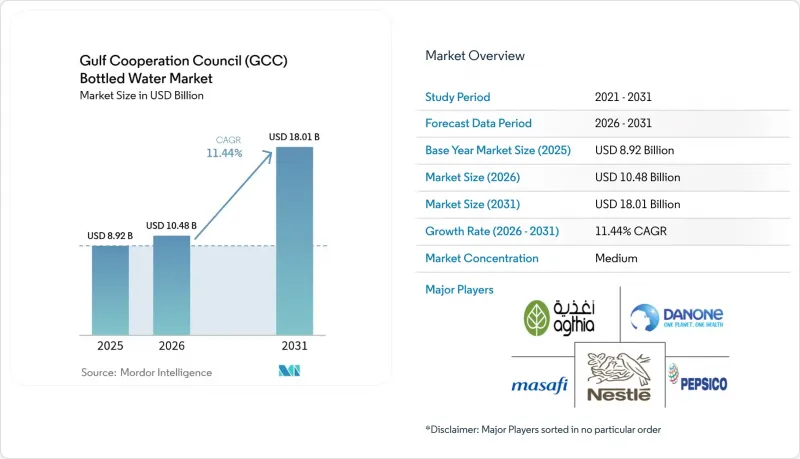
This report is Segmented by Product Type (Still Water, Sparkling Water, and More), Packaging Size (<=330ml, 331-500ml, and More), Packaging Type (PET Bottles, Glass Bottles, and More), Distribution Channels (On-Trade, Off-Trade, and More), and Geography (Saudi Arabia, United Arab Emirates and More). The Market Forecasts are Provided in Terms of Value (USD) and Volume (Liters).
Gulf Cooperation Council (GCC) Bottled Water Market Trends and Insights
Extreme climatic conditions and year-round hydration needs
Ambient temperatures exceeding 45°C for 4-5 months annually across the GCC drive non-discretionary water consumption, making demand resilient to economic downturns. Per-capita bottled water consumption in the UAE and Saudi Arabia consistently ranks among the highest globally. This is influenced by outdoor work restrictions during peak heat hours and cultural preferences for chilled, sealed beverages over tap water. The World Health Organization's 2024 guidelines on hydration in extreme heat recommend a daily intake of 3-4 liters for adults engaged in moderate outdoor activity. This aligns with observed consumption increases during Ramadan and summer months, when iftar gatherings contribute to bulk purchases . While desalination-dependent municipal water supplies meet potability standards under GSO 149:2021, taste and odor concerns often lead consumers to prefer bottled water, particularly in older residential areas where distribution infrastructure predates modern corrosion-resistant piping.
Growth of the tourism industry, coupled with government initiatives
The GCC bottled water market is experiencing steady growth, driven by tourism, pilgrimage activities, and substantial government investments in water infrastructure. The region's hot climate, high tourist arrivals, and expanding hospitality sector are key factors increasing demand for safe, packaged drinking water in hotels, airports, religious sites, entertainment venues, and transport hubs. Tourism in the GCC has demonstrated strong performance. In 2024, Qatar welcomed approximately 5 million visitors and recorded nearly 10 million room nights, with 41% of visitors coming from other GCC countries, highlighting robust intra-regional travel . Similarly, the UAE is experiencing an 11% annual growth in tourism investments, projected to reach USD 20.3 billion by 2027, according to the Ministry of Economy . The expansion of hospitality infrastructure, including hotels, resorts, serviced apartments, and entertainment attractions, is directly contributing to increased bottled water consumption across retail and on-premise channels. In addition to tourism growth, government-led initiatives in water security are enhancing supply stability and reinforcing consumer reliance on packaged drinking water. In March 2025, the GCC established a regional water security task force, supported by USD 58 billion in environmental investments made between November 2024 and March 2025, reflecting strong policy coordination. Furthermore, the Saline Water Conversion Corporation (SWCC), the world's largest producer of desalinated water, achieved daily production exceeding 11.5 million cubic meters in 2024. While desalination strengthens national water resilience, bottled water remains the preferred choice for tourists and mobile populations due to its convenience, perceived safety, and portability.
Plastic-waste legislation raising compliance costs
Abu Dhabi's 2025 Water Quality Regulations introduce extended producer responsibility requirements, obligating bottlers to fund collection and recycling infrastructure. This is expected to increase compliance costs by an estimated USD 0.02-0.04 per unit, which may disproportionately impact smaller regional players that lack economies of scale. Additionally, the GCC Standardization Organization's draft standard on contaminant limits for mineral water, anticipated to be finalized by late 2026, will impose stricter limits on heavy metals such as lead, arsenic, and mercury. This will require bottlers to upgrade their filtration and testing protocols to avoid product recalls and potential reputational harm. Furthermore, Dubai Municipality's 2024 technical guidelines for plastic waste management establish minimum recycled content thresholds, starting at 25% by 2026 and increasing to 50% by 2030. Compliance with these guidelines will necessitate capital investments in rPET sourcing and quality assurance systems, with non-compliance penalties reaching up to AED 500,000 (USD 136,000) per violation.
Other drivers and restraints analyzed in the detailed report include:
- Rising disposable incomes across Saudi Arabia and UAE
- Innovation in packaging and portability
- Market saturation with many local and international brands
For complete list of drivers and restraints, kindly check the Table Of Contents.
Segment Analysis
Still water accounted for 77.14% of the projected 2025 revenue, driven by its role in meeting everyday hydration needs and its popularity for bulk purchasing in homes, offices, and events. However, functional/enhanced water is expected to grow at a compound annual growth rate (CAGR) of 12.59% through 2031, as urban professionals and fitness enthusiasts increasingly seek products offering electrolyte replenishment, vitamin fortification, and alkaline pH levels, which are marketed as performance and wellness enhancers. Sparkling water maintains a niche market share of 5-7%, limited by cultural preferences for non-carbonated beverages and restricted shelf space in convenience stores. Despite these constraints, premium imports such as Perrier and San Pellegrino continue to have a presence in hospitality channels.
Flavored and infused water, featuring natural fruit essences and herbal extracts, is capturing a 3-4% market share by appealing to younger consumers aged 18-30, who often perceive plain water as uninteresting and prefer sensory variety without the calorie content of sugary soft drinks. Brands are increasingly fortifying water with magnesium, zinc, and B vitamins, positioning these products at a 20-40% price premium over standard still water. These variants are primarily targeted at distribution channels such as gyms, yoga studios, and corporate wellness programs.
The 331-500 mL segment accounted for a 40.18% market share in 2025, driven by its single-serve convenience in retail, foodservice, and vending channels. Meanwhile, the 501-1000 mL format is experiencing growth at a CAGR of 11.55%, as consumers prioritize cost efficiency per liter for activities such as gym sessions, office use, and car cup holders, where larger volumes help reduce repurchase frequency. Packaging sizes under 330 mL, such as 250 mL and 200 mL, cater to specific needs like children's lunchboxes and airline services, maintaining a stable market share of 8-10%. The 1001-2000 mL range, including 1.5 L bottles, dominates home consumption with a 22-25% share, preferred for refrigerator storage and family meals.
The 2001-5000 mL segment, comprising 5 L and 6 L jugs, along with formats above 5001 mL, such as 10 L and 18.9 L water cooler bottles, collectively represent 15-18% of the market volume. These larger formats are primarily used in home and office delivery subscriptions, offering 30-40% cost savings compared to single-serve options. Packaging size preferences vary across distribution channels. Convenience stores and petrol stations tend to favor 330-500 mL formats for impulse purchases, while hypermarkets focus on 1.5 L bottles and multipacks for planned shopping trips. Online platforms show higher penetration of bulk formats, such as 5 L and 6 L, as delivery logistics mitigate the challenges of handling heavier products.
Complete Report Scope:
- By Product Type
- Still Water
- Sparkling Water
- Functional / Enhanced Water
- Flavored / Infused Water
- By Packaging Size
- *Less than 330 mL
- *331 mL-500 mL
- *501 mL-1000 mL
- *1001 mL- 2000 mL
- *2001 mL- 5000 mL
- *More than 5001 mL
- By Pakaging Type
- PET Bottles
- Glass Bottles
- Aluminium Cans and Bottles
- Others
- By Distribution Channels
- On-Trade
- Off-Trade
- Supermarkets/Hypermarkets
- Convenience/Grocery Stores
- Online Retail Stores
- Other Distribution Channels
- Home and Office Space
- By Geography
- United Arab Emirates
- Saudi Arabia
- Kuwait
- Qatar
- Bahrain
- Oman
List of Companies Covered in this Report:
- Nestle SA
- Agthia Group PJSC (Al Ain Water)
- Masafi LLC
- PepsiCo Inc. (Aquafina)
- Danone SA
- Mai Dubai LLC
- Hana Food Industries Co. (Hana Water)
- Berain Water
- Nova Water
- Almarai Company
- Crystal Mineral Water and Refreshments LLC
- Al-Qassim Water
- Al Furat Drinking Water LLC
- Al-Rawdatain Water Bottling Co.
- Rayyan Mineral Water Company (Qatar)
- Al Jomaih Water and Beverages
- New Technology Bottling Company KSCC
- The Coca-Cola Company
- Highland Spring Limited
- The Wonderful Company LLC
Additional Benefits:
- The market estimate (ME) sheet in Excel format
- 3 months of analyst support
TABLE OF CONTENTS
1 INTRODUCTION
- 1.1 Study Assumptions and Market Definition
- 1.2 Scope of the Study
2 RESEARCH METHODOLOGY
3 EXECUTIVE SUMMARY
4 MARKET LANDSCAPE
- 4.1 Market Overview
- 4.2 Market Drivers
- 4.2.1 Extreme climatic conditions and year-round hydration needs
- 4.2.2 Growth of the tourism industry, coupled with government initiatives
- 4.2.3 Rising disposable incomes across Saudi Arabia and UAE
- 4.2.4 Innovation in packaging and portability
- 4.2.5 E-commerce and rapid-delivery expansion
- 4.2.6 Marketing and premiumisation strategies by major brands
- 4.3 Market Restraints
- 4.3.1 Plastic-waste legislation raising compliance costs
- 4.3.2 Market saturation with many local and international brands
- 4.3.3 High energy cost of desalination bottling
- 4.3.4 Water scarcity and resource limitations
- 4.4 Consumer Behaviour Analysis
- 4.5 Regulatory Landscape
- 4.6 Technological Outlook
- 4.7 Porter's Five Forces
- 4.7.1 Threat of New Entrants
- 4.7.2 Bargaining Power of Buyers
- 4.7.3 Bargaining Power of Suppliers
- 4.7.4 Threat of Substitutes
- 4.7.5 Competitive Rivalry
5 MARKET SIZE AND GROWTH FORECASTS (VALUE AND VOLUME)
- 5.1 By Product Type
- 5.1.1 Still Water
- 5.1.2 Sparkling Water
- 5.1.3 Functional / Enhanced Water
- 5.1.4 Flavored / Infused Water
- 5.2 By Packaging Size
- 5.2.1 *Less than 330 mL
- 5.2.2 *331 mL-500 mL
- 5.2.3 *501 mL-1000 mL
- 5.2.4 *1001 mL- 2000 mL
- 5.2.5 *2001 mL- 5000 mL
- 5.2.6 *More than 5001 mL
- 5.3 By Pakaging Type
- 5.3.1 PET Bottles
- 5.3.2 Glass Bottles
- 5.3.3 Aluminium Cans and Bottles
- 5.3.4 Others
- 5.4 By Distribution Channels
- 5.4.1 On-Trade
- 5.4.2 Off-Trade
- 5.4.2.1 Supermarkets/Hypermarkets
- 5.4.2.2 Convenience/Grocery Stores
- 5.4.2.3 Online Retail Stores
- 5.4.2.4 Other Distribution Channels
- 5.4.3 Home and Office Space
- 5.5 By Geography
- 5.5.1 United Arab Emirates
- 5.5.2 Saudi Arabia
- 5.5.3 Kuwait
- 5.5.4 Qatar
- 5.5.5 Bahrain
- 5.5.6 Oman
6 COMPETITIVE LANDSCAPE
- 6.1 Market Concentration
- 6.2 Strategic Moves
- 6.3 Market Share Analysis
- 6.4 Company Profiles (includes Global level Overview, Market level overview, Core Segments, Financials as available, Strategic Information, Market Rank/Share for key companies, Products and Services, and Recent Developments)
- 6.4.1 Nestle SA
- 6.4.2 Agthia Group PJSC (Al Ain Water)
- 6.4.3 Masafi LLC
- 6.4.4 PepsiCo Inc. (Aquafina)
- 6.4.5 Danone SA
- 6.4.6 Mai Dubai LLC
- 6.4.7 Hana Food Industries Co. (Hana Water)
- 6.4.8 Berain Water
- 6.4.9 Nova Water
- 6.4.10 Almarai Company
- 6.4.11 Crystal Mineral Water and Refreshments LLC
- 6.4.12 Al-Qassim Water
- 6.4.13 Al Furat Drinking Water LLC
- 6.4.14 Al-Rawdatain Water Bottling Co.
- 6.4.15 Rayyan Mineral Water Company (Qatar)
- 6.4.16 Al Jomaih Water and Beverages
- 6.4.17 New Technology Bottling Company KSCC
- 6.4.18 The Coca-Cola Company
- 6.4.19 Highland Spring Limited
- 6.4.20 The Wonderful Company LLC
7 MARKET OPPORTUNITIES AND FUTURE OUTLOOK

