PUBLISHER: Mordor Intelligence | PRODUCT CODE: 2154845

PUBLISHER: Mordor Intelligence | PRODUCT CODE: 2154845
South America Oral Anti-Diabetic Drugs - Market Share Analysis, Industry Trends & Statistics, Growth Forecasts (2026 - 2031)
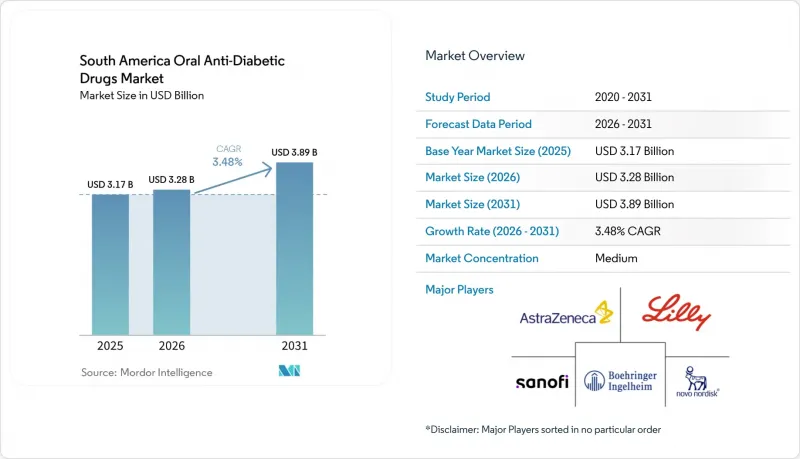
According to Mordor Intelligence, the South America oral Anti-Diabetic drugs market size is expected to grow from USD 3.17 billion in 2025 to USD 3.28 billion in 2026 and is forecast to reach USD 3.89 billion by 2031 at 3.48% CAGR over 2026-2031.
South America Oral Anti-Diabetic Drugs Market Trends and Insights
Expanding Type 2 Diabetes Treatment Pool
The diagnosed Type 2 Diabetes population is expanding across South America, supporting demand for routine oral treatment in public and private care settings. The International Diabetes Federation estimated that 35.4 million adults in South and Central America had diabetes in 2024, and 30.4%, or 10.7 million people, were undiagnosed. Brazil, Peru, Panama, and Bolivia have conducted national diabetes studies during the past 5 years, strengthening the evidence base for screening programs, local patient registries, and earlier treatment referrals. The IDF projects that the regional diabetes population will increase by 46% to 52 million by 2050, confirming that the prospective treatment population extends beyond a short-term diagnosis initiative. Better identification of people already living with diabetes can translate unmet clinical need into prescriptions within the South America oral anti-diabetic drugs market, even before changes in the underlying rate of disease occurrence.
Cardiovascular and Renal Benefits of SGLT2 Inhibitors
SGLT2 inhibitors are being used beyond glycemic control because their cardiovascular and renal roles have expanded across clinical guidelines and specialist practice. A Brazilian study of 203 million people found that public dapagliflozin access, introduced in 2021, was associated with a 19.1% reduction in cardiovascular mortality rates by 2024 relative to the 2017 baseline. The KDIGO 2024 guideline recommended SGLT2 inhibitors as part of chronic kidney disease management, which broadens their relevance in renal care and reinforces their role in patients with comorbid conditions. Cardiology and nephrology providers manage many patients with coexisting Type 2 Diabetes, so this guidance expands the potential prescriber base beyond endocrinology and general diabetes clinics. This wider clinical role supports demand for these therapies in the South America oral anti-diabetic drugs market, particularly in urban specialty care settings in Brazil, Argentina, and Colombia.
High Out-of-Pocket Medication Burden
Affordability remains a constraint for second-line and third-line oral treatments that cost more than metformin, particularly where insurance coverage is incomplete. A Colombian study found that 23% of people with Type 2 Diabetes incurred significant out-of-pocket medicine costs within a disease management program. The same source reported that out-of-pocket payments represented 39.5% of total health expenditure across the region, placing medicine affordability within a wider household healthcare burden. In Argentina, medicines accounted for 80-81% of direct Type 2 Diabetes treatment costs per patient, leaving patients sensitive to price differences when coverage does not meet the full cost. Generic medicines can narrow price gaps, but affordability will continue to affect the adoption of SGLT2 inhibitors and DPP-4 inhibitors in lower-income parts of the South America oral anti-diabetic drugs market.
Other drivers and restraints analyzed in the detailed report include:
- Shift Toward Fixed-Dose Combination Tablets
- Growth of Digital Refills and Online Pharmacy Access
- Substitution by Injectable and Weight-Management Therapies
For complete list of drivers and restraints, kindly check the Table Of Contents.
Segment Analysis
Biguanides held 43.31% of the South America oral anti-diabetic drugs market share in 2025, supported by metformin's presence in public formularies and generic availability. Metformin is provided through SUS, Farmacia Popular, and comparable public subsidy programs in the main country markets. Sulfonylureas and DPP-4 inhibitors serve patients whose treatment progresses beyond metformin monotherapy. Sitagliptin, vildagliptin, and linagliptin have a growing generic presence after patent expirations. Fixed-dose combinations also support treatment escalation when prescribers move beyond monotherapy. The format reduces separate dispensing while retaining the established medicine classes used in a patient's regimen.
SGLT2 inhibitors are forecast to grow at a 6.58% CAGR from 2026 to 2031, compared with the overall 3.48% CAGR for the South America oral anti-diabetic drugs market size. Dapagliflozin and empagliflozin have relevance in cardiology and nephrology because their use extends beyond diabetes specialty care. Alpha-glucosidase inhibitors, dopamine D2 receptor agonists, and meglitinides retain smaller specialist-led roles. Oral GLP-1 receptor agonists, primarily Rybelsus, remain concentrated in premium private channels because public reimbursement is limited.
Type 2 Diabetes represented 89.24% of revenue in 2025 and is forecast to expand at a 4.22% CAGR through 2031. The size of this patient group reflects a regional diabetes burden of 35 million adults in 2024. Treatment initiation rates can rise as screening and patient registration improve. Later treatment stages can also add SGLT2 inhibitors and combination tablets to initial metformin therapy.
Prediabetes and insulin resistance remain areas of unmet need, with 32.2 million people in South and Central America estimated to have impaired fasting glucose in 2024. The Brazilian SBD 2026 dispensing guideline identifies prediabetes management as a priority for public investment. Free metformin access through Farmacia Popular lowers the cost barrier for early intervention. Reimbursement for oral treatment specifically indicated for prediabetes remains limited in most countries. Type 1 Diabetes adjunctive oral therapy remains a small segment within the regional treatment mix. SGLT2 inhibitors are used cautiously as off-label additions to insulin in academic medical centers.
Complete Report Scope:
- By Drug Class
- Biguanides
- Sulfonylureas
- Dipeptidyl Peptidase-4 Inhibitors
- Sodium-Glucose Cotransport-2 Inhibitors
- Alpha-Glucosidase Inhibitors
- Dopamine D2 Receptor Agonists
- Meglitinides
- Oral GLP-1 Receptor Agonists
- Fixed-Dose Combination Oral Therapies
- By Diabetes Type
- Type 2 Diabetes
- Type 1 Diabetes Adjunctive Oral Therapy
- Prediabetes and Insulin Resistance
- By Formulation
- Immediate-Release Tablets
- Extended-Release Tablets
- Film-Coated Tablets
- Other Formulations
- By Distribution Channel
- Retail Pharmacies
- Hospital Pharmacies
- Online Pharmacies
- Other Distribution Channels
- By Country
- Brazil
- Argentina
- Colombia
- Chile
- Peru
- Rest of South America
List of Companies Covered in this Report:
- AstraZeneca
- Biomm S.A.
- Boehringer Ingelheim
- Eli Lilly and Company
- EMS S.A.
- Eurofarma Laboratorios S.A.
- Grupo Farmaceutico Somar
- Hypera S.A.
- Johnson & Johnson
- Laboratorios Bago S.A.
- Laboratorios Roemmers S.A.
- Merck
- Novartis
- Novo Nordisk
- Pfizer
- Sanofi
- Takeda Pharmaceuticals
Additional Benefits:
- The market estimate (ME) sheet in Excel format
- 3 months of analyst support
TABLE OF CONTENTS
1 Introduction
- 1.1 Study Assumptions and Market Definition
- 1.2 Scope of the Study
2 Research Methodology
3 Executive Summary
4 Market Landscape
- 4.1 Market Overview
- 4.2 Market Drivers
- 4.2.1 Expanding Type 2 Diabetes Treatment Pool
- 4.2.2 Metformin-Led Public-Sector Treatment Access
- 4.2.3 Cardiovascular and Renal Benefits of SGLT2 Inhibitors
- 4.2.4 Shift Toward Fixed-Dose Combination Tablets
- 4.2.5 Growth of Digital Refills and Online Pharmacy Access
- 4.2.6 Local Generic and Technology-Transfer Capacity
- 4.3 Market Restraints
- 4.3.1 High Out-of-Pocket Medication Burden
- 4.3.2 Unequal Rural Diagnosis and Treatment Access
- 4.3.3 Regulatory and Reimbursement Fragmentation
- 4.3.4 Substitution by Injectable and Weight-Management Therapies
- 4.4 Supply-Chain Analysis
- 4.5 Regulatory Landscape
- 4.6 Technological Outlook
- 4.7 Porter's Five Forces Analysis
- 4.7.1 Bargaining Power of Suppliers
- 4.7.2 Bargaining Power of Buyers
- 4.7.3 Threat of New Entrants
- 4.7.4 Threat of Substitutes
- 4.7.5 Competitive Rivalry
5 Market Size & Growth Forecasts (Value, USD)
- 5.1 By Drug Class
- 5.1.1 Biguanides
- 5.1.2 Sulfonylureas
- 5.1.3 Dipeptidyl Peptidase-4 Inhibitors
- 5.1.4 Sodium-Glucose Cotransport-2 Inhibitors
- 5.1.5 Alpha-Glucosidase Inhibitors
- 5.1.6 Dopamine D2 Receptor Agonists
- 5.1.7 Meglitinides
- 5.1.8 Oral GLP-1 Receptor Agonists
- 5.1.9 Fixed-Dose Combination Oral Therapies
- 5.2 By Diabetes Type
- 5.2.1 Type 2 Diabetes
- 5.2.2 Type 1 Diabetes Adjunctive Oral Therapy
- 5.2.3 Prediabetes and Insulin Resistance
- 5.3 By Formulation
- 5.3.1 Immediate-Release Tablets
- 5.3.2 Extended-Release Tablets
- 5.3.3 Film-Coated Tablets
- 5.3.4 Other Formulations
- 5.4 By Distribution Channel
- 5.4.1 Retail Pharmacies
- 5.4.2 Hospital Pharmacies
- 5.4.3 Online Pharmacies
- 5.4.4 Other Distribution Channels
- 5.5 By Country
- 5.5.1 Brazil
- 5.5.2 Argentina
- 5.5.3 Colombia
- 5.5.4 Chile
- 5.5.5 Peru
- 5.5.6 Rest of South America
6 Competitive Landscape
- 6.1 Market Concentration
- 6.2 Market Share Analysis
- 6.3 Company Profiles (includes Global Level Overview, Market Level Overview, Core Segments, Financials as available, Strategic Information, Market Rank/Share, Products and Services, Recent Developments)
- 6.3.1 AstraZeneca PLC
- 6.3.2 Biomm S.A.
- 6.3.3 Boehringer Ingelheim International GmbH
- 6.3.4 Eli Lilly and Company
- 6.3.5 EMS S.A.
- 6.3.6 Eurofarma Laboratorios S.A.
- 6.3.7 Grupo Farmaceutico Somar
- 6.3.8 Hypera S.A.
- 6.3.9 Johnson & Johnson
- 6.3.10 Laboratorios Bago S.A.
- 6.3.11 Laboratorios Roemmers S.A.
- 6.3.12 Merck & Co., Inc.
- 6.3.13 Novartis AG
- 6.3.14 Novo Nordisk A/S
- 6.3.15 Pfizer Inc.
- 6.3.16 Sanofi S.A.
- 6.3.17 Takeda Pharmaceutical Company Limited
7 Market Opportunities and Future Outlook
- 7.1 White-Space and Unmet-Need Assessment

