PUBLISHER: Mordor Intelligence | PRODUCT CODE: 2119830

PUBLISHER: Mordor Intelligence | PRODUCT CODE: 2119830
Semaglutide - Market Share Analysis, Industry Trends & Statistics, Growth Forecasts (2026 - 2031)
According to Mordor Intelligence, the semaglutide market size was valued at USD 27.84 billion in 2025 and is estimated to grow from USD 31.97 billion in 2026 to reach USD 58.72 billion by 2031, at a CAGR of 12.93% during the forecast period (2026-2031).
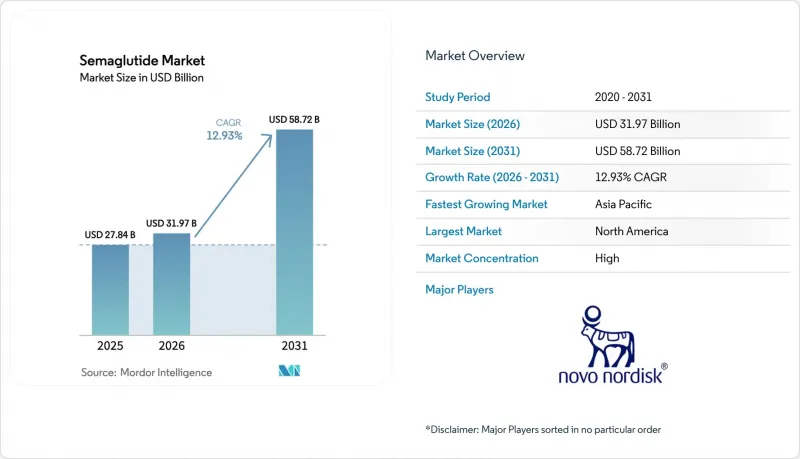
This report is Segmented by Brand (Wegovy, Ozempic, Rybelsus), Formulation (Injectable, Oral), Indication (Type-2 Diabetes, Chronic Weight Management, and More), Distribution Channel (Hospital Pharmacies, Retail Pharmacies, Online Pharmacies), and Geography (North America, Europe, Asia-Pacific, Middle East & Africa, South America). The Market Forecasts are Provided in Terms of Value (USD).
Global Semaglutide Market Trends and Insights
Rising Prevalence of Obesity & Type-2 Diabetes
Global obesity surpassed 1 billion adults in 2024, while 537 million people lived with diabetes, creating fundamental demand for therapies that address both conditions. Middle Eastern ministries included GLP-1 agonists on essential medicines lists in 2025, signaling a policy-level acceleration of demand. Asia-Pacific health agencies report earlier onset of diabetes, with China noting that 35% of new diagnoses now occur in adults under 45 years. Working-age populations favor once-weekly injections over daily pills, reinforcing uptake. The interplay between rising disease burden and patient convenience is thus central to the expansion of the semaglutide market.
Superior Weight-Loss Efficacy Versus Other GLP-1 RAs
Wegovy achieved a 15.8% mean weight loss in the STEP 1 trial, whereas tirzepatide posted a 22.5% mean weight loss, prompting U.S. payers to tier formularies by patient profile. European cost-effectiveness bodies updated modeling frameworks in 2025 to credit cardiovascular benefit, tilting decisions toward semaglutide for secondary prevention. Novo Nordisk is currently testing 25 mg and 50 mg oral doses to close the efficacy gap without injections, with Phase III readouts expected in late 2026.
High Therapy Cost & Limited Reimbursement
Semaglutide ranked among the costliest chronic therapies in obesity care, at USD 1,300 per month in 2025. Brazil, Mexico, South Africa, and Turkey declined reimbursement, citing budget-impact models showing 5-8% of drug spending would shift to a single product. Even in high-income markets, prior-authorization delays average six weeks, which can dampen initiation. Tiered pricing and patient-assistance programs have yet to impact uptake in price-sensitive geographies significantly.
Other drivers and restraints analyzed in the detailed report include:
- Expanded Regulatory Approvals for CVD Risk Reduction
- Growing Adoption of Self-Injectable Pens & Oral Tablets
- Supply Shortages of Pen-Fill & Cartridge Capacity
For complete list of drivers and restraints, kindly check the Table Of Contents.
Segment Analysis
Ozempic held a 65.31% brand share in 2025, underpinned by its 2017 launch and subsequent inclusion in cardiometabolic guidelines following the SUSTAIN-6 study, which showed a 26% reduction in cardiovascular events. Wegovy is advancing at a 15.13% CAGR through 2031 as expanded labels unlock broader payer coverage. The semaglutide market size for cardiovascular risk reduction is therefore scaling rapidly, enabling Novo Nordisk to segment indications and optimize lifecycle revenue. Rybelsus, the oral variant, serves injection-averse patients and is positioned to gain share pending higher-dose approvals.
Competitive pressure from tirzepatide is prompting Novo Nordisk to accelerate oral dose escalation and explore combination regimens with amylin analogs. Brand-level negotiations vary by budget silo, with Ozempic reimbursed under diabetes spend and Wegovy under obesity or preventive care, granting the innovator flexibility to shift promotional focus. This multi-brand strategy stabilizes revenue even as individual formularies shift volume between indications.
Injectable pens accounted for 59.73% of 2025 revenue and are forecast to grow at a 16.87% CAGR, as once-weekly dosing sustains 72% 12-month adherence. Oral tablets currently hold the balance; they exploit SNAC technology protected by patents through 2032, temporarily insulating against generic erosion. If ongoing Phase III trials validate the 25 mg and 50 mg doses, the oral segment's semaglutide market share is likely to increase, particularly in primary care channels.
Manufacturing economics differ: oral bioavailability below 1% drives up API usage and cost, whereas injectables concentrate demand on pen-fill capacity. Innovation across delivery devices, including auto-injectors with integrated sharps disposal, is expected to sustain injectable preference despite gains in oral administration. The semaglutide industry is therefore investing on both fronts to meet heterogeneous patient preferences.
Complete Report Scope:
- By Brand
- Wegovy
- Ozempic
- Rybelsus
- By Formulation
- Injectable
- Oral
- By Indication
- Type-2 Diabetes
- Chronic Weight Management
- Cardiovascular Risk Reduction
- Others
- By Distribution Channel
- Hospital Pharmacies
- Retail Pharmacies
- Online Pharmacies
- By Geography
- North America
- United States
- Canada
- Mexico
- Europe
- Germany
- United Kingdom
- France
- Italy
- Spain
- Rest of Europe
- Asia-Pacific
- China
- Japan
- India
- Australia
- South Korea
- Rest of Asia-Pacific
- Middle East & Africa
- GCC
- South Africa
- Rest of Middle East & Africa
- South America
- Brazil
- Argentina
- Rest of South America
- North America
Geography Analysis
North America generated 46.38% of global revenue in 2025, driven by extensive employer coverage and the inclusion of Medicare Part D for diabetes, as well as the growth of cardiovascular indications. U.S. adult obesity prevalence reached 41.9% in 2024, sustaining high demand. Canada added the cardiovascular label in 2024, and provincial formularies followed by mid-2025, expanding patient eligibility. Mexico remains largely private pay due to limited public reimbursement, moderating uptake.
Europe exhibits broad albeit patchy reimbursement. Germany's IQWiG recognized considerable additional benefit for cardiovascular prevention in 2025, enabling premium pricing. The UK's NICE recommended semaglutide for adults with established CVD and BMI >= 27 kg/m2 in March 2025, opening NHS access to more than 1 million patients. France and Italy await real-world evidence before finalizing budgets, while Spain completed formulary inclusion in late 2025. Aging demographics and high cardiovascular burden underpin continued growth.
The Asia-Pacific region posts the strongest growth at a 17.12% CAGR. China approved the obesity indication in late 2024 and targets essential-medicine reimbursement in 2026, amplified by domestic API production scaling. Japan's anticipated mid-2026 cardiovascular approval will unlock national insurance coverage, while South Korea's December 2025 label extension makes it the regional trailblazer. India's market is currently cash-based, yet biosimilar initiatives by Dr. Reddy's and Gland Pharma aim to widen affordability post-2031 patent expiries. Australia reimburses Wegovy under the Pharmaceutical Benefits Scheme but enforces strict prior-authorization criteria.
The Middle East & Africa and South America together hold smaller shares but exhibit double-digit growth. Gulf Cooperation Council states added semaglutide to formularies in 2024-2025, although high list prices restrict access to insured populations. Brazil rejected public reimbursement in 2024, yet private demand persists in major urban centers. Over time, the expansion of middle classes and evolving reimbursement policies are expected to unlock incremental volume.
- Novo Nordisk
Additional Benefits:
- The market estimate (ME) sheet in Excel format
- 3 months of analyst support
TABLE OF CONTENTS
1 Introduction
- 1.1 Study Assumptions & Market Definition
- 1.2 Scope of the Study
2 Research Methodology
3 Executive Summary
4 Market Landscape
- 4.1 Market Overview
- 4.2 Market Drivers
- 4.2.1 Rising Prevalence of Obesity & Type-2 Diabetes
- 4.2.2 Superior Weight-Loss Efficacy Versus Other GLP-1 RAs
- 4.2.3 Expanded Regulatory Approvals for CVD Risk Reduction
- 4.2.4 Growing Adoption of Self-Injectable Pens & Oral Tablets
- 4.2.5 Employer-Sponsored Obesity-Management Programs
- 4.2.6 API Supply-Chain Localization Incentives in Asia
- 4.3 Market Restraints
- 4.3.1 High Therapy Cost & Limited Reimbursement
- 4.3.2 Supply Shortages of Pen-Fill & Cartridge Capacity
- 4.3.3 GI Side-Effects Driving Real-World Discontinuations
- 4.3.4 Regulatory Scrutiny of Off-Label Cosmetic Use
- 4.4 Value / Supply-Chain Analysis
- 4.5 Regulatory Landscape
- 4.6 Technological Outlook
- 4.7 Porter's Five Forces Analysis
- 4.7.1 Threat of New Entrants
- 4.7.2 Bargaining Power of Buyers
- 4.7.3 Bargaining Power of Suppliers
- 4.7.4 Threat of Substitutes
- 4.7.5 Competitive Rivalry
5 Market Size & Growth Forecasts
- 5.1 By Brand
- 5.1.1 Wegovy
- 5.1.2 Ozempic
- 5.1.3 Rybelsus
- 5.2 By Formulation
- 5.2.1 Injectable
- 5.2.2 Oral
- 5.3 By Indication
- 5.3.1 Type-2 Diabetes
- 5.3.2 Chronic Weight Management
- 5.3.3 Cardiovascular Risk Reduction
- 5.3.4 Others
- 5.4 By Distribution Channel
- 5.4.1 Hospital Pharmacies
- 5.4.2 Retail Pharmacies
- 5.4.3 Online Pharmacies
- 5.5 By Geography
- 5.5.1 North America
- 5.5.1.1 United States
- 5.5.1.2 Canada
- 5.5.1.3 Mexico
- 5.5.2 Europe
- 5.5.2.1 Germany
- 5.5.2.2 United Kingdom
- 5.5.2.3 France
- 5.5.2.4 Italy
- 5.5.2.5 Spain
- 5.5.2.6 Rest of Europe
- 5.5.3 Asia-Pacific
- 5.5.3.1 China
- 5.5.3.2 Japan
- 5.5.3.3 India
- 5.5.3.4 Australia
- 5.5.3.5 South Korea
- 5.5.3.6 Rest of Asia-Pacific
- 5.5.4 Middle East & Africa
- 5.5.4.1 GCC
- 5.5.4.2 South Africa
- 5.5.4.3 Rest of Middle East & Africa
- 5.5.5 South America
- 5.5.5.1 Brazil
- 5.5.5.2 Argentina
- 5.5.5.3 Rest of South America
- 5.5.1 North America
6 Competitive Landscape
- 6.1 Market Concentration
- 6.2 Market Share Analysis
- 6.3 Company Profiles (includes Global level Overview, Market-level Overview, Core Segments, Financials, Strategic Information, Market Rank/Share, Products & Services, Recent Developments)
- 6.3.1 Novo Nordisk A/S
7 Market Opportunities & Future Outlook
- 7.1 White-space & Unmet-need Assessment

