PUBLISHER: Mordor Intelligence | PRODUCT CODE: 2155623

PUBLISHER: Mordor Intelligence | PRODUCT CODE: 2155623
Italy Pharmaceutical Logistics - Market Share Analysis, Industry Trends & Statistics, Growth Forecasts (2026 - 2031)
According to Mordor Intelligence, the Italy pharmaceutical logistics market size was valued at USD 8.28 billion in 2025 and is estimated to grow from USD 8.67 billion in 2026 to reach USD 10.79 billion by 2031, at a CAGR of 4.47% during the forecast period (2026-2031).
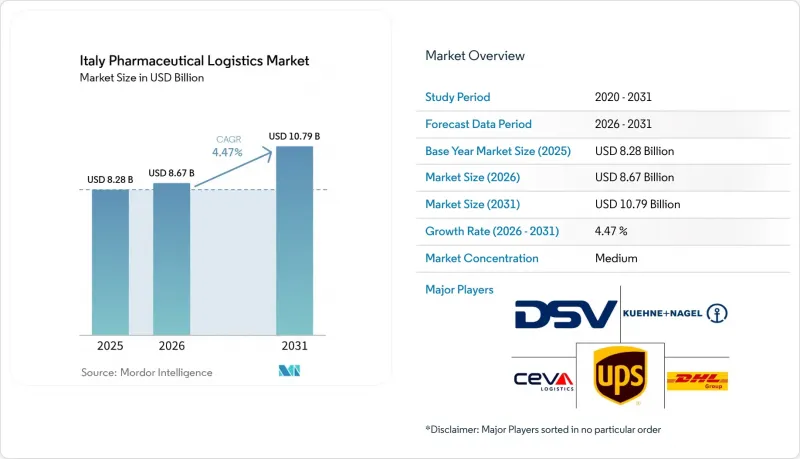
Italy's pharmaceutical production base creates recurring inbound flows of active pharmaceutical ingredients and outbound flows of finished medicines. This report is Segmented by Logistics Function (Transportation, Warehousing & Distribution, and More), by Mode of Operation (Cold-Chain Logistics and Non-Cold-Chain Logistics), by Product Type (Prescription Drugs, OTC Drugs, and More), and by Region (Northern Italy, Central Italy, and Southern Italy (Including the Islands)). The Market Forecasts are Provided in Terms of Value (USD).
Italy Pharmaceutical Logistics Market Trends and Insights
Growth of Biologics, Vaccines, and Advanced Therapies
Italian manufacturing generates a substantial share of the country's need for specialized pharmaceutical logistics. Pharmaceutical facilities in Italy produced EUR 74 billion (USD 87.04 billion) of output in 2025. Biologics and vaccines need validated packaging, continuous temperature monitoring, and complete transport records. These requirements apply from manufacturing release through storage, transport, and delivery. The Italy pharmaceutical logistics market, therefore, benefits from higher service intensity as production shifts toward sensitive therapies. Cell and gene therapies extend this need because each shipment requires strict chain-of-custody controls and carefully planned delivery steps.
Expansion of Temperature-Controlled and Specialty Logistics
Smaller order sizes are changing the operating model for pharmaceutical distribution. Parcels per shipment in the Italian pharmacy channel increased 17% in 2025. More deliveries require more vehicle preparation, packaging checks, temperature records, and route controls. These activities are needed even when the shipment contains a small product volume. This pattern supports demand for temperature-controlled and specialty services in the Italy pharmaceutical logistics market. It also increases the value of automated distribution centers that can process frequent orders with consistent handling standards. DHL Supply Chain Italy opened a robotic system at its Livraga Health Logistics Campus in July 2025, reflecting the focus on warehouse productivity and traceability.
High Cost of Validated Cold-Chain Infrastructure
A GDP-compliant cold-chain site requires more investment than a standard warehouse. Operators need controlled temperature zones, continuous monitoring, backup cooling, calibrated equipment, and documented qualification processes. Italian healthcare logistics operating margins were recorded at 3% in 2025, compared with 6% for the broader Italian logistics sector. This limits the ability of smaller providers to finance new cold-chain capacity from internal resources. Larger integrated providers can invest more readily in controlled assets and digital systems. The resulting gap is most visible outside the main Northern Italian logistics corridor. Cell and gene therapy deliveries to Southern Italy and Sicily also require cryogenic packaging and specialized local courier coordination.
Other drivers and restraints analyzed in the detailed report include:
- Outsourcing to GDP-Compliant Third-Party Logistics Providers
- Regionalization of Clinical-Trial and Direct-to-Patient Networks
- Stringent GDP, GMP, and AIFA Compliance Burden
For complete list of drivers and restraints, kindly check the Table Of Contents.
Segment Analysis
Transportation held 48.29% of the Italy pharmaceutical logistics market share in 2025. The segment's scale reflects the need to move medicines between production sites, wholesale depots, hospitals, pharmacies, and export gateways. Road freight remains the foundation of domestic pharmaceutical distribution because it serves routine multi-stop delivery networks. GDP-certified refrigerated fleets support products that require controlled temperature conditions. Air freight carries smaller volumes but has a higher service value for biologics, clinical trial materials, and advanced therapies. Milan and Rome provide important connections for international pharmaceutical flows. Rail, sea, and inland waterway services have smaller roles, although rail supports selected temperature-controlled intermodal movements in the Northern industrial corridor.
The value-added services and others segment is forecast to expand at a 7.30% CAGR between 2026 and 2031. This category includes secondary packaging, serialization code verification, quality documentation, and cold-chain repackaging. Manufacturers use these services when they redirect internal capacity toward production activities. The Italy pharmaceutical logistics market size for this function is supported by the growing need for compliance-related tasks after manufacturing. Warehousing and distribution also benefit as customers outsource inventory management and controlled storage. GDP-certified hubs in Central and Northern Italy add capacity for ambient and temperature-controlled inventory. Transportation will remain essential for revenue, while service bundles can increase the role of specialist logistics contracts. The pattern favors providers that combine freight operations with documented quality and handling capabilities.
Complete Report Scope:
- By Logistics Function
- Transportation
- Road
- Air
- Sea and Inland Waterways
- Rail
- Warehousing and Distribution
- Value-added Services and Others
- Transportation
- By Mode of Operation
- Cold-Chain Logistics
- Non-Cold-Chain Logistics
- By Product Type
- Prescription Drugs
- OTC Drugs
- Biologics and Biosimilars
- Vaccines and Blood Products
- Clinical Trial Materials
- Cell and Gene Therapies
- Medical Devices and Diagnostics
- Veterinary Medicine
- Others
- By Region
- Northern Italy
- Central Italy
- Southern Italy (incl. the Islands)
List of Companies Covered in this Report:
- DHL Group
- United Parcel Service, Inc.
- Kuehne + Nagel International AG
- CEVA Logistics SA
- DSV A/S
- GXO Logistics, Inc.
- NIPPON EXPRESS HOLDINGS, INC.
- Logista Pharma, S.A.U.
- Alloga AG
- GEODIS SA
- Rhenus SE & Co. KG
- Fercam S.p.A.
- Savino Del Bene S.p.A.
- Arcese Holding S.p.A.
- STEF S.A.
- Expeditors International of Washington, Inc.
- Medlog SA
- Yusen Logistics (Including Movianto)
- PHSE S.r.l.
- H.Essers N.V.
- Biocair International Limited
Additional Benefits:
- The market estimate (ME) sheet in Excel format
- 3 months of analyst support
TABLE OF CONTENTS
1 Introduction
- 1.1 Study Assumptions and Market Definition
- 1.2 Scope of the Study
2 Research Methodology
3 Executive Summary
4 Market Landscape
- 4.1 Market Overview and Role of Logistics in Pharmaceutical
- 4.2 Pharmaceutical Spending Trends
- 4.3 Market Drivers
- 4.3.1 Growth of Biologics, Vaccines and Advanced Therapies
- 4.3.2 Expansion of Temperature-Controlled and Specialty Logistics
- 4.3.3 Pharmaceutical Manufacturing and Export Concentration
- 4.3.4 Outsourcing to GDP-Compliant Third-Party Logistics Providers
- 4.3.5 High-Value, Time-Critical Cell and Gene Therapy Flows
- 4.3.6 Regionalization of Clinical-Trial and Direct-to-Patient Networks
- 4.4 Market Restraints
- 4.4.1 High Cost of Validated Cold-Chain Infrastructure
- 4.4.2 Stringent GDP, GMP and AIFA Compliance Burden
- 4.4.3 Fragmented Regional Healthcare Delivery and Last-Mile Complexity
- 4.4.4 Limited Viability of Low-Volume Ultra-Cold and Cryogenic Routes
- 4.5 Regulatory Framework
- 4.6 Value Chain and Distribution Channel Architecture Analysis
- 4.7 Technology Innovations Outlook
- 4.8 Porter's Five Forces Analysis
- 4.8.1 Threat of New Entrants
- 4.8.2 Bargaining Power of Suppliers
- 4.8.3 Bargaining Power of Buyers
- 4.8.4 Threat of Substitutes
- 4.8.5 Rivalry Among Competitors
- 4.9 Evolution of Pharmaceutical Logistics Requirements
- 4.10 Impact of Geo-Political Events on Supply Chain Shifts
5 Market Size and Growth Forecasts (Value, 2026-2031)
- 5.1 By Logistics Function
- 5.1.1 Transportation
- 5.1.1.1 Road
- 5.1.1.2 Air
- 5.1.1.3 Sea and Inland Waterways
- 5.1.1.4 Rail
- 5.1.2 Warehousing and Distribution
- 5.1.3 Value-added Services and Others
- 5.1.1 Transportation
- 5.2 By Mode of Operation
- 5.2.1 Cold-Chain Logistics
- 5.2.2 Non-Cold-Chain Logistics
- 5.3 By Product Type
- 5.3.1 Prescription Drugs
- 5.3.2 OTC Drugs
- 5.3.3 Biologics and Biosimilars
- 5.3.4 Vaccines and Blood Products
- 5.3.5 Clinical Trial Materials
- 5.3.6 Cell and Gene Therapies
- 5.3.7 Medical Devices and Diagnostics
- 5.3.8 Veterinary Medicine
- 5.3.9 Others
- 5.4 By Region
- 5.4.1 Northern Italy
- 5.4.2 Central Italy
- 5.4.3 Southern Italy (incl. the Islands)
6 Competitive Landscape
- 6.1 Market Concentration
- 6.2 Key Strategic Moves
- 6.3 Market Share Analysis
- 6.4 Company Profiles (includes Global level Overview, Market level overview, Core Segments, Financials as available, Strategic Information, Geographic/Network Coverage, Products and Services, and Recent Developments)
- 6.4.1 DHL Group
- 6.4.2 United Parcel Service, Inc.
- 6.4.3 Kuehne + Nagel International AG
- 6.4.4 CEVA Logistics SA
- 6.4.5 DSV A/S
- 6.4.6 GXO Logistics, Inc.
- 6.4.7 NIPPON EXPRESS HOLDINGS, INC.
- 6.4.8 Logista Pharma, S.A.U.
- 6.4.9 Alloga AG
- 6.4.10 GEODIS SA
- 6.4.11 Rhenus SE & Co. KG
- 6.4.12 Fercam S.p.A.
- 6.4.13 Savino Del Bene S.p.A.
- 6.4.14 Arcese Holding S.p.A.
- 6.4.15 STEF S.A.
- 6.4.16 Expeditors International of Washington, Inc.
- 6.4.17 Medlog SA
- 6.4.18 Yusen Logistics (Including Movianto)
- 6.4.19 PHSE S.r.l.
- 6.4.20 H.Essers N.V.
- 6.4.21 Biocair International Limited
7 Market Opportunities and Future Outlook
- 7.1 White-space and Unmet-Need Assessment

