PUBLISHER: Mordor Intelligence | PRODUCT CODE: 2119725

PUBLISHER: Mordor Intelligence | PRODUCT CODE: 2119725
Vietnam Data Center Server - Market Share Analysis, Industry Trends & Statistics, Growth Forecasts (2026 - 2031)
According to Mordor Intelligence, the Vietnam data center server market size is expected to grow from USD 497 million in 2025 to USD 540.23 million in 2026 and is forecast to reach USD 810.89 million by 2031 at 8.48% CAGR over 2026-2031.
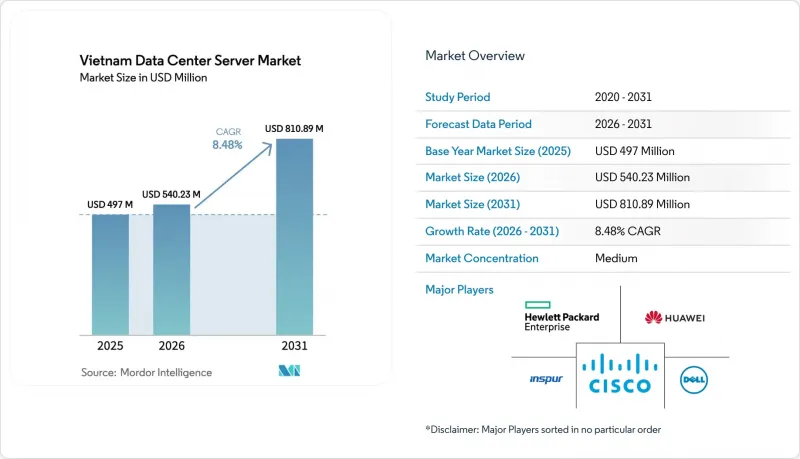
This report Segments the Industry Into Type (Tier 1, Tier 2, and More), Form Factor(Half-Height Blades, Full-Height Blades, and More), End-User Verticals (BFSI, Manufacturing, and More), Data Center Type(Hyperscalers/Cloud Service Provider, and More) and by Application / Workload (Virtualisation and Private Cloud, Storage-Centric and More). The Market Forecasts are Provided in Terms of Value (USD).
Vietnam Data Center Server Market Trends and Insights
Increase in construction of new data centers and internet infrastructure
Vietnam's construction boom is redefining server demand. Viettel's 140 MW Ho Chi Minh City campus is the first domestic site to break the 100 MW threshold, prompting bespoke blade configurations optimized for tropical airflow and renewable-ready power systems. Secondary-city edge sites are multiplying to support 5G backhaul and latency-sensitive workloads. Foreign investors such as Saigon Asset Management have committed USD 1.5 billion for a 150 MW campus in Binh Duong Province, intensifying requirements for local assembly partnerships that shorten delivery cycles.
Increasing adoption of cloud and IoT services
A USD 45 billion digital-economy target for 2025 stimulates enterprise cloud migration. Manufacturing zones in Tan Thuan deploy ruggedized edge servers for predictive-maintenance analytics, while Foxconn's Lighthouse Factory in Bac Giang runs GPU-enabled digital-twin workloads that drive premium server demand. Healthcare digitization adds further momentum as Bach Mai Hospital scales electronic medical records across a nationwide care network.
High initial capex for data-center construction
Even at USD 6.9 million per MW, financing hurdles constrain small-to-mid-size firms. Electrical systems absorb a disproportionate share of budgets, steering buyers to standardized rack-mount servers that maximize watt-per-compute ratios. Asset-management funds are emerging to defray capex, yet procurement teams still favor lifecycle-cost optimization over raw performance.
Other drivers and restraints analyzed in the detailed report include:
- Government data-localization and digital-economy mandates
- China + 1 shift catalyzing server assembly in Vietnam
- Limited grid reliability and rising electricity tariffs
For complete list of drivers and restraints, kindly check the Table Of Contents.
Segment Analysis
Tier 3 facilities held 71.45% share of the Vietnam data center server market in 2025, mirroring enterprise tolerance for cost-balanced redundancy. This tier underpins banking, telecom and public-sector workloads that stipulate 99.982% availability. Operators specify dual-power blades, hot-swappable drives and battery-assisted modules to control Mean-Time-To-Repair. Tier 4 sites, growing 16.08% CAGR, are propelled by hyperscalers building AI clusters that require concurrent maintainability.
Vietnam data center server market size within Tier 4 is projected to expand sharply as GPU-dense racks demand fault-tolerant cooling. Tier 1 and Tier 2 venues remain viable for distributed edge nodes, housing cost-optimized 1U and 2U servers. NTT's 6 MW Ho Chi Minh City 1 facility exemplifies how foreign entrants target Tier 3 specifications for regional cloud tenancy. AI-ready blueprinting accelerates Tier 4 adoption, with facilities provisioning 100 kW per rack for Blackwell-class GPUs.
Half-height blades retained 47.98% share in 2025, delivering a sweet spot of density versus thermal headroom. Enterprises leverage integrated chassis management to streamline firmware updates and power budgeting. Quarter-height and micro-blade platforms rise at 14.87% CAGR, reflecting edge-site constraints where floor space and power feeds are limited.
Vietnam data center server market size for micro-blade deployments benefits from telecom 5G rollouts that embed compute at radio access points. Full-height blades serve HPC clusters in research institutes funded under the Vietnam National University program. Telecommunications players, notably Viettel, standardize micro-blades to minimize heat per RU, aiding operations in 35 °C ambient climates.
Complete Report Scope:
- By Data-Center Tier
- Tier 1 and 2
- Tier 3
- Tier 4
- By Form Factor
- Half-height Blades
- Full-height Blades
- Quarter-height / Micro-blades
- By Application / Workload
- Virtualisation and Private Cloud
- High-Performance Computing (HPC)
- Artificial Intelligence/Machine Learning and Data Analytics
- Storage-centric
- Edge / IoT Gateways
- By Data Center Type
- Hyperscalers/Cloud Service Provider
- Colocation Facilities
- Enterprise and Edge
- By End-use Industry
- BFSI
- IT and Telecom
- Healthcare and Life-Sciences
- Manufacturing and Industry 4.0
- Energy and Utilities
- Government and Defence
List of Companies Covered in this Report:
- Dell Inc.
- Cisco Systems Inc.
- Kingston Technology Company Inc.
- Inspur Group
- Fujitsu Limited
- NEC Corporation
- Oracle Corporation
- Huawei Technologies Co. Ltd.
- International Business Machines (IBM) Corporation
- Hewlett Packard Enterprise
- Super Micro Computer Inc.
- Lenovo Group Ltd.
- xFusion Digital Technologies Co. Ltd.
- Viettel Group (Viettel IDC)
- VNPT Technology (VNPT IDC)
- FPT Telecom (FPT Data Center)
- CMC Telecom
- VNG Corporation
- ST Telemedia Global Data Centres (STT GDC)
- MiTAC Holdings Corp. (TYAN)
Additional Benefits:
- The market estimate (ME) sheet in Excel format
- 3 months of analyst support
TABLE OF CONTENTS
1 INTRODUCTION
- 1.1 Study Assumptions and Market Definition
- 1.2 Scope of the Study
2 RESEARCH METHODOLOGY
3 EXECUTIVE SUMMARY
4 MARKET LANDSCAPE
- 4.1 Market Overview
- 4.2 Market Drivers
- 4.2.1 Increase in construction of new data centers and internet infrastructure
- 4.2.2 Increasing adoption of cloud and IoT services
- 4.2.3 Government data-localization and digital-economy mandates
- 4.2.4 China + 1 shift catalyzing server assembly in Vietnam
- 4.2.5 Tier-2 city tax abatements attracting second-wave data-center builds
- 4.2.6 Emergence of AI/GPU clusters for Vietnamese LLMs
- 4.3 Market Restraints
- 4.3.1 High initial capex for data-center construction
- 4.3.2 Limited grid reliability and rising electricity tariffs
- 4.3.3 Shortage of certified data-center engineers
- 4.3.4 Fragmented local supply chain for advanced components
- 4.4 Value / Supply-Chain Analysis
- 4.5 Regulatory Landscape
- 4.6 Technological Outlook
- 4.7 Porter's Five Forces
- 4.7.1 Threat of New Entrants
- 4.7.2 Bargaining Power of Buyers
- 4.7.3 Bargaining Power of Suppliers
- 4.7.4 Threat of Substitutes
- 4.7.5 Intensity of Competitive Rivalry
- 4.8 Assessment of the Impact on Macro Economic Trends on the Market
5 MARKET SIZE AND GROWTH FORECASTS (VALUES)
- 5.1 By Data-Center Tier
- 5.1.1 Tier 1 and 2
- 5.1.2 Tier 3
- 5.1.3 Tier 4
- 5.2 By Form Factor
- 5.2.1 Half-height Blades
- 5.2.2 Full-height Blades
- 5.2.3 Quarter-height / Micro-blades
- 5.3 By Application / Workload
- 5.3.1 Virtualisation and Private Cloud
- 5.3.2 High-Performance Computing (HPC)
- 5.3.3 Artificial Intelligence/Machine Learning and Data Analytics
- 5.3.4 Storage-centric
- 5.3.5 Edge / IoT Gateways
- 5.4 By Data Center Type
- 5.4.1 Hyperscalers/Cloud Service Provider
- 5.4.2 Colocation Facilities
- 5.4.3 Enterprise and Edge
- 5.5 By End-use Industry
- 5.5.1 BFSI
- 5.5.2 IT and Telecom
- 5.5.3 Healthcare and Life-Sciences
- 5.5.4 Manufacturing and Industry 4.0
- 5.5.5 Energy and Utilities
- 5.5.6 Government and Defence
6 COMPETITIVE LANDSCAPE
- 6.1 Market Concentration
- 6.2 Strategic Moves
- 6.3 Market Share Analysis
- 6.4 Company Profiles (includes Global level Overview, Market level overview, Core Segments, Financials as available, Strategic Information, Market Rank/Share for key companies, Products and Services, and Recent Developments)
- 6.4.1 Dell Inc.
- 6.4.2 Cisco Systems Inc.
- 6.4.3 Kingston Technology Company Inc.
- 6.4.4 Inspur Group
- 6.4.5 Fujitsu Limited
- 6.4.6 NEC Corporation
- 6.4.7 Oracle Corporation
- 6.4.8 Huawei Technologies Co. Ltd.
- 6.4.9 International Business Machines (IBM) Corporation
- 6.4.10 Hewlett Packard Enterprise
- 6.4.11 Super Micro Computer Inc.
- 6.4.12 Lenovo Group Ltd.
- 6.4.13 xFusion Digital Technologies Co. Ltd.
- 6.4.14 Viettel Group (Viettel IDC)
- 6.4.15 VNPT Technology (VNPT IDC)
- 6.4.16 FPT Telecom (FPT Data Center)
- 6.4.17 CMC Telecom
- 6.4.18 VNG Corporation
- 6.4.19 ST Telemedia Global Data Centres (STT GDC)
- 6.4.20 MiTAC Holdings Corp. (TYAN)
7 MARKET OPPORTUNITIES and FUTURE OUTLOOK
- 7.1 White-space and Unmet-Need Assessment

