PUBLISHER: Mordor Intelligence | PRODUCT CODE: 2119805

PUBLISHER: Mordor Intelligence | PRODUCT CODE: 2119805
Indonesia Data Center Storage - Market Share Analysis, Industry Trends & Statistics, Growth Forecasts (2026 - 2031)
According to Mordor Intelligence, Indonesia's data center storage market size in 2026 is estimated at USD 1.02 billion, growing from 2025 value of USD 890 million with 2031 projections showing USD 2.02 billion, growing at 14.62% CAGR over 2026-2031.
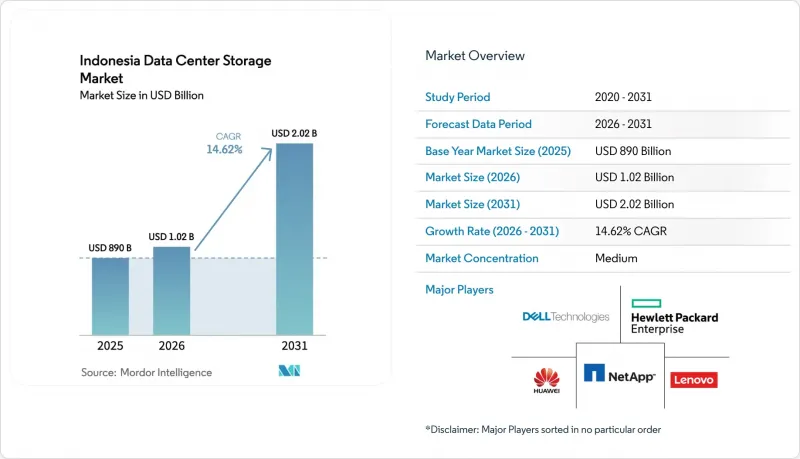
This report is Segmented by Storage Technology (Network-Attached Storage, Storage Area Network, and More), Storage Type (Traditional HDD Arrays and More ), Data Center Type (Colocation Facilities and More), End User (IT and Telecommunication, BFSI and More), Form Factor (Rack-Mounted and More), Interface(sas / SATA, Nvme, Fibre Channel and ISCSI). The Market Forecasts are Provided in Terms of Value (USD).
Indonesia Data Center Storage Market Trends and Insights
Expansion of IT Infrastructure Nationwide
Nationwide backbone roll-outs move capacity from Jakarta toward 514 municipalities, forcing operators to adopt distributed storage topologies that guarantee low-latency services across 17,000 islands. Telkom Indonesia has extended fiber to 10 million homes, stimulating edge-storage nodes for video caching and IoT telemetry. Rising mobile data consumption-up fifty-fold since 2013-magnifies aggregate storage volumes, while municipal "smart-city" projects create dozens of micro demand centers. Vendors, therefore, pivot to federated SAN and object stores capable of autonomous operations in bandwidth-constrained sites. This pattern anchors long-run growth for Indonesia data center storage market solutions that combine self-healing capabilities with lightweight management stacks.
Rising Investments in Hyperscale Facilities
Microsoft's USD 1.7 billion cloud region is setting a new benchmark for AI-ready infrastructure, pairing GPU clusters with NVMe-oF fabrics for sub-100-microsecond latency. Digital Realty's USD 100 million joint venture with Bersama Digital Infrastructure Asia shows how global firms secure local compliance through shared equity structures. Hyperscale clusters in Jakarta and Batam concentrate power, fiber, and neutral colocation, compressing per-terabyte pricing and accelerating refresh cycles toward all-flash arrays. Smaller providers rush to retrofit legacy halls to stay relevant, fuelling a virtuous upgrade loop in the Indonesia data center storage market. These capital flows shorten adoption timelines for next-generation storage protocols and intensify competition on service-level commitments.
High Upfront CAPEX for Modern Storage Arrays
All-flash platforms often exceed USD 500,000 for enterprise-grade sets, a hurdle for cash-constrained Indonesian firms. Semiconductor shortages amplified procurement costs in 2024, extending lead times and delaying refresh cycles. SMEs resort to leasing models or continue with HDD-centric layouts that inflate OPEX and limit performance headroom. Financial institutions, bound by stringent encryption and audit rules, face even higher bills when layering compliance modules onto base hardware. This capital drain postpones the broader penetration of NVMe and software-defined architectures within the Indonesian data center storage market.
Other drivers and restraints analyzed in the detailed report include:
- Accelerated Enterprise Cloud-Adoption Wave
- Government "Making Indonesia 4.0" Digital Push
- Shortage of Advanced Storage-Management Talent
For complete list of drivers and restraints, kindly check the Table Of Contents.
Segment Analysis
The Indonesian data center storage market size attributable to SAN reached USD 232.5 million in 2025, equal to a 26.12% share. High-performance block access keeps SAN entrenched in core banking, billing, and ERP workloads. Yet, NAS is expanding faster at a 14.78% CAGR as provincial branches cache files locally and then mirror to the capital, cutting WAN traffic. Object and tape retain niche but strategic seats: object captures OTT video libraries, whereas tape safeguards air-gapped compliance archives.
NAS growth underscores a structural tilt toward distributed compute. Retail chains deploy dual-controller NAS clusters near point-of-sale systems, sustaining operations during network outages. SAN vendors counter by bundling NVMe-over-Fabrics to shave latency, defending mission-critical shares. As hybrid footprints mature, orchestration tools automatically migrate datasets between SAN, NAS, and object pools, keeping the Indonesian data center storage market aligned with workload profiles and cost envelopes.
HDD arrays retained 43.02% revenue share in 2025, favored for cold data and video retention. Still, flash shipments surged year on year as all-flash arrays answered latency complaints in fintech and ride-hailing apps. Falling cost per gigabyte and power savings strengthen flash ROI, especially when megawatt tariffs track global fuel trends. Hybrid arrays bridge the gap: auto-tiering software dynamically demotes idle blocks to HDD, cutting capacity spend by 30-40%.
Flash also improves rack density, while all-flash arrays are growing at 15.12% through 2031. Distributors report lead times under six weeks for mainstream AFA SKUs, an edge over HDD batches that often queue at Tanjung Priok port. As the NAND roadmap heads to 3D-QLC, the Indonesian data center storage market anticipates parity pricing for read-intensive workloads by 2027, accelerating the rotation out of spinning media
Complete Report Scope:
- By Storage Technology
- Network Attached Storage (NAS)
- Storage Area Network (SAN)
- Direct Attached Storage (DAS)
- Object and Tape Storage
- By Storage Type
- Traditional HDD Arrays
- All-Flash Arrays (AFA)
- Hybrid Storage
- By Data Center Type
- Colocation Facilities
- Hyperscalers/Cloud Service Providers
- Enterprise and Edge
- By End User
- IT and Telecommunication
- BFSI
- Government and Public Sector
- Media and Entertainment
- Healthcare and Life Sciences
- Manufacturing
- By Form Factor
- Rack-mounted
- Blade and Modular
- Disaggregated / Composable
- By Interface
- SAS / SATA
- NVMe
- Fibre Channel and iSCSI
List of Companies Covered in this Report:
- Dell Technologies
- Hewlett Packard Enterprise (HPE)
- Huawei Technologies
- NetApp
- Lenovo
- Fujitsu
- Seagate Technology
- Western Digital
- IBM
- Hitachi Vantara
- Pure Storage
- Kingston Technology
- Inspur
- Synology
- Oracle
- NEC
- QNAP Systems
- Supermicro
- Infortrend
- Micron Technology Inc.
Additional Benefits:
- The market estimate (ME) sheet in Excel format
- 3 months of analyst support
TABLE OF CONTENTS
1 INTRODUCTION
- 1.1 Study Assumptions and Market Definition
- 1.2 Scope of the Study
2 RESEARCH METHODOLOGY
3 EXECUTIVE SUMMARY
4 MARKET LANDSCAPE
- 4.1 Market Overview
- 4.2 Market Drivers
- 4.2.1 Expansion of IT infrastructure nationwide
- 4.2.2 Rising investments in hyperscale facilities
- 4.2.3 Accelerated enterprise cloud-adoption wave
- 4.2.4 Government Making Indonesia 4.0 digital push
- 4.2.5 Uptake of S3-compatible object storage for OTT and CCTV
- 4.2.6 New submarine-cable landings enabling data-localisation
- 4.3 Market Restraints
- 4.3.1 High upfront CAPEX for modern storage arrays
- 4.3.2 Shortage of advanced storage-management talent
- 4.3.3 Grid-power unreliability inflating TCO
- 4.3.4 Seismic and flood risks boosting insurance/design costs
- 4.4 Supply-Chain Analysis
- 4.5 Regulatory Landscape
- 4.6 Technological Outlook
- 4.7 Porter's Five Forces Analysis
- 4.7.1 Threat of New Entrants
- 4.7.2 Bargaining Power of Buyers
- 4.7.3 Bargaining Power of Suppliers
- 4.7.4 Threat of Substitutes
- 4.7.5 Competitive Rivalry
- 4.8 Assessment of Macroeconomic Factors on the Market
5 MARKET SIZE and GROWTH FORECASTS (VALUE)
- 5.1 By Storage Technology
- 5.1.1 Network Attached Storage (NAS)
- 5.1.2 Storage Area Network (SAN)
- 5.1.3 Direct Attached Storage (DAS)
- 5.1.4 Object and Tape Storage
- 5.2 By Storage Type
- 5.2.1 Traditional HDD Arrays
- 5.2.2 All-Flash Arrays (AFA)
- 5.2.3 Hybrid Storage
- 5.3 By Data Center Type
- 5.3.1 Colocation Facilities
- 5.3.2 Hyperscalers/Cloud Service Providers
- 5.3.3 Enterprise and Edge
- 5.4 By End User
- 5.4.1 IT and Telecommunication
- 5.4.2 BFSI
- 5.4.3 Government and Public Sector
- 5.4.4 Media and Entertainment
- 5.4.5 Healthcare and Life Sciences
- 5.4.6 Manufacturing
- 5.5 By Form Factor
- 5.5.1 Rack-mounted
- 5.5.2 Blade and Modular
- 5.5.3 Disaggregated / Composable
- 5.6 By Interface
- 5.6.1 SAS / SATA
- 5.6.2 NVMe
- 5.6.3 Fibre Channel and iSCSI
6 COMPETITIVE LANDSCAPE
- 6.1 Market Concentration
- 6.2 Strategic Moves
- 6.3 Market Share Analysis
- 6.4 Company Profiles {(includes Global level Overview, Market level overview, Core Segments, Financials as available, Strategic Information, Market Rank/Share for key companies, Products and Services, and Recent Developments)}
- 6.4.1 Dell Technologies
- 6.4.2 Hewlett Packard Enterprise (HPE)
- 6.4.3 Huawei Technologies
- 6.4.4 NetApp
- 6.4.5 Lenovo
- 6.4.6 Fujitsu
- 6.4.7 Seagate Technology
- 6.4.8 Western Digital
- 6.4.9 IBM
- 6.4.10 Hitachi Vantara
- 6.4.11 Pure Storage
- 6.4.12 Kingston Technology
- 6.4.13 Inspur
- 6.4.14 Synology
- 6.4.15 Oracle
- 6.4.16 NEC
- 6.4.17 QNAP Systems
- 6.4.18 Supermicro
- 6.4.19 Infortrend
- 6.4.20 Micron Technology Inc.
7 MARKET OPPORTUNITIES and FUTURE OUTLOOK
- 7.1 White-space and Unmet-need Assessment

