PUBLISHER: Mordor Intelligence | PRODUCT CODE: 2119861

PUBLISHER: Mordor Intelligence | PRODUCT CODE: 2119861
Malaysia Data Center Storage - Market Share Analysis, Industry Trends & Statistics, Growth Forecasts (2026 - 2031)
According to Mordor Intelligence, the Malaysia data center storage market size is expected to grow from USD 0.90 billion in 2025 to USD 1.01 billion in 2026 and is forecast to reach USD 1.79 billion by 2031 at 12.18% CAGR over 2026-2031.
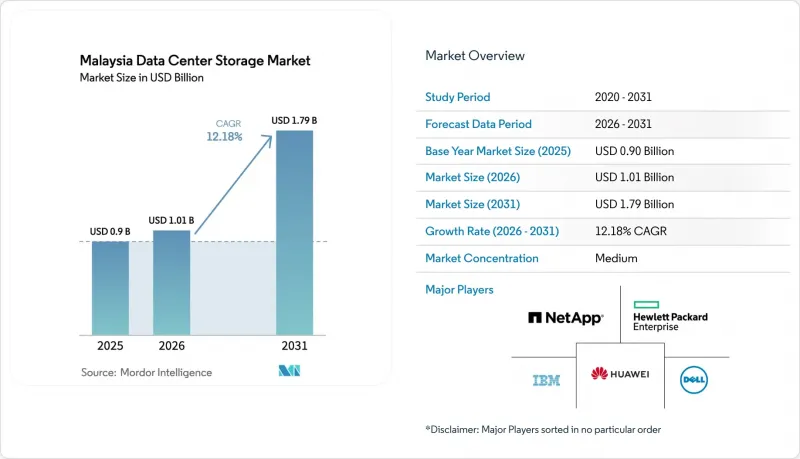
This report Segments the Industry Into Storage Technology (Network Attached Storage (NAS), and More), Storage Type (Traditional Storage, and More), Data Center Type (Colocation Facilities and More), Form Factor(Rack-Mounted and More), Interface(sas / SATA, and More)and End User (IT and Telecommunication, and More). The Market Forecasts are Provided in Terms of Value (USD).
Malaysia Data Center Storage Market Trends and Insights
Rapid Hyperscale and Colocation Build-outs
Johor Bahru doubled operational capacity in 2024 and now exceeds 1.6 GW, attracting Google, Microsoft, Oracle, and NTT to commit more than USD 10 billion to new campuses. Oracle's USD 6.5 billion plan, Princeton Digital Group's 150 MW AI-ready facility, and the Johor-Singapore Special Economic Zone signal an escalating need for petabyte-scale all-flash arrays that can sustain AI training throughput. This influx drives the Malaysia data center storage market toward NVMe architectures that synthesize low latency with high bandwidth, giving vendors with AI-optimized offerings a competitive edge
JENDELA Phase 2 Fiber Backbone Expansion
By early 2024, 81.5% population coverage and nearly 40,000 upgraded transmitters under the RM 21 billion JENDELA program produced gigabit links to 7.5 million premises. The extended backbone empowers SMEs in Penang's semiconductor cluster to adopt distributed storage nodes for latency-sensitive process control. Rural edge nodes in palm-oil plantations leverage JENDELA's reach to stage IoT sensor data locally before replicating to colocation hubs, stretching the Malaysia data center storage market into previously underserved districts.
High Capex for Tier III/IV Infrastructure
Meeting Tier III redundancy elevates initial storage costs by 40-60%, a hurdle for Malaysia's 3,000 Penang-based SMEs that rarely budget RM 500,000 per project. Although the Industry4WRD fund subsidizes upgrades, many firms delay transitions, limiting near-term penetration of advanced all-flash arrays within the Malaysia data center storage market
Other drivers and restraints analyzed in the detailed report include:
- 5G Stand-Alone Core and Private 5G Campuses
- Government Cloud-First and Digital Nasional Initiatives
- Global NAND/HDD Supply-Chain Volatility
For complete list of drivers and restraints, kindly check the Table Of Contents.
Segment Analysis
Storage Area Networks captured 38.05% of Malaysia data center storage market share in 2025, confirming entrenched demand for block-level performance in financial services and smart-factory ERP clusters. High-availability SAN fabrics synchronized across Cyberjaya and Johor underpin regulatory DR mandates. Network Attached Storage, growing at a 15.72% CAGR, appeals to SMEs that prioritize simplified file shares and scalable capacity without FC licensing. The Malaysia data center storage market size for NAS solutions is projected to double by 2030, aligning with expanding creative-content workloads and collaboration suites.
Adoption of software-defined storage overlays amplifies both SAN and NAS flexibility. Dell's PowerScale, already deployed by more than 16,000 GPU users globally, gains traction among AI start-ups seeking petabyte consolidation without forklift migrations. NetApp's distributed cloud fabric with Google Cloud grants CIOs a single namespace across on-prem, Johor hyperscale nodes, and sovereign AI clusters, reinforcing hybrid leadership in the Malaysia data center storage market.
Conventional HDD arrays held 46.55% share of the Malaysia data center storage market in 2025, leveraged for video surveillance archives and low-frequency medical images that tolerate higher latency. Yet all-flash arrays are sprinting at 16.92% CAGR as AI training, real-time payments, and high-frequency analytics dictate sub-millisecond latency. The Malaysia data center storage market size for flash is forecast to surpass USD 782.6 million by 2031, despite macro headwinds.
Hybrid platforms mitigate cost and performance tension: automatic tiering drives hot data onto NVMe SSD pools while cold blocks remain on nearline HDD. Seagate's 40 TB HAMR drives and NVMe HDD prototypes could further compress TCO, delaying full flash substitution but expanding total terabytes shipped within the Malaysia data center storage market.
Complete Report Scope:
- By Storage Technology
- Network Attached Storage (NAS)
- Storage Area Network (SAN)
- Direct Attached Storage (DAS)
- Object and Tape Storage
- By Storage Type
- Traditional HDD Arrays
- All-Flash Arrays (AFA)
- Hybrid Storage
- By Data Center Type
- Colocation Facilities
- Hyperscalers/Cloud Service Providers
- Enterprise and Edge
- By End User
- IT and Telecommunication
- BFSI
- Government and Public Sector
- Media and Entertainment
- Healthcare and Life Sciences
- Manufacturing
- By Form Factor
- Rack-mounted
- Blade and Modular
- Disaggregated / Composable
- By Interface
- SAS / SATA
- NVMe
- Fibre Channel and iSCSI
List of Companies Covered in this Report:
- Dell Technologies Inc.
- Hewlett Packard Enterprise Co.
- NetApp Inc.
- Huawei Technologies Co., Ltd.
- Kingston Technology Co., Inc.
- Lenovo Group Ltd.
- Fujitsu Ltd.
- Oracle Corp.
- Seagate Technology plc
- Western Digital Corp.
- IBM Corp.
- Hitachi Vantara LLC
- Pure Storage Inc.
- NEC Corp.
- Inspur Group Co., Ltd.
- Cisco Systems Inc.
- Super Micro Computer Inc.
- QNAP Systems Inc.
- Synology Inc.
- Acronis International GmbH
Additional Benefits:
- The market estimate (ME) sheet in Excel format
- 3 months of analyst support
TABLE OF CONTENTS
1 INTRODUCTION
- 1.1 Study Assumptions and Market Definition
- 1.2 Scope of the Study
2 RESEARCH METHODOLOGY
3 EXECUTIVE SUMMARY
4 MARKET LANDSCAPE
- 4.1 Market Overview
- 4.2 Market Drivers
- 4.2.1 Rapid hyperscale and colocation build-outs
- 4.2.2 JENDELA Phase 2 fibre backbone expansion
- 4.2.3 Roll-out of 5G SA core and private 5G campuses
- 4.2.4 Government cloud-first and Digital Nasional initiatives
- 4.2.5 Edge--ready palm-oil plantations and smart manufacturing demand (under-reported)
- 4.2.6 Strict data-residency compliance under PDPA amendments (under-reported)
- 4.3 Market Restraints
- 4.3.1 High capex for Tier III/IV storage infrastructure
- 4.3.2 Skilled storage-architect talent shortage
- 4.3.3 Global NAND / HDD supply-chain volatility
- 4.3.4 Ringgit-dollar exchange risk on imported arrays (under-reported)
- 4.4 Value / Supply-Chain Analysis
- 4.5 Regulatory Landscape
- 4.6 Technological Outlook
- 4.7 Porter's Five Forces
- 4.7.1 Threat of New Entrants
- 4.7.2 Bargaining Power of Buyers
- 4.7.3 Bargaining Power of Suppliers
- 4.7.4 Threat of Substitutes
- 4.7.5 Intensity of Competitive Rivalry
- 4.8 Assessment of the impact of Macro Economic Trends on the Market
5 Market Size and Growth Forecasts (Value)
- 5.1 By Storage Technology
- 5.1.1 Network Attached Storage (NAS)
- 5.1.2 Storage Area Network (SAN)
- 5.1.3 Direct Attached Storage (DAS)
- 5.1.4 Object and Tape Storage
- 5.2 By Storage Type
- 5.2.1 Traditional HDD Arrays
- 5.2.2 All-Flash Arrays (AFA)
- 5.2.3 Hybrid Storage
- 5.3 By Data Center Type
- 5.3.1 Colocation Facilities
- 5.3.2 Hyperscalers/Cloud Service Providers
- 5.3.3 Enterprise and Edge
- 5.4 By End User
- 5.4.1 IT and Telecommunication
- 5.4.2 BFSI
- 5.4.3 Government and Public Sector
- 5.4.4 Media and Entertainment
- 5.4.5 Healthcare and Life Sciences
- 5.4.6 Manufacturing
- 5.5 By Form Factor
- 5.5.1 Rack-mounted
- 5.5.2 Blade and Modular
- 5.5.3 Disaggregated / Composable
- 5.6 By Interface
- 5.6.1 SAS / SATA
- 5.6.2 NVMe
- 5.6.3 Fibre Channel and iSCSI
6 COMPETITIVE LANDSCAPE
- 6.1 Market Concentration
- 6.2 Strategic Moves
- 6.3 Market Share Analysis
- 6.4 Company Profiles (includes Global level Overview, Market level overview, Core Segments, Financials as available, Strategic Information, Market Rank/Share for key companies, Products and Services, and Recent Developments)
- 6.4.1 Dell Technologies Inc.
- 6.4.2 Hewlett Packard Enterprise Co.
- 6.4.3 NetApp Inc.
- 6.4.4 Huawei Technologies Co., Ltd.
- 6.4.5 Kingston Technology Co., Inc.
- 6.4.6 Lenovo Group Ltd.
- 6.4.7 Fujitsu Ltd.
- 6.4.8 Oracle Corp.
- 6.4.9 Seagate Technology plc
- 6.4.10 Western Digital Corp.
- 6.4.11 IBM Corp.
- 6.4.12 Hitachi Vantara LLC
- 6.4.13 Pure Storage Inc.
- 6.4.14 NEC Corp.
- 6.4.15 Inspur Group Co., Ltd.
- 6.4.16 Cisco Systems Inc.
- 6.4.17 Super Micro Computer Inc.
- 6.4.18 QNAP Systems Inc.
- 6.4.19 Synology Inc.
- 6.4.20 Acronis International GmbH
7 MARKET OPPORTUNITIES and FUTURE OUTLOOK
- 7.1 White-space and Unmet-Need Assessment

