PUBLISHER: Mordor Intelligence | PRODUCT CODE: 2119808

PUBLISHER: Mordor Intelligence | PRODUCT CODE: 2119808
India Data Center Storage - Market Share Analysis, Industry Trends & Statistics, Growth Forecasts (2026 - 2032)
According to Mordor Intelligence, India data center storage market size in 2026 is estimated at USD 3.51 billion, growing from 2025 value of USD 2.90 billion with 2032 projections showing USD 11.05 billion, growing at 21.12% CAGR over 2026-2032.
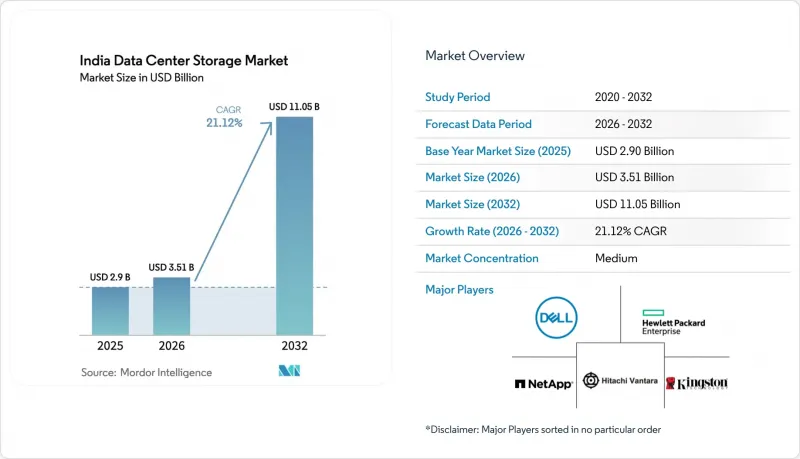
This report is Segmented by Storage Technology (Network Attached Storage, Storage Area Network, and More), Storage Type (Traditional Storage, All-Flash Storage, Hybrid Storage), Data Center Type (Colocation, Hyperscale/Self-built, and More), End-User Industry (IT and Telecommunication, and More). The Market Forecasts are Provided in Terms of Value (USD).
India Data Center Storage Market Trends and Insights
Expansion of IT Infrastructure
Enterprise modernization continues to double national capacity, rising from 1,255 MW to an expected 2,070 MW by end-2025. Data center capex programs tied to the Digital India initiative inject over USD 100 billion through 2027, pulling forward demand for next-generation arrays that underpin hybrid-cloud rollouts. Federal projects such as the National Informatics Centre's USD 600 million Guwahati build add regional nodes that stimulate vendor ecosystems serving northeastern states. Storage architects are retiring direct-attached deployments in favor of software-defined stacks that interoperate across public, private, and edge clouds, reinforcing revenue visibility for the India data center storage market. Secondary hubs such as Nagpur and Raipur gain relevance because land and power pricing widen TCO advantages over saturated metros, further decentralizing opportunities.
Increased Investments in Hyperscale Data Centers
Landmark capital outlays are reshaping the India data center storage market. Reliance Industries' planned USD 30 billion Jamnagar campus targets a record 3 GW IT load and is optimized for AI training clusters that need massively parallel flash arrays. In parallel, the USD 30 billion Project MGX consortium-anchored by Microsoft, BlackRock, and Temasek-selects Mumbai among fourteen Asia sites, underscoring sustained hyperscale momentum.
Google's USD 6 billion Visakhapatnam facility cements the sovereign-cloud narrative, further locking in localized storage demand. Such megaprojects tilt procurement toward NVMe-oF, erasure coding, and advanced tiering that help hyperscalers curb latency and power draw. The ripple effect compels incumbent vendors in the India data center storage market to pivot toward open APIs and consumption-based contracting.
High Initial Investment Cost
Average build costs hover at USD 5.4 million per MW, with storage absorbing 15-20% of budgets, impeding cash-constrained adopters . All-flash arrays, while performance-superior, command higher ASPs than hybrid peers, delaying refresh cycles within small enterprises. Premium colocation rents in Mumbai and Bengaluru compound TCO concerns, making opex-based storage-as-a-service models more enticing. Vendors such as Hitachi Vantara and Dell are scaling pay-per-use offerings that flex in capacity and performance, partially offsetting this restraint within the India data center storage market.
Other drivers and restraints analyzed in the detailed report include:
- Government Data-Localization Mandates
- AI/ML Workload Proliferation Driving High-Performance Arrays
- Import-Dependent Component Price Volatility
For complete list of drivers and restraints, kindly check the Table Of Contents.
Segment Analysis
Storage Area Networks continued to dominate the India data center storage market in 2025 with a 45.40% share, driven by BFSI and telecom platforms that mandate block-level throughput for mission-critical databases. Although capital intensive, SAN fabrics deliver consistent latency and robust zoning required for high-transaction workloads. State Bank of India's YONO expansion underscores SAN relevance by anchoring 64 million mobile users on low-latency Oracle RAC clusters. The India data center storage market size for SAN-based deployments is projected to rise steadily as tier-1 banks consolidate databases. At the same time, Network Attached Storage posts a 18.97% CAGR through 2032, fueled by streaming, design collaboration, and analytics workloads in media production houses around Mumbai and Hyderabad.
Migration from cumbersome file servers to clustered NAS advances data democratization and simplifies scale-out growth. Vendors such as QNAP and NetApp now bundle multiprotocol access, enabling customers to toggle between SAN and NAS modalities within unified arrays. Direct-attached configurations retain niche roles at edge nodes where simplicity trumps scalability, while software-defined storage is carving early footholds among tech startups attracted to commodity hardware economics. Overall, blended protocol strategies are expected to elevate flexibility across the India data center storage market as compliance rules favor architectures providing audit trails and immutable snapshots.
All-flash arrays already captured 38.10% of the India data center storage market share in 2025 and are projected to compound at 17.05% annually, reflecting maturing price-performance economics. Large AI training clusters require petabyte-scale flash pools to minimize GPU idle time, an imperative that conventional HDD tiers cannot satisfy. The India data center storage market size for flash systems is poised to grow as organizations execute latency-critical fintech and OTT workloads.
Traditional spinning media endures within archival tiers, where cost per TB remains decisive. Hybrid arrays marry SSD front-ends with HDD back-ends, offering transitional economics for cautious CIOs. Industry alliances such as Samsung-Acro aim to widen SSD accessibility and localize supply to cushion NAND price swings. As PCIe 5.0 and zoned-namespace SSDs mainstream, unit energy per I/O is set to decline, reinforcing flash momentum within the India data center storage market.
Complete Report Scope:
- By Storage Technology
- Network Attached Storage (NAS)
- Storage Area Network (SAN)
- Direct Attached Storage (DAS)
- Other Technologies
- By Storage Type
- Traditional Storage
- All-Flash Storage
- Hybrid Storage
- By Data Center Type
- Colocation
- Hyperscale / Self-built
- Enterprise / Edge / Modular
- By End-User Industry
- IT and Telecommunication
- BFSI
- Government
- Media and Entertainment
- Other End Users
List of Companies Covered in this Report:
- Dell Inc.
- Hewlett Packard Enterprise
- NetApp Inc.
- Hitachi Vantara LLC
- Kingston Technology Company Inc.
- Pure Storage Inc.
- Lenovo Group Limited
- Fujitsu Limited
- Oracle Corporation
- Seagate Technology LLC
- Cisco Systems Inc.
- IBM Corporation
- Huawei Technologies Co. Ltd.
- Western Digital Corporation
- Micron Technology Inc.
- Super Micro Computer Inc.
- Inspur Group
- Synology Inc.
- QNAP Systems Inc.
- Nimbus Data Inc.
- Zadara Storage Inc.
Additional Benefits:
- The market estimate (ME) sheet in Excel format
- 3 months of analyst support
TABLE OF CONTENTS
1 INTRODUCTION
- 1.1 Study Assumptions and Market Definition
- 1.2 Scope of the Study
2 RESEARCH METHODOLOGY
3 EXECUTIVE SUMMARY
4 MARKET LANDSCAPE
- 4.1 Market Overview
- 4.2 Market Drivers
- 4.2.1 Expansion of IT infrastructure
- 4.2.2 Increased investments in hyperscale data centers
- 4.2.3 Government data-localisation mandates
- 4.2.4 AI/ML workload proliferation driving high-performance arrays
- 4.2.5 Rise of edge data centers in tier-2/3 cities
- 4.2.6 Growth of fintech and digital payments ecosystem
- 4.3 Market Restraints
- 4.3.1 High initial investment cost
- 4.3.2 Unreliable power supply in secondary cities
- 4.3.3 Import-dependent component price volatility
- 4.3.4 Shortage of skilled storage professionals
- 4.4 Value / Supply-Chain Analysis
- 4.5 Regulatory Landscape
- 4.6 Technological Outlook
5 MARKET SIZE and GROWTH FORECASTS
- 5.1 By Storage Technology
- 5.1.1 Network Attached Storage (NAS)
- 5.1.2 Storage Area Network (SAN)
- 5.1.3 Direct Attached Storage (DAS)
- 5.1.4 Other Technologies
- 5.2 By Storage Type
- 5.2.1 Traditional Storage
- 5.2.2 All-Flash Storage
- 5.2.3 Hybrid Storage
- 5.3 By Data Center Type
- 5.3.1 Colocation
- 5.3.2 Hyperscale / Self-built
- 5.3.3 Enterprise / Edge / Modular
- 5.4 By End-User Industry
- 5.4.1 IT and Telecommunication
- 5.4.2 BFSI
- 5.4.3 Government
- 5.4.4 Media and Entertainment
- 5.4.5 Other End Users
6 COMPETITIVE LANDSCAPE
- 6.1 Market Share Analysis
- 6.2 Company Profiles (includes Global level Overview, Market level overview, Core Segments, Financials as available, Strategic Information, Market Rank/Share for key companies, Products and Services, and Recent Developments)
- 6.2.1 Dell Inc.
- 6.2.2 Hewlett Packard Enterprise
- 6.2.3 NetApp Inc.
- 6.2.4 Hitachi Vantara LLC
- 6.2.5 Kingston Technology Company Inc.
- 6.2.6 Pure Storage Inc.
- 6.2.7 Lenovo Group Limited
- 6.2.8 Fujitsu Limited
- 6.2.9 Oracle Corporation
- 6.2.10 Seagate Technology LLC
- 6.2.11 Cisco Systems Inc.
- 6.2.12 IBM Corporation
- 6.2.13 Huawei Technologies Co. Ltd.
- 6.2.14 Western Digital Corporation
- 6.2.15 Micron Technology Inc.
- 6.2.16 Super Micro Computer Inc.
- 6.2.17 Inspur Group
- 6.2.18 Synology Inc.
- 6.2.19 QNAP Systems Inc.
- 6.2.20 Nimbus Data Inc.
- 6.2.21 Zadara Storage Inc.
7 MARKET OPPORTUNITIES and FUTURE OUTLOOK
- 7.1 White-space and Unmet-Need Assessment

