PUBLISHER: Mordor Intelligence | PRODUCT CODE: 2119865

PUBLISHER: Mordor Intelligence | PRODUCT CODE: 2119865
Germany Data Center Storage - Market Share Analysis, Industry Trends & Statistics, Growth Forecasts (2026 - 2031)
According to Mordor Intelligence, Germany data center storage market size in 2026 is estimated at USD 2.17 billion, growing from 2025 value of USD 2.10 billion with 2031 projections showing USD 2.53 billion, growing at 3.18% CAGR over 2026-2031.
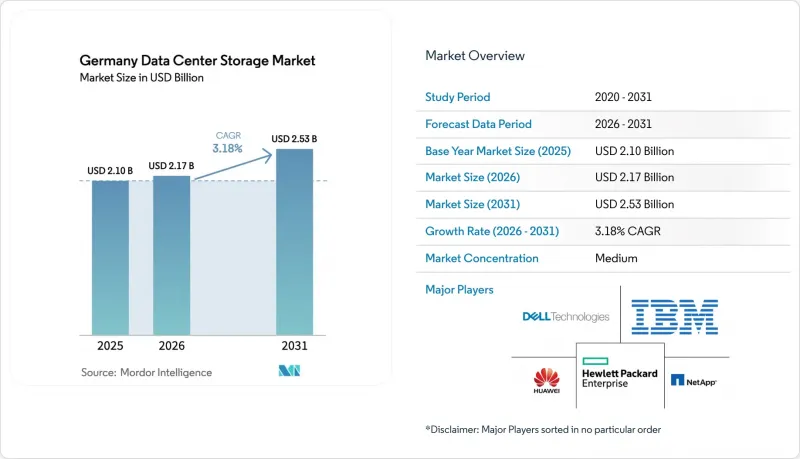
This report is Segmented by Storage Technology (Network-Attached Storage, Storage Area Network, and More), Storage Type (Traditional HDD Arrays and More ), Data Center Type (Colocation Facilities and More), End User (IT and Telecommunication, BFSI and More), Form Factor (Rack-Mounted and More), Interface(sas / SATA, Nvme, Fibre Channel and ISCSI). The Market Forecasts are Provided in Terms of Value (USD).
Germany Data Center Storage Market Trends and Insights
Cloud-Computing Boom Among German Enterprises
German firms are migrating workloads to cloud platforms at a controlled pace that preserves on-premises investments while unlocking elastic compute for analytics. A Fraunhofer IESE survey shows systems-engineering complexity scoring 7.6 today and rising to 8.7 within five years, revealing that legacy stacks can no longer cope with real-time integration demands. Hybrid storage that bridges data center, colocation and Gaia-X compliant sovereign clouds, therefore finds favor, supporting gradual refactoring without breaching residency rules. Frankfurt, Munich and Berlin remain hubs thanks to latency-sensitive BFSI and SaaS workloads. Federal incentives for digitalization, detailed in the 2024 Haushaltsplan, are further lowering adoption barriers through tax breaks on cloud spending.
Shift to Green / Energy-Efficient Data-Centres
Germany's carbon-neutrality target for 2045 has moved PUE and recyclability to the top of procurement scorecards. Operators are adopting liquid and immersion cooling to manage thermals in high-density racks where air cooling hits physical limits. AI-driven orchestration platforms, such as Dell Technologies' Concept Astro, now simulate server and storage loads in a digital twin to modulate fan speeds and CPU states, cutting power draw up to 14% in field tests. Demand is rising for modular enclosures built from recyclable alloys so components can be swapped without energy-intensive refits.
Up-Front Capex & Stringent Data-Sovereignty Audits
Before procuring new arrays, banks and ministries must complete exhaustive privacy impact assessments that can extend project cycles by six months. The Palantir litigation in Hesse shows how platforms face scrutiny for potential mass-surveillance risk, elevating encryption, key custody and audit log features as must-haves. Custom secure configurations push bill-of-materials costs above standard SKUs, dampening short-term volume.
Other drivers and restraints analyzed in the detailed report include:
- Accelerated AI / Gen-AI Workloads Driving Flash Adoption
- Edge-Location Build-Out for Industry 4.0 / 5G
- Volatile Electricity Prices Linked to Energiewende
For complete list of drivers and restraints, kindly check the Table Of Contents.
Segment Analysis
Storage Area Networks provided the robustness that mission-critical SAP HANA and core-banking workloads demanded, holding 26.95% revenue in 2025. Yet NAS systems, helped by software-defined file services, are projected to record 3.58% CAGR. Adoption is strongest among software-as-a-service vendors that value simplified scale-out and REST-API integration. Direct-attached storage retains a role in line-side robotics cells where deterministic latency trumps shared fabric convenience. Object storage paired with tape remains vital for compliance archives, ensuring immutable copies that satisfy BaFin retention rules.
German operators favor iterative refresh cycles. Fraunhofer IESE notes a sector-wide pivot toward model-driven development that reduces bespoke scripting. Consequently, platform teams gravitate to NAS clusters with familiar NFS and SMB semantics, limiting retraining and freeing scarce storage engineers for optimization work.
HDD arrays continued to dominate capacity-oriented tiers, representing 43.05% share in 2025. However, all-flash arrays will expand at 4.12% CAGR as NVMe pricing falls and AI inference gains traction. Hybrid arrays provide a hedge, enabling automatic placement of hot datasets on TLC or QLC NAND and cold files on high-capacity disks, supporting compliance retention yet satisfying performance SLAs. HDD vendors counter with helium-filled 30 TB drives shipping in 2026, delaying full conversion in backup tiers.
Complete Report Scope:
- By Storage Technology
- Network Attached Storage (NAS)
- Storage Area Network (SAN)
- Direct Attached Storage (DAS)
- Object and Tape Storage
- By Storage Type
- Traditional HDD Arrays
- All-Flash Arrays (AFA)
- Hybrid Storage
- By Data Center Type
- Colocation Facilities
- Hyperscalers/Cloud Service Providers
- Enterprise and Edge
- By End User
- IT and Telecommunication
- BFSI
- Government and Public Sector
- Media and Entertainment
- Healthcare and Life Sciences
- Manufacturing
- By Form Factor
- Rack-mounted
- Blade and Modular
- Disaggregated / Composable
- By Interface
- SAS / SATA
- NVMe
- Fibre Channel and iSCSI
List of Companies Covered in this Report:
- Dell Technologies
- Hewlett Packard Enterprise
- NetApp
- IBM
- Huawei Technologies
- Hitachi Vantara
- Lenovo
- Pure Storage
- Fujitsu
- Nutanix
- Oracle
- Commvault
- Cisco Systems
- Western Digital
- Seagate Technology
- VAST Data
- Infinidat
- Qumulo
- NEC
- Samsung Electronics (Flash)
Additional Benefits:
- The market estimate (ME) sheet in Excel format
- 3 months of analyst support
TABLE OF CONTENTS
1 INTRODUCTION
- 1.1 Study Assumptions and Market Definition
- 1.2 Scope of the Study
2 RESEARCH METHODOLOGY
3 EXECUTIVE SUMMARY
4 MARKET LANDSCAPE
- 4.1 Market Overview
- 4.2 Market Drivers
- 4.2.1 Cloud-computing boom among German enterprises
- 4.2.2 Shift to green/energy-efficient data-centres
- 4.2.3 Accelerated AI/Gen-AI workloads driving flash adoption
- 4.2.4 Edge-location build-out for Industry 4.0/5G
- 4.2.5 Germany's surplus-heat re-use subsidies (new 2025 law)
- 4.2.6 Bundesbank-backed sovereign cloud push (Gaia-X)
- 4.3 Market Restraints
- 4.3.1 Up-front capex and stringent data-sovereignty audits
- 4.3.2 Volatile electricity prices linked to Energiewende
- 4.3.3 Lengthy power-grid connection lead times
- 4.3.4 Scarcity of skilled storage engineers
- 4.4 Supply-Chain Analysis
- 4.5 Regulatory Landscape
- 4.6 Technological Outlook
- 4.7 Porter's Five Forces
- 4.7.1 Threat of New Entrants
- 4.7.2 Bargaining Power of Buyers
- 4.7.3 Bargaining Power of Suppliers
- 4.7.4 Threat of Substitutes
- 4.7.5 Competitive Rivalry
- 4.8 Assessment of Macroeconomic Trends on the Market
5 MARKET SIZE AND GROWTH FORECASTS (VALUE)
- 5.1 By Storage Technology
- 5.1.1 Network Attached Storage (NAS)
- 5.1.2 Storage Area Network (SAN)
- 5.1.3 Direct Attached Storage (DAS)
- 5.1.4 Object and Tape Storage
- 5.2 By Storage Type
- 5.2.1 Traditional HDD Arrays
- 5.2.2 All-Flash Arrays (AFA)
- 5.2.3 Hybrid Storage
- 5.3 By Data Center Type
- 5.3.1 Colocation Facilities
- 5.3.2 Hyperscalers/Cloud Service Providers
- 5.3.3 Enterprise and Edge
- 5.4 By End User
- 5.4.1 IT and Telecommunication
- 5.4.2 BFSI
- 5.4.3 Government and Public Sector
- 5.4.4 Media and Entertainment
- 5.4.5 Healthcare and Life Sciences
- 5.4.6 Manufacturing
- 5.5 By Form Factor
- 5.5.1 Rack-mounted
- 5.5.2 Blade and Modular
- 5.5.3 Disaggregated / Composable
- 5.6 By Interface
- 5.6.1 SAS / SATA
- 5.6.2 NVMe
- 5.6.3 Fibre Channel and iSCSI
6 COMPETITIVE LANDSCAPE
- 6.1 Market Concentration
- 6.2 Strategic Moves (MandA, JVs, DC-as-a-Service)
- 6.3 Market Share Analysis
- 6.4 Company Profiles (includes Global level Overview, Market level overview, Core Segments, Financials as available, Strategic Information, Market Rank/Share for key companies, Products and Services, and Recent Developments)
- 6.4.1 Dell Technologies
- 6.4.2 Hewlett Packard Enterprise
- 6.4.3 NetApp
- 6.4.4 IBM
- 6.4.5 Huawei Technologies
- 6.4.6 Hitachi Vantara
- 6.4.7 Lenovo
- 6.4.8 Pure Storage
- 6.4.9 Fujitsu
- 6.4.10 Nutanix
- 6.4.11 Oracle
- 6.4.12 Commvault
- 6.4.13 Cisco Systems
- 6.4.14 Western Digital
- 6.4.15 Seagate Technology
- 6.4.16 VAST Data
- 6.4.17 Infinidat
- 6.4.18 Qumulo
- 6.4.19 NEC
- 6.4.20 Samsung Electronics (Flash)
7 MARKET OPPORTUNITIES AND FUTURE OUTLOOK
- 7.1 White-Space and Unmet-Need Assessment

