PUBLISHER: Mordor Intelligence | PRODUCT CODE: 2119809

PUBLISHER: Mordor Intelligence | PRODUCT CODE: 2119809
Philippines Data Center Storage - Market Share Analysis, Industry Trends & Statistics, Growth Forecasts (2026 - 2031)
According to Mordor Intelligence, the Philippines data center storage market size was valued at USD 0.68 billion in 2025 and estimated to grow from USD 0.75 billion in 2026 to reach USD 1.22 billion by 2031, at a CAGR of 10.18% during the forecast period (2026-2031).
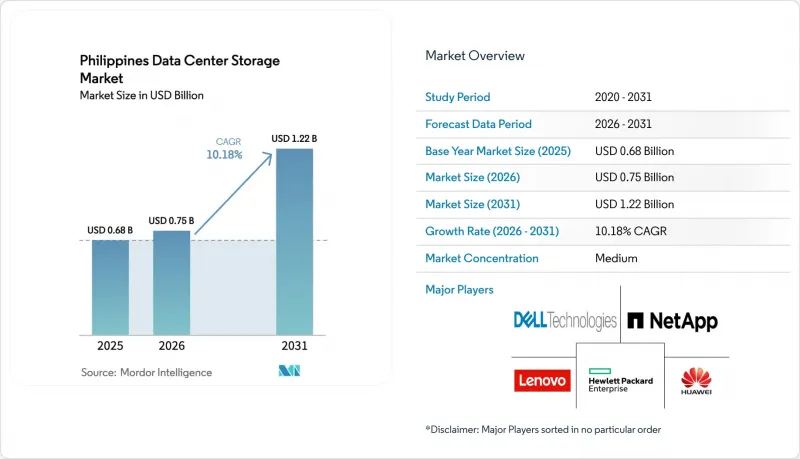
This report is Segmented Into Storage Technology (Network Attached Storage (NAS), Storage Area Network (SAN) and More), Storage Type (Traditional Storage, and More), and End-User (IT & Telecommunication, BFSI, Government, and More). Form Factor (Rack-Mounted and More), Interface (SAS / SATA and More). The Market Sizes and Forecasts are Provided in Terms of Value (USD) for all the Segments.
Philippines Data Center Storage Market Trends and Insights
Expansion of IT infrastructure and digital transformation
The digital economy reached USD 45 billion in 2024, equating to 8.5% of GDP, and could unlock PHP 5 trillion in value by 2030. This national pivot is overhauling storage architectures as enterprises move from siloed arrays to cloud-native platforms that scale elastically. Manila Water's cloud-based water-management rollout illustrates mission-critical adoption, safeguarding service continuity for 27 million residents while minimizing data-loss risk. Government programs such as the Digital Philippines Campaign and the National Broadband Plan mean 85% of firms intend to migrate workloads to cloud by 2026, spurring uptake of hybrid storage that spans on-premises, edge, and hyperscale facilities. The Department of Trade and Industry's Smart Industry Readiness Index across 400+ factories is further prompting demand for edge storage that enables real-time analytics.
Surge in hyperscale and colocation investments
Hyperscalers are allocating USD 4.7 billion to Philippine builds in 2024 alone, as AI racks require more than double traditional power density. Equinix's USD 100 million purchase of three Manila sites adds 1,000 carrier-neutral cabinets, demonstrating foreign confidence. PLDT opened a 50 MW hyperscale facility and is weighing a USD 1 billion REIT listing, while Globe Telecom has broken ground on a 124 MW campus . Narra Technology Park's 300 MW green data-center build in New Clark City will be the country's largest. These projects demand NVMe-based all-flash arrays that deliver low-latency throughput for AI inference workloads.
High capex for enterprise-grade storage
Flash media retains a 5-7X price premium to HDD despite 15% annual declines and a projected 60% QLC price crash between 2022-2025. SMEs struggle to fund redundant arrays, backup appliances, and compliance controls mandated by the Data Privacy Act. Financing gaps are wider outside Metro Manila, where leasing and credit lines are limited. Subscription models are gaining ground-Pure Storage's Evergreen portfolio drove 22% subscription revenue expansion in Q3 FY 2025-offering opex options that soften initial cash outlays.
Other drivers and restraints analyzed in the detailed report include:
- Rapid cloud and hybrid-cloud adoption
- Government CREATE and DICT green-DC incentives
- Shortage of certified storage engineers
For complete list of drivers and restraints, kindly check the Table Of Contents.
Segment Analysis
Storage Area Networks led revenue with 43.75% share in 2025, underscoring their reliability for mission-critical core-banking and telco OSS/BSS workloads. Object and Tape Storage is the fastest riser at 12.02% CAGR, propelled by AI, media streaming, and IoT data that scale better on flat-namespace architectures. Network-attached systems retain footholds among SMEs that favor file-level simplicity, while direct-attached setups cater to HPC clusters in research labs. The Philippines data center storage market size for object storage will expand swiftly as hyperscalers like Google deploy TPU cables delivering 260 Tbps capacity and flooding local nodes with unstructured content Vendors such as Dell have embedded S3-compatible services in PowerStore, aligning block, file, and object protocols inside a single appliance.
Operators increasingly apply AI-infused tiering to shuttle cold datasets into tape libraries or cloud buckets while reserving SAN flash for latency-sensitive analytics. This optimization preserves capital and aligns with BSP retention rules. In turn, the Philippines data center storage market benefits from widening hybrid adoption across BFSI and media enterprises pursuing cost-per-GB discipline without sacrificing performance.
HDD arrays still captured 41.60% revenue in 2025, servicing media archives and backup vaults that value USD/terabyte. Yet all-flash arrays will post a 12.85% CAGR through 2031 as AI inference workloads require microsecond response times. The Philippines data center storage market share of all-flash will thus rise sharply alongside NVMe penetration. Seagate's 30 TB Heat-Assisted Magnetic Recording drives underscore HDD innovation, yet Western Digital's corporate split indicates divergent futures for disk and flash. As flash price curves drop 15% yearly, hybrid arrays offer a compromise, combining SSD tiers with high-capacity spindles to serve transactional databases across telecom and fintech tenants.
Migration to flash accelerates under DICT's cloud-first policy because SaaS and PaaS stacks expect IOPS densities unattainable on legacy HDD SANs. Data-localization rules also keep large datasets on-shore, lifting demand for efficient flash-based deduplication that stretches scarce floor space in Metro Manila. Consequently, the Philippines data center storage market continues to skew toward NVMe and QLC SSD deployments over the forecast horizon.
Complete Report Scope:
- By Storage Technology
- Network Attached Storage (NAS)
- Storage Area Network (SAN)
- Direct Attached Storage (DAS)
- Object and Tape Storage
- By Storage Type
- Traditional HDD Arrays
- All-Flash Arrays (AFA)
- Hybrid Storage
- By Data Center Type
- Colocation Facilities
- Hyperscalers/Cloud Service Providers
- Enterprise and Edge
- By End User
- IT and Telecommunication
- BFSI
- Government and Public Sector
- Media and Entertainment
- Healthcare and Life Sciences
- Manufacturing
- By Form Factor
- Rack-mounted
- Blade and Modular
- Disaggregated / Composable
- By Interface
- SAS / SATA
- NVMe
- Fibre Channel and iSCSI
List of Companies Covered in this Report:
- Dell Inc.
- Huawei Technologies Co., Ltd.
- Hewlett Packard Enterprise Company
- Lenovo Group Limited
- NetApp, Inc.
- Fujitsu Limited
- Oracle Corporation
- Seagate Technology Holdings PLC
- Western Digital Corporation
- Infortrend Technology, Inc.
- Pure Storage, Inc.
- Hitachi Vantara LLC
- IBM Corporation
- Synology Inc.
- Toshiba Electronic Devices and Storage Corp.
- Nutanix, Inc.
- NEC Corporation
- Netgear, Inc.
- Overland-Tandberg Holdings AB
- Kingston Technology Company, Inc.
Additional Benefits:
- The market estimate (ME) sheet in Excel format
- 3 months of analyst support
TABLE OF CONTENTS
1 INTRODUCTION
- 1.1 Study Assumptions and Market Definition
- 1.2 Scope of the Study
2 RESEARCH METHODOLOGY
3 EXECUTIVE SUMMARY
4 MARKET LANDSCAPE
- 4.1 Market Overview
- 4.2 Market Drivers
- 4.2.1 Expansion of IT infrastructure and digital transformation
- 4.2.2 Surge in hyperscale and colocation investments
- 4.2.3 Rapid cloud and hybrid-cloud adoption
- 4.2.4 Government CREATE and DICT green-DC incentives
- 4.2.5 BSP Circular 1122 data-localization mandate
- 4.2.6 AI-driven analytics workload boom (NVMe flash uptake)
- 4.3 Market Restraints
- 4.3.1 High capex for enterprise-grade storage
- 4.3.2 Shortage of certified storage engineers
- 4.3.3 Inter-island fibre and power reliability gaps
- 4.3.4 Peso depreciation inflating imported flash costs
- 4.4 Value / Supply-Chain Analysis
- 4.5 Regulatory Landscape (PH-specific)
- 4.6 Technological Outlook (AI/Edge/NVMe, SDS)
- 4.7 Porters Five Forces
- 4.7.1 Threat of New Entrants
- 4.7.2 Bargaining Power of Buyers
- 4.7.3 Bargaining Power of Suppliers
- 4.7.4 Threat of Substitutes
- 4.7.5 Intensity of Competitive Rivalry
- 4.8 Assessment of Macro Economic Trends on the Market
5 Market Size and Growth Forecasts (Value)
- 5.1 By Storage Technology
- 5.1.1 Network Attached Storage (NAS)
- 5.1.2 Storage Area Network (SAN)
- 5.1.3 Direct Attached Storage (DAS)
- 5.1.4 Object and Tape Storage
- 5.2 By Storage Type
- 5.2.1 Traditional HDD Arrays
- 5.2.2 All-Flash Arrays (AFA)
- 5.2.3 Hybrid Storage
- 5.3 By Data Center Type
- 5.3.1 Colocation Facilities
- 5.3.2 Hyperscalers/Cloud Service Providers
- 5.3.3 Enterprise and Edge
- 5.4 By End User
- 5.4.1 IT and Telecommunication
- 5.4.2 BFSI
- 5.4.3 Government and Public Sector
- 5.4.4 Media and Entertainment
- 5.4.5 Healthcare and Life Sciences
- 5.4.6 Manufacturing
- 5.5 By Form Factor
- 5.5.1 Rack-mounted
- 5.5.2 Blade and Modular
- 5.5.3 Disaggregated / Composable
- 5.6 By Interface
- 5.6.1 SAS / SATA
- 5.6.2 NVMe
- 5.6.3 Fibre Channel and iSCSI
6 COMPETITIVE LANDSCAPE
- 6.1 Market Concentration
- 6.2 Strategic Moves
- 6.3 Market Share Analysis
- 6.4 Company Profiles (includes Global level Overview, Market level overview, Core Segments, Financials as available, Strategic Information, Market Rank/Share for key companies, Products and Services, and Recent Developments)
- 6.4.1 Dell Inc.
- 6.4.2 Huawei Technologies Co., Ltd.
- 6.4.3 Hewlett Packard Enterprise Company
- 6.4.4 Lenovo Group Limited
- 6.4.5 NetApp, Inc.
- 6.4.6 Fujitsu Limited
- 6.4.7 Oracle Corporation
- 6.4.8 Seagate Technology Holdings PLC
- 6.4.9 Western Digital Corporation
- 6.4.10 Infortrend Technology, Inc.
- 6.4.11 Pure Storage, Inc.
- 6.4.12 Hitachi Vantara LLC
- 6.4.13 IBM Corporation
- 6.4.14 Synology Inc.
- 6.4.15 Toshiba Electronic Devices and Storage Corp.
- 6.4.16 Nutanix, Inc.
- 6.4.17 NEC Corporation
- 6.4.18 Netgear, Inc.
- 6.4.19 Overland-Tandberg Holdings AB
- 6.4.20 Kingston Technology Company, Inc.
7 MARKET OPPORTUNITIES and FUTURE OUTLOOK
- 7.1 White-space and Unmet-need Assessment

