PUBLISHER: Mordor Intelligence | PRODUCT CODE: 2119814

PUBLISHER: Mordor Intelligence | PRODUCT CODE: 2119814
Singapore Data Center Storage - Market Share Analysis, Industry Trends & Statistics, Growth Forecasts (2026 - 2031)
According to Mordor Intelligence, Singapore data center storage market size in 2026 is estimated at USD 1.24 billion, growing from 2025 value of USD 1.20 billion with 2031 projections showing USD 1.46 billion, growing at 3.40% CAGR over 2026-2031.
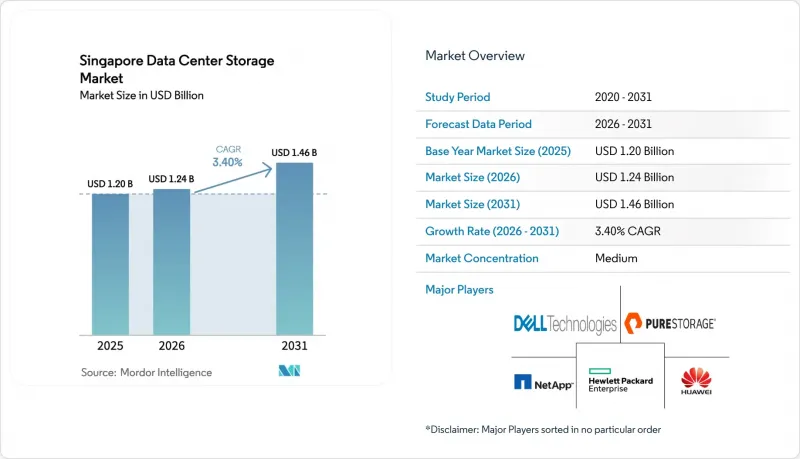
This report is Segmented Into Storage Technology (Network Attached Storage (NAS), Storage Area Network (SAN) and More), Storage Type (Traditional Storage, and More), and End-User (IT & Telecommunication, BFSI, Government, and More). Form Factor (Rack-Mounted and ), Interface (SAS / SATA and More). The Market Sizes and Forecasts are Provided in Terms of Value (USD) for all the Segments.
Singapore Data Center Storage Market Trends and Insights
Government "Green DC" Power-Allocation Drives Flash Storage Adoption
Singapore earmarked 300 MW of new capacity, with 200 MW ring-fenced for operators using renewable energy, nudging buyers toward low-power all-flash arrays that fit within a strict 1.3 PUE threshold. Operators report up to an 85% power reduction versus HDD and significantly smaller rack footprints. A recent ministry refresh trimmed floor area by 94% after deploying Pure Storage systems, underscoring how policy catalyzes technology. The same policy grants early adopters preferential power allocation, creating a competitive edge that accelerates flash demand across the Singapore data center storage market.
AI Workloads Demand NVMe Performance Capabilities
Generative-AI models strain classical storage designs; NVMe's parallel queues eliminate latency bottlenecks vital for high-volume GPU clusters. Kioxia's 122.88 TB enterprise SSD and Micron's 6500 ION series each raise throughput while curbing rack power use. These performance gains shorten AI training cycles, prompting cloud providers to specify NVMe as a standard for new capacity in the Singapore data center storage market.
High Upfront Capex Creates Adoption Barriers
All-flash arrays still cost 2-3x more at purchase than HDD systems, straining budgets for mid-market firms Additional costs arise from power upgrades and cooling retrofits, extending payback periods. Storage-as-a-service models partly offset capex but can introduce sovereignty concerns for regulated workloads, tempering growth in the Singapore data center storage market.
Other drivers and restraints analyzed in the detailed report include:
- Data Sovereignty Rules Reshape Storage Architectures
- Expansion of IT Infrastructure and Cloud On-ramps
- Land and Power Constraints Persist Despite Policy Changes
For complete list of drivers and restraints, kindly check the Table Of Contents.
Segment Analysis
Storage Area Networks captured 46.85% share in 2025, reflecting their position as the performance backbone for financial and telco applications that demand low-latency block storage. NAS, scaling at 5.12% CAGR, is taking on collaborative workloads and edge ingestion use cases where flexible file protocols matter. The Singapore data center storage market continues to blend both technologies in hybrid estates that add object storage tiers for long-term archives. Vendor roadmaps increasingly offer unified management layers, allowing operators to shift datasets between SAN and NAS without downtime.
At the same time, disaggregated memory architectures outlined in US Patent US10917321B2 create an emerging option that separates compute from storage to optimize resource use patents.google.com. Early proofs suggest improved utilization rates that reduce stranded capacity, a compelling benefit as carbon-based cost pressures intensify across the Singapore data center storage market.
Traditional HDD arrays still hold 39.55% share in 2025, yet all-flash arrays rise the fastest at 6.54% CAGR. The switch is driven by tangible performance gains-sub-millisecond latency and higher IOPS-that directly improve AI and analytics workloads. The Singapore data center storage market size, reflecting both falling media costs and rising energy prices that favor flash's lower watt-per-IO profile.
Public-sector projects illustrate flash economics vividly: a ministerial deployment reduced rack space by 94% and cut energy bills in half. Flash density roadmaps that promise 150 TB and 300 TB drives by 2026 will only hasten HDD retirement, though hybrid systems remain in play for tier-2 workloads through the mid-term horizon of the Singapore data center storage market.
Complete Report Scope:
- By Storage Technology
- Network Attached Storage (NAS)
- Storage Area Network (SAN)
- Direct Attached Storage (DAS)
- Object and Tape Storage
- By Storage Type
- Traditional HDD Arrays
- All-Flash Arrays (AFA)
- Hybrid Storage
- By Data Center Type
- Hyperscalers/Cloud Service Provider
- Colocation Facilities
- Enterprise and Edge
- By End User
- IT and Telecommunication
- BFSI
- Government and Public Sector
- Media and Entertainment
- Healthcare and Life Sciences
- Manufacturing
- By Form Factor
- Rack-mounted
- Blade and Modular
- Disaggregated / Composable
- By Interface
- SAS / SATA
- NVMe
- Fibre Channel and iSCSI
List of Companies Covered in this Report:
- Dell Technologies
- Hewlett Packard Enterprise
- NetApp
- Huawei Technologies
- Pure Storage
- Lenovo
- Fujitsu
- Oracle
- Seagate Technology
- Kingston Technology
- IBM
- Hitachi Vantara
- Western Digital
- Micron Technology
- Kioxia Singapore
- Amazon Web Services
- Microsoft Azure
- Inspur
- Supermicro
- Synology
- QNAP Systems
Additional Benefits:
- The market estimate (ME) sheet in Excel format
- 3 months of analyst support
TABLE OF CONTENTS
1 Introduction
- 1.1 Study Assumptions and Market Definition
- 1.2 Scope of the Study
2 Research Methodology
3 Executive Summary
4 Market Landscape
- 4.1 Market Overview
- 4.2 Market Drivers
- 4.2.1 Government Green DC power-allocation (300 MW) unlocks flash-storage capex
- 4.2.2 AI build-outs demand ultra-low-latency NVMe arrays
- 4.2.3 Surge in data-sovereignty rules (PDPA amendments)
- 4.2.4 Expansion of IT infrastructure and cloud on-ramps
- 4.2.5 Hyperscale investment pipeline (Equinix, Digital Realty)
- 4.2.6 Johor-Singapore SEZ enabling modular cross-border storage pods
- 4.3 Market Restraints
- 4.3.1 High upfront capex of enterprise-grade storage
- 4.3.2 Land-and-power scarcity despite moratorium lift
- 4.3.3 SSD controller supply-chain volatility (geo-political)
- 4.3.4 Rising carbon-tax / ESG compliance costs
- 4.4 Value / Supply-Chain Analysis
- 4.5 Regulatory Landscape
- 4.6 Technological Outlook
- 4.7 Porters Five Forces
- 4.7.1 Threat of New Entrants
- 4.7.2 Bargaining Power of Buyers
- 4.7.3 Bargaining Power of Suppliers
- 4.7.4 Threat of Substitutes
- 4.7.5 Intensity of Competitive Rivalry
- 4.8 Assessment of Macro Economic Trends on the Market
5 Market Size and Growth Forecasts (Value)
- 5.1 By Storage Technology
- 5.1.1 Network Attached Storage (NAS)
- 5.1.2 Storage Area Network (SAN)
- 5.1.3 Direct Attached Storage (DAS)
- 5.1.4 Object and Tape Storage
- 5.2 By Storage Type
- 5.2.1 Traditional HDD Arrays
- 5.2.2 All-Flash Arrays (AFA)
- 5.2.3 Hybrid Storage
- 5.3 By Data Center Type
- 5.3.1 Hyperscalers/Cloud Service Provider
- 5.3.2 Colocation Facilities
- 5.3.3 Enterprise and Edge
- 5.4 By End User
- 5.4.1 IT and Telecommunication
- 5.4.2 BFSI
- 5.4.3 Government and Public Sector
- 5.4.4 Media and Entertainment
- 5.4.5 Healthcare and Life Sciences
- 5.4.6 Manufacturing
- 5.5 By Form Factor
- 5.5.1 Rack-mounted
- 5.5.2 Blade and Modular
- 5.5.3 Disaggregated / Composable
- 5.6 By Interface
- 5.6.1 SAS / SATA
- 5.6.2 NVMe
- 5.6.3 Fibre Channel and iSCSI
6 Competitive Landscape
- 6.1 Market Concentration
- 6.2 Strategic Moves
- 6.3 Market Share Analysis
- 6.4 Company Profiles (includes Global-level Overview, Market-level Overview, Core Segments, Financials as available, Strategic Information, Market Rank/Share, Products and Services, Recent Developments)
- 6.4.1 Dell Technologies
- 6.4.2 Hewlett Packard Enterprise
- 6.4.3 NetApp
- 6.4.4 Huawei Technologies
- 6.4.5 Pure Storage
- 6.4.6 Lenovo
- 6.4.7 Fujitsu
- 6.4.8 Oracle
- 6.4.9 Seagate Technology
- 6.4.10 Kingston Technology
- 6.4.11 IBM
- 6.4.12 Hitachi Vantara
- 6.4.13 Western Digital
- 6.4.14 Micron Technology
- 6.4.15 Kioxia Singapore
- 6.4.16 Amazon Web Services
- 6.4.17 Microsoft Azure
- 6.4.18 Inspur
- 6.4.19 Supermicro
- 6.4.20 Synology
- 6.4.21 QNAP Systems
7 Investment Analysis
8 Market Opportunities and Future Outlook
- 8.1 White-space and Unmet-need Assessment

