PUBLISHER: Mordor Intelligence | PRODUCT CODE: 2120262

PUBLISHER: Mordor Intelligence | PRODUCT CODE: 2120262
United Kingdom Renewable Energy - Market Share Analysis, Industry Trends & Statistics, Growth Forecasts (2026 - 2031)
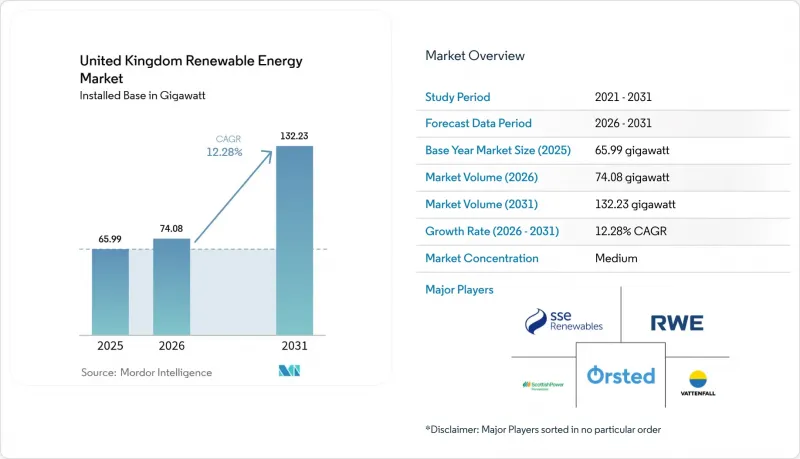
According to Mordor Intelligence, the United Kingdom renewable energy market size is expected to grow from 65.99 gigawatt in 2025 to 74.08 gigawatt in 2026 and is forecast to reach 132.23 gigawatt by 2031 at 12.28% CAGR over 2026-2031.
This report is Segmented by Technology (Solar Energy, Wind Energy, Hydropower, Bioenergy, Geothermal, and Ocean Energy) and End-User (Utility, Commercial and Industrial, and Residential). The Market Sizes and Forecasts are Provided in Terms of Installed Capacity (GW).
United Kingdom Renewable Energy Market Trends and Insights
Offshore-wind CfD strike-price resets accelerating the North Sea pipeline
The government lifted strike prices to GBP 73/MWh for fixed-bottom and GBP 176/MWh for floating projects after the Allocation Round 5 stalemate, unlocking 5.3 GW in Allocation Round 6 and re-energizing the 40 GW development queue. Predictable 6-8 GW annual CfD rounds, coupled with a Clean Industry Bonus worth up to GBP 200 million, de-risk domestic blade factories and port upgrades, further strengthening the UK renewable energy market.
CfD scheme providing revenue certainty
More than 25 GW of operational capacity benefits from 15-year indexed contracts that protect both developers and consumers from spot-price fluctuations. Eligibility now spans tidal stream, floating wind, and green hydrogen, signaling a policy toolbox designed to future-proof the UK renewable energy market.
National Grid queue bottlenecks causing five-year connection delays
The queue ballooned to 739 GW, ten times the 2020 levels, forcing some assets to be assigned to 2035 slots. Ofgem's TMO4+ "first ready, first connected" reform removes speculative placeholders and could free up 500 GW. Yet, construction of the GBP 4.3 billion Eastern Green Link 2 will not be completed until 2029, keeping pressure on the near-term buildout of the UK renewable energy market.
Other drivers and restraints analyzed in the detailed report include:
- Corporate PPAs from UK data-centre and heavy-industry off-takers
- Ofgem RIIO-ED2 grid-upgrade commitments boosting distributed solar
- Reduced Smart-Export-Guarantee tariff hitting rooftop solar ROI
For complete list of drivers and restraints, kindly check the Table Of Contents.
Segment Analysis
Wind remains the anchor of the UK renewable energy market, supplying 50.05% of 2025 output and earning the largest UK renewable energy market share through high-capacity-factor offshore arrays, such as the 3.6 GW Dogger Bank complex. Yet, ocean energy promises a 72.9% CAGR between 2026 and 2031, catapulting tidal-stream pioneers from demonstrators to bankable assets as CfD carve-outs guarantee price floors. Government R&D grants and predictable export-credit financing shrink levelized costs, raising the UK renewable energy market size for marine technologies and attracting supply-chain investment in coastal hubs from Aberdeen to Cornwall. Solar continues its steady expansion through mandatory rooftop rules starting in 2025, while bioenergy transitions toward carbon-negative configurations under new BECCS trials. Hydropower's pumped-storage reservoirs add flexibility that mitigates intermittency, and early-stage geothermal pilots diversify the portfolio without diluting wind's core position in the UK renewable energy market.
Second-generation wave converters and array-scale tidal turbines utilize modular production, reducing both balance-of-plant and installation risks. These learning-curve benefits, when stacked with hydrogen offtake contracts, make ocean assets a compelling hedge within the broader UK renewable energy market size outlook to 2030 and beyond.
Complete Report Scope:
- By Technology
- Solar Energy (PV and CSP)
- Wind Energy (Onshore and Offshore)
- Hydropower (Small, Large, PSH)
- Bioenergy
- Geothermal
- Ocean Energy (Tidal and Wave)
- By End-User
- Utilities
- Commercial and Industrial
- Residential
List of Companies Covered in this Report:
- SSE Renewables
- Orsted A/S
- ScottishPower Renewables (Iberdrola SA)
- RWE Renewables GmbH
- Vattenfall AB
- EDF Energy
- Statkraft AS
- RES Group Ltd.
- Brookfield Renewable Partners
- Greencoat UK Wind PLC
- Bluefield Solar Income Fund
- Octopus Renewables Infrastructure Trust
- NextEnergy Solar Fund
- Equinor ASA
- TotalEnergies SE
- Siemens Gamesa Renewable Energy SA
- Vestas Wind Systems A/S
- GE Vernova
- Lightsource BP
- Drax Group PLC
Additional Benefits:
- The market estimate (ME) sheet in Excel format
- 3 months of analyst support
TABLE OF CONTENTS
1 Introduction
- 1.1 Study Assumptions & Market Definition
- 1.2 Scope of the Study
2 Research Methodology
3 Executive Summary
4 Market Landscape
- 4.1 Market Overview
- 4.2 Market Drivers
- 4.2.1 Offshore-wind CfD Strike-Price Declines Accelerating North-Sea Pipeline
- 4.2.2 Contracts-for-Difference (CfD) Scheme Providing Revenue Certainty
- 4.2.3 Rise of Corporate PPAs from UK Data-Centre & Heavy-Industry Off-takers
- 4.2.4 Ofgem RIIO-ED2 Grid-Upgrade Commitments Boosting Distributed Solar
- 4.2.5 Green-Hydrogen Strategy Linking Electrolyser Build-out to Renewables
- 4.2.6 Cost Drop in Floating Offshore Turbines for Deep-water Scottish Sites
- 4.3 Market Restraints
- 4.3.1 National-Grid Queue Bottlenecks Causing 5-year Connection Delays
- 4.3.2 Reduced Smart-Export-Guarantee Tariff Hitting Rooftop Solar ROI
- 4.3.3 Offshore-Wind Monopile Cost Inflation Post-Brexit Steel Tariffs
- 4.3.4 Visual-Impact Objections Stalling Onshore Wind Permitting
- 4.4 Supply-Chain Analysis
- 4.5 Regulatory Outlook
- 4.6 Technological Outlook
- 4.7 Porter's Five Forces
- 4.7.1 Threat of New Entrants
- 4.7.2 Bargaining Power of Suppliers
- 4.7.3 Bargaining Power of Buyers
- 4.7.4 Threat of Substitutes
- 4.7.5 Industry Rivalry
- 4.8 PESTLE Analysis
5 Market Size & Growth Forecasts
- 5.1 By Technology
- 5.1.1 Solar Energy (PV and CSP)
- 5.1.2 Wind Energy (Onshore and Offshore)
- 5.1.3 Hydropower (Small, Large, PSH)
- 5.1.4 Bioenergy
- 5.1.5 Geothermal
- 5.1.6 Ocean Energy (Tidal and Wave)
- 5.2 By End-User
- 5.2.1 Utilities
- 5.2.2 Commercial and Industrial
- 5.2.3 Residential
6 Competitive Landscape
- 6.1 Market Concentration
- 6.2 Strategic Moves (M&A, JVs, Funding, PPAs)
- 6.3 Market Share Analysis (Market Rank/Share for key companies)
- 6.4 Company Profiles (includes Global-level Overview, Market-level Overview, Core Segments, Financials, Strategic Information, Products & Services, Recent Developments)
- 6.4.1 SSE Renewables
- 6.4.2 Orsted A/S
- 6.4.3 ScottishPower Renewables (Iberdrola SA)
- 6.4.4 RWE Renewables GmbH
- 6.4.5 Vattenfall AB
- 6.4.6 EDF Energy
- 6.4.7 Statkraft AS
- 6.4.8 RES Group Ltd.
- 6.4.9 Brookfield Renewable Partners
- 6.4.10 Greencoat UK Wind PLC
- 6.4.11 Bluefield Solar Income Fund
- 6.4.12 Octopus Renewables Infrastructure Trust
- 6.4.13 NextEnergy Solar Fund
- 6.4.14 Equinor ASA
- 6.4.15 TotalEnergies SE
- 6.4.16 Siemens Gamesa Renewable Energy SA
- 6.4.17 Vestas Wind Systems A/S
- 6.4.18 GE Vernova
- 6.4.19 Lightsource BP
- 6.4.20 Drax Group PLC
7 Market Opportunities & Future Outlook
- 7.1 White-space & Unmet-Need Assessment
- 7.2 10 GW Floating-Wind Pipeline Beyond 2030 Target

