PUBLISHER: Mordor Intelligence | PRODUCT CODE: 2124313

PUBLISHER: Mordor Intelligence | PRODUCT CODE: 2124313
Southeast Asia Renewable Energy - Market Share Analysis, Industry Trends & Statistics, Growth Forecasts (2026 - 2031)
According to Mordor Intelligence, the Southeast Asia renewable energy market size was valued at 125.10 gigawatt in 2025 and estimated to grow from 142.01 gigawatt in 2026 to reach 267.84 gigawatt by 2031, at a CAGR of 13.52% during the forecast period (2026-2031).
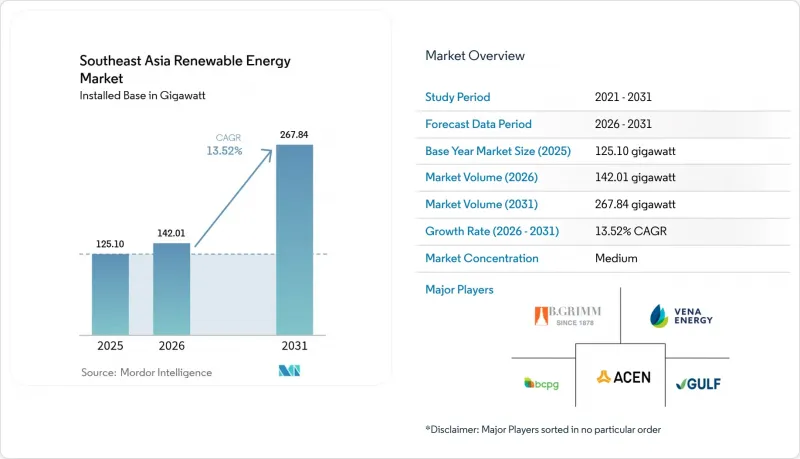
This report is Segmented by Technology (Solar Energy, Wind Energy, Hydropower, Bioenergy, Geothermal, and Ocean Energy), End-User (Utilities, Commercial and Industrial, and Residential), and Geography (Vietnam, Indonesia, Philippines, Thailand, Malaysia, Singapore, and Rest of Southeast Asia). The Market Sizes and Forecasts are Provided in Terms of Installed Capacity (GW).
Southeast Asia Renewable Energy Market Trends and Insights
Green-energy financing booms led by Singapore-based funds
Singapore's Green Bond Framework aims to target SGD 35 billion of sustainable issuance by 2030, catalyzing cross-border capital flows into renewable projects across ASEAN. Sovereign investment vehicles, such as Temasek, partnering with BlackRock's USD 1.4 billion climate fund, are steering private capital toward distributed solar developers, unlocking commercial and industrial (C&I) rooftops that were previously underserved. The Norwegian Climate Investment Fund's USD 55 million equity investment in Indonesia's Xurya demonstrates that foreign investors favor smaller, scalable arrays that match industrial electricity profiles. Local banks follow suit, DBS's RE100 pledge signals that financiers are embedding green-sourcing clauses in corporate loans, creating an ecosystem where renewable procurement becomes a baseline requirement.
Rapid corporate RE100 procurement across export-led industries in Vietnam & Thailand
Vietnam has lifted its 2030 solar target to 73 GW after multinationals relocating from China indicated demand that outstrips earlier forecasts. Thailand mirrors this push: its 5 GW feed-in-tariff round explicitly earmarks industrial zones where auto and electronics producers need verified clean electricity. The Asian Development Bank's USD 820 million loan for 12 Thai solar-plus-storage projects underscores storage moving from pilot to prerequisite for round-the-clock supply. Long-term corporate PPAs, often spanning 15 to 20 years, now price below volatile LNG-indexed tariffs, providing exporters with both cost certainty and compliance with supplier codes of conduct.
Grid congestion & curtailment risks in Vietnam's southern corridor
Vietnam's renewable energy rollout has outpaced its 500 kV backbone, forcing solar farms in Ninh Thuan and Binh Thuan to curtail output as demand lies hundreds of kilometers to the north. The eighth Power Development Plan acknowledges this bottleneck, but timelines for new lines remain vague. Developers are incorporating 5 to 10% curtailment assumptions into their cash flows, which increases the required tariffs or returns. The government has floated direct-wire PPAs to local industry as an interim relief, yet that would shift rather than solve congestion. Until transmission catches up, financiers may favor regions with excess evacuation capacity.
Other drivers and restraints analyzed in the detailed report include:
- Accelerating LNG price volatility improving LCOE competitiveness of solar-plus-storage
- Cross-border power-trade initiatives (Lao-PDR-Thailand-Malaysia-Singapore) scaling regional demand
- Land-banking & right-of-way challenges for utility-scale projects in the Philippines
For complete list of drivers and restraints, kindly check the Table Of Contents.
Segment Analysis
Hydropower accounted for 51.35% of installed capacity in 2025, underpinned by large dams in Laos and Malaysia's Sarawak region that export surplus electricity to neighbors. Solar photovoltaics supplied roughly 35% of Vietnam's energy after its 2019-2020 boom, benefiting from a module oversupply that pushed prices below USD 0.15 per watt. Onshore wind contributed 8-10%, concentrated in Vietnam's central highlands, while offshore wind remained in pre-construction despite multi-gigawatt concessions. Ocean energy is poised for significant growth, with a projected 134.85% CAGR through 2031 for tidal and wave pilots in the Philippines and Indonesia.
Ocean technologies currently total less than 10 MW, so even modest additions will result in triple-digit growth. Capital expenditure per megawatt remains 3-4 times that of offshore wind, and regional supply chains for subsea cables are lacking, which temper near-term commercialization. Bioenergy supplied 4-5%, mainly from palm oil mill effluent in Indonesia and rice husk combustion in Thailand, whereas geothermal, classified under "Other", delivered roughly 2 GW, mostly in Indonesia and the Philippines.
Complete Report Scope:
- By Technology
- Solar Energy (PV and CSP)
- Wind Energy (Onshore and Offshore)
- Hydropower (Small, Large, PSH)
- Bioenergy
- Geothermal
- Ocean Energy (Tidal and Wave)
- By End-User
- Utilities
- Commercial and Industrial
- Residential
- By Geography
- Vietnam
- Indonesia
- Philippines
- Thailand
- Malaysia
- Singapore
- Rest of Southeast Asia
List of Companies Covered in this Report:
- ACEN Corp (Ayala Group)
- B.Grimm Power PCL
- Gulf Energy Development PCL
- BCPG PCL
- Trung Nam Group
- JinkoSolar Holding Co. Ltd
- Canadian Solar Inc.
- Trina Solar Co. Ltd
- Sindicatum Renewable Energy Co.
- Sunseap Group Pte Ltd (EDP Renewables)
- Sembcorp Industries Ltd
- Nexif Energy
- Orsted A/S
- Vena Energy
- Citicore Renewable Energy Corp
- Siemens Gamesa Renewable Energy SA
- Vestas Wind Systems A/S
- First Gen Corporation
- Sarawak Energy Berhad
- PT Pertamina Geothermal Energy Tbk
- Masdar
Additional Benefits:
- The market estimate (ME) sheet in Excel format
- 3 months of analyst support
TABLE OF CONTENTS
1 Introduction
- 1.1 Study Assumptions & Market Definition
- 1.2 Scope of the Study
2 Research Methodology
3 Executive Summary
4 Market Landscape
- 4.1 Market Overview
- 4.2 Market Drivers
- 4.2.1 ASEAN Green-Energy Financing Booms Led by Singapore-Based Funds
- 4.2.2 Rapid Corporate RE100 Procurement Across Export-Led Industries in Vietnam & Thailand
- 4.2.3 Accelerating LNG Price Volatility Improving LCOE Competitiveness of Solar-Plus-Storage
- 4.2.4 Cross-Border Power-Trade Initiatives (Lao-PDR-Thailand-Malaysia-Singapore) Scaling Regional Demand
- 4.2.5 Aggressive Net-Zero Targets from Indonesia & Philippines Unlocking Gigawatt-Scale Auctions
- 4.2.6 Grid-Connected Floating Solar Pilots Unlocking Water-Constrained Opportunities in Indonesia
- 4.3 Market Restraints
- 4.3.1 Grid Congestion & Curtailment Risks in Vietnam's Southern Corridor
- 4.3.2 Uncertain Feed-in-Tariff Transition to Auction in Indonesia Delaying IPP Pipelines
- 4.3.3 Land-Banking & Right-of-Way Challenges for Utility-Scale Projects in the Philippines
- 4.3.4 Limited Regional Wind-Turbine Manufacturing Base Elevating Cap-Ex & Lead-Times
- 4.4 Supply-Chain Analysis
- 4.5 Regulatory Outlook
- 4.6 Technological Outlook
- 4.7 Porters Five Forces
- 4.7.1 Bargaining Power of Suppliers
- 4.7.2 Bargaining Power of Consumers
- 4.7.3 Threat of New Entrants
- 4.7.4 Threat of Substitutes
- 4.7.5 Competitive Rivalry
5 Market Size & Growth Forecasts
- 5.1 By Technology
- 5.1.1 Solar Energy (PV and CSP)
- 5.1.2 Wind Energy (Onshore and Offshore)
- 5.1.3 Hydropower (Small, Large, PSH)
- 5.1.4 Bioenergy
- 5.1.5 Geothermal
- 5.1.6 Ocean Energy (Tidal and Wave)
- 5.2 By End-User
- 5.2.1 Utilities
- 5.2.2 Commercial and Industrial
- 5.2.3 Residential
- 5.3 By Geography
- 5.3.1 Vietnam
- 5.3.2 Indonesia
- 5.3.3 Philippines
- 5.3.4 Thailand
- 5.3.5 Malaysia
- 5.3.6 Singapore
- 5.3.7 Rest of Southeast Asia
6 Competitive Landscape
- 6.1 Market Concentration
- 6.2 Strategic Moves (M&A, Partnerships, PPAs)
- 6.3 Market Share Analysis (Market Rank/Share for key companies)
- 6.4 Company Profiles (includes Global level Overview, Market level overview, Core Segments, Financials as available, Strategic Information, Products & Services, and Recent Developments)
- 6.4.1 ACEN Corp (Ayala Group)
- 6.4.2 B.Grimm Power PCL
- 6.4.3 Gulf Energy Development PCL
- 6.4.4 BCPG PCL
- 6.4.5 Trung Nam Group
- 6.4.6 JinkoSolar Holding Co. Ltd
- 6.4.7 Canadian Solar Inc.
- 6.4.8 Trina Solar Co. Ltd
- 6.4.9 Sindicatum Renewable Energy Co.
- 6.4.10 Sunseap Group Pte Ltd (EDP Renewables)
- 6.4.11 Sembcorp Industries Ltd
- 6.4.12 Nexif Energy
- 6.4.13 Orsted A/S
- 6.4.14 Vena Energy
- 6.4.15 Citicore Renewable Energy Corp
- 6.4.16 Siemens Gamesa Renewable Energy SA
- 6.4.17 Vestas Wind Systems A/S
- 6.4.18 First Gen Corporation
- 6.4.19 Sarawak Energy Berhad
- 6.4.20 PT Pertamina Geothermal Energy Tbk
- 6.4.21 Masdar
7 Market Opportunities & Future Outlook
- 7.1 White-Space & Unmet-Need Assessment

