PUBLISHER: Mordor Intelligence | PRODUCT CODE: 2121653

PUBLISHER: Mordor Intelligence | PRODUCT CODE: 2121653
Middle East Mammography - Market Share Analysis, Industry Trends & Statistics, Growth Forecasts (2026 - 2031)
According to Mordor Intelligence, the Middle East mammography market size was valued at USD 83.26 million in 2025 and is estimated to grow from USD 88.92 million in 2026 to reach USD 125.57 million by 2031, at a CAGR of 7.32% during the forecast period (2026-2031).
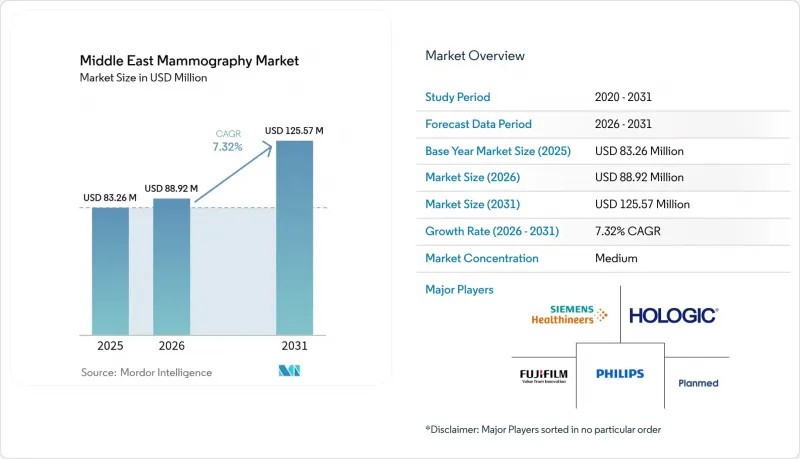
This report is Segmented by Product Type (Analog Mammography Systems, Full-Field Digital Mammography, Digital Breast Tomosynthesis), Technology (2-D Digital Mammography, 3-D Digital Tomosynthesis, CAD & AI-Assisted Mammography), End User (Hospitals, Diagnostic Imaging Centers, and More), and Geography (Saudi Arabia, UAE, Qatar, Kuwait, and More). Market Forecasts are Provided in Terms of Value (USD).
Middle East Mammography Market Trends and Insights
Rising Incidence of Breast Cancer Across Middle East
Breast cancer is now the top malignancy among women in the region, and median diagnosis ages of 48-51 compress the screening window, driving urgent demand for higher-sensitivity imaging platforms. Case numbers in Egypt climbed 12% between 2024-2025, prompting a USD 1.8 billion boost in oncology capacity and accelerating equipment procurement. Governments now mandate biennial screening from age 40, favoring digital breast tomosynthesis systems that detect small, dense-tissue lesions that are invisible on legacy analog units. The epidemiological shift anchors long-term demand for the Middle East mammography market.
Expansion of Government-Funded Screening Programs
Saudi Arabia aims to achieve 70% screening coverage by 2030 and has deployed mobile units across remote provinces to reach women who previously lacked access. The UAE integrated AI-equipped portable systems into school health checks, reducing diagnostic wait times to a single day and demonstrating cost-effective opportunistic screening. Qatar's partnership with Lunit demonstrates how integrating AI at the primary-care level improves sensitivity and throughput. Together, these programs expand the Middle East mammography market footprint and sustain vendor pipelines.
High Capital Cost of Advanced Mammography Equipment
Premium 3-D systems carry price tags of USD 215,000-275,000 and annual service fees of up to USD 45,000, costs that many public hospitals cannot meet. Egypt's 25% health-budget rise prioritizes brick-and-mortar expansion over equipment upgrades, sustaining two-dimensional demand at USD 55,000-75,000 per unit. Even in Gulf states, shifting resources to software subscriptions and teleradiology narrows the headroom for hardware capex, moderating the Middle East mammography market's acceleration.
Other drivers and restraints analyzed in the detailed report include:
- Rapid Adoption of Digital Breast Tomosynthesis Systems
- Growing Medical Tourism for Oncology Diagnostics
- Shortage of Trained Radiologists & Technicians
For complete list of drivers and restraints, kindly check the Table Of Contents.
Segment Analysis
Digital breast tomosynthesis generated 41.67% of 2025 sales as tertiary hospitals upgraded to 3-D imaging to cut recall rates and attract medical tourists. Full-field digital mammography is forecast to log the fastest 8.06% CAGR through 2031, driven by public tenders in Egypt, Turkey, and emerging GCC markets seeking lower capex and proven throughput. Analog systems persist in rural clinics but are declining steadily as digital archiving and picture-archiving mandates spread. The Middle East mammography market size for full-field digital mammography is expected to climb alongside Egypt's 58-hospital build-out, underscoring a budget-balanced adoption curve.
Complete Report Scope:
- By Product Type
- Analog Mammography Systems
- Full-Field Digital Mammography (FFDM)
- Digital Breast Tomosynthesis (DBT)
- By Technology
- 2-D Digital Mammography
- 3-D Digital Tomosynthesis
- CAD & AI-Assisted Mammography
- By End User
- Hospitals
- Diagnostic Imaging Centers
- Breast Care Clinics
- Mobile Screening Units
- By Country
- Saudi Arabia
- United Arab Emirates
- Qatar
- Kuwait
- Oman
- Bahrain
- Turkey
- Israel
- Egypt
- Rest of Middle East
List of Companies Covered in this Report:
- Canon
- Carestream Health
- Delphinus Medical Technologies Inc.
- Esaote S.p.A.
- Fujifilm Holdings Corpration
- GE HealthCare Technologies Inc.
- General Medical Merate
- Hologic
- Koninklijke Philips
- Metaltronica S.r.l.
- Mindray Bio-Medical Electronics Co. Ltd.
- Planmed
- Samsung Medison Co. Ltd.
- Siemens Healthineers
- Sonocine Inc.
Additional Benefits:
- The market estimate (ME) sheet in Excel format
- 3 months of analyst support
TABLE OF CONTENTS
1 Introduction
- 1.1 Study Assumptions & Market Definition
- 1.2 Scope of the Study
2 Research Methodology
3 Executive Summary
4 Market Landscape
- 4.1 Market Overview
- 4.2 Market Drivers
- 4.2.1 Rising Incidence of Breast Cancer Across Middle East
- 4.2.2 Expansion of Government-Funded Screening Programs
- 4.2.3 Rapid Adoption of Digital Breast Tomosynthesis Systems
- 4.2.4 Growing Medical Tourism for Oncology Diagnostics
- 4.2.5 Surge In Private-Sector AI-Enabled Reading Centers
- 4.2.6 GCC-Wide AI Teleradiology Reimbursement Pilots
- 4.3 Market Restraints
- 4.3.1 High Capital Cost of Advanced Mammography Equipment
- 4.3.2 Shortage of Trained Radiologists & Technicians
- 4.3.3 Cultural Barriers Reducing Screening Uptake
- 4.3.4 Supply-Chain Risks for Flat-Panel Detectors
- 4.4 Regulatory Landscape
- 4.5 Technological Outlook
- 4.6 Porter's Five Forces Analysis
- 4.6.1 Threat of New Entrants
- 4.6.2 Bargaining Power of Buyers
- 4.6.3 Bargaining Power of Suppliers
- 4.6.4 Threat of Substitute Products
- 4.6.5 Intensity of Competitive Rivalry
5 Market Size & Growth Forecasts
- 5.1 By Product Type
- 5.1.1 Analog Mammography Systems
- 5.1.2 Full-Field Digital Mammography (FFDM)
- 5.1.3 Digital Breast Tomosynthesis (DBT)
- 5.2 By Technology
- 5.2.1 2-D Digital Mammography
- 5.2.2 3-D Digital Tomosynthesis
- 5.2.3 CAD & AI-Assisted Mammography
- 5.3 By End User
- 5.3.1 Hospitals
- 5.3.2 Diagnostic Imaging Centers
- 5.3.3 Breast Care Clinics
- 5.3.4 Mobile Screening Units
- 5.4 By Country
- 5.4.1 Saudi Arabia
- 5.4.2 United Arab Emirates
- 5.4.3 Qatar
- 5.4.4 Kuwait
- 5.4.5 Oman
- 5.4.6 Bahrain
- 5.4.7 Turkey
- 5.4.8 Israel
- 5.4.9 Egypt
- 5.4.10 Rest of Middle East
6 Competitive Landscape
- 6.1 Market Concentration
- 6.2 Market Share Analysis
- 6.3 Company Profiles (includes Global Level Overview, Market Level Overview, Core Segments, Financials as Available, Strategic Information, Market Rank/Share for Key Companies, Products & Services, and Recent Developments)
- 6.3.1 Canon Medical Systems Corp.
- 6.3.2 Carestream Health Inc.
- 6.3.3 Delphinus Medical Technologies Inc.
- 6.3.4 Esaote S.p.A.
- 6.3.5 Fujifilm Holdings Corpration
- 6.3.6 GE HealthCare Technologies Inc.
- 6.3.7 General Medical Merate S.p.A.
- 6.3.8 Hologic Inc.
- 6.3.9 Koninklijke Philips N.V.
- 6.3.10 Metaltronica S.r.l.
- 6.3.11 Mindray Bio-Medical Electronics Co. Ltd.
- 6.3.12 Planmed Oy
- 6.3.13 Samsung Medison Co. Ltd.
- 6.3.14 Siemens Healthineers AG
- 6.3.15 Sonocine Inc.
7 Market Opportunities & Future Outlook
- 7.1 White-space & Unmet-Need Assessment

