PUBLISHER: Mordor Intelligence | PRODUCT CODE: 2121743

PUBLISHER: Mordor Intelligence | PRODUCT CODE: 2121743
US Plastic Packaging - Market Share Analysis, Industry Trends & Statistics, Growth Forecasts (2026 - 2031)
According to Mordor Intelligence, the United States plastic packaging market size in 2026 is estimated at 30.9 million tonnes, growing from 2025 value of 29.97 million tonnes with 2031 projections showing 36.04 million tonnes, growing at 3.12% CAGR over 2026-2031.
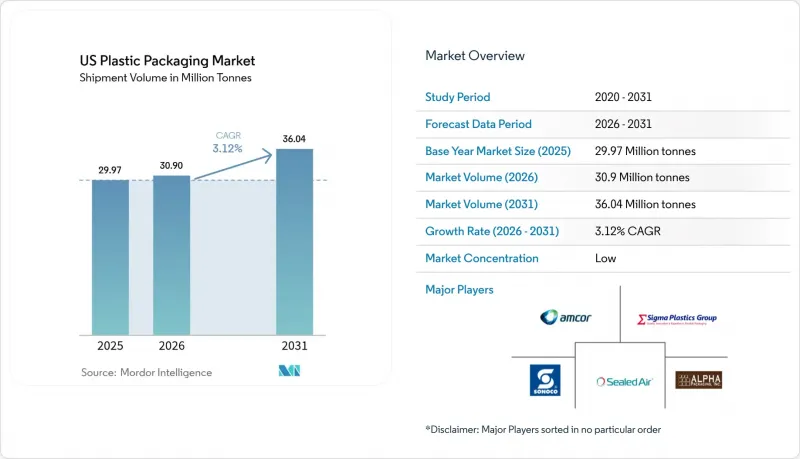
This report is Segmented by Material Type ((Rigid Plastic(Polyethylene (PE), Polypropylene (PP) and More)), Flexible Plastic (Polyethylene (PE), Biaxially Oriented Polypropylene (BOPP) and More)), Packaging Type (Rigid Plastic Packaging, Flexible Plastic Packaging), End-Use Industry (Food, Beverage, Pharmaceutical, and More) and Packaging Technology (Extrusion, Thermoforming, and More)
US Plastic Packaging Market Trends and Insights
Rapid Adoption of Recyclable Mono-Material Pouches by US CPG Brands
Mono-material polyethylene and polypropylene laminates are replacing mixed-substrate films that once obstructed recycling streams. Converters now deliver heat-resistant, high-barrier pouches that comply with the U.S. Plastics Pact 2025 design targets, giving brand owners a straightforward route to "recycle-ready" claims. DNP Indonesia's commercial roll-out of mono-material snack and pet-food packs demonstrates how barrier performance can be maintained while simplifying end-of-life processing. Retailers request specification parity with legacy foil structures, and test data confirm comparable oxygen-transmission rates, enabling broad SKU conversion. Packaging teams within the United States plastic packaging market are synchronizing material down-gauging with roll-stock width optimization to shrink film consumption per unit.
Surging E-Commerce Demand for Lightweight Protective Mailers in the US Parcel Network
Parcel shippers continue to eliminate unnecessary void fill, driving interest in thin-gauge, curbside-recyclable mailers that cut dimensional-weight fees while preserving product integrity. Amazon has shifted one-third of its U.S. outbound parcels to paper-based alternatives, eliminating 15 billion plastic air pillows since program inception. The company's pilot plants validate line speeds exceeding 250 parcels per minute, setting new benchmarks for automation. Competitors are matching performance with mono-material LDPE bubble mailers containing 30% PCR, as mandated by Washington's recycled-content law. Converters positioned within the United States plastic packaging market are investing in high-output blown-film towers and automated wicketing to address the spike in daily parcel volumes.
Escalating State-Level Single-Use Plastics Bans Reducing Certain Packaging Formats
California SB 54 mandates a 25% reduction in virgin plastic packaging sold within state borders by 2032, and producers must join a Producer Responsibility Organization by 2025. Similar mandates in New Jersey, Colorado, and Maine create a fragmented compliance map that raises complexity for nationwide brands. Converters are pre-emptively retiring PS clamshells and PVC blisters from their catalogs, turning to PET G and coated paperboard alternatives even when cost of goods rises. The regulatory uncertainty embeds risk premiums into long-term supply contracts, curbing discretionary capital spend within the United States plastic packaging market as firms await harmonized federal guidelines.
Other drivers and restraints analyzed in the detailed report include:
- Growth of Ready-to-Eat and On-the-Go Foods Requiring High-Barrier Flexible Films
- Corporate Commitments to 25% PCR Content Boosting Demand for rPET and rHDPE Bottles
- Consumer Shift Toward Paper and Aluminum Alternatives for Sustainability
For complete list of drivers and restraints, kindly check the Table Of Contents.
Segment Analysis
Flexible formats delivered 53.86% of United States plastic packaging market share in 2025 and are marching ahead at a 4.82% CAGR. Each new pouch replaces rigid counterparts with 60-70% less polymer, reducing freight emissions and warehouse footprints. E-commerce giants favor flat mailers because they collapse to one-tenth the inbound cube of corrugated boxes, slashing storage overhead. Brands now employ near-infrared (NIR) readable inks so flexibles sort efficiently at material-recovery facilities, improving real recycling rates. Meanwhile, "smart" pouches embed RFID or NFC tags, providing end-to-end visibility from filler to consumer scanning events.
Rigid plastics still account for essential roles in beverages, pharmaceuticals, and household chemicals, yet growth lags at 2.03% CAGR. Lightweight HDPE bottles use up to 12% less resin than 2023 designs, but performance thresholds on drop strength and taste neutrality limit further down-gauging. Washington State's recycled-content law compels bottle makers to secure stable rHDPE streams, prompting co-investment in in-house wash lines. Competition within the United States plastic packaging market now revolves around tethered caps that comply with forthcoming closure-retention mandates, merging convenience and litter reduction.
Polyethylene retained a 45.12% share of flexible volumes in 2025, supported by its broad processing window and robust curbside collection infrastructure. FDA approval for 100% rLLDPE content in snack wrappers confirms food-safety compliance pathways, allowing national retailers to launch "circular" private labels. Development teams adopt metallocene catalysts that provide higher dart impact at reduced gauge, contributing to resin savings of 8-10%. The United States plastic packaging market size for PE-based flexibles will continue scaling as co-extrusion technology accommodates recycled pellet variability without compromising film clarity.
The "other materials" category advances 6.09% CAGR, propelled by compostable PLA blends, cellulose-based films, and silicium-oxide coated papers. Consumer brands experiment with bio-PE derived from sugarcane that offers equivalent mechanical properties and a lower carbon footprint. BOPP remains indispensable for glossy snack and confectionery overwraps, yet new varnish systems deliver metallization-free barrier performance aligned with mono-material recycling guidelines. Partnerships between resin suppliers and film converters accelerate qualification cycles, shortening time-to-market for emerging formulations.
Complete Report Scope:
- By Material Type
- Rigid Plastic
- Polyethylene (PE)
- Polypropylene (PP)
- Polyethylene Terephthalate (PET)
- Polyvinyl Chloride (PVC)
- Polystyrene (PS) and Expanded Polystyrene (EPS)
- Other Material Types
- Flexible Plastic
- Polyethylene (PE)
- Biaxially Oriented Polypropylene (BOPP)
- Cast Polypropylene (CPP)
- Other Material Types
- Rigid Plastic
- By Packaging Type
- Rigid Plastic Packaging
- Bottles and Jars
- Caps and Closures
- Trays and Clamshells
- Other Product Types
- Flexible Plastic Packaging
- Pouches
- Bags
- Films and Wraps
- Other Product Types
- Rigid Plastic Packaging
- By End-use Industry
- Food
- Beverage
- Pharmaceutical
- Cosmetics and Personal Care
- Home and Industrial Chemicals
- Pet Food and Animal Care
- Other End-use Industry
- By Packaging Technology
- Injection Molding
- Blow Molding
- Extrusion
- Thermoforming
List of Companies Covered in this Report:
- Amcor plc
- Sealed Air Corp.
- Sonoco Products Co.
- Sigma Plastics Group Inc.
- ProAmpac LLC
- Constantia Flexibles
- Alpha Packaging Inc.
- Centor Inc. (Gerresheimer)
- Silgan Holdings Inc.
- Bericap Holdings
- Plastipak Holdings Inc.
- Coveris Holdings SA
- Printpack Inc.
- AptarGroup Inc.
- Pactiv Evergreen Inc.
- Novolex Holdings LLC
- Sabert Corp.
- Genpak LLC
- Mondi plc
Additional Benefits:
- The market estimate (ME) sheet in Excel format
- 3 months of analyst support
TABLE OF CONTENTS
1 INTRODUCTION
- 1.1 Study Assumptions and Market Definition
- 1.2 Scope of the Study
2 RESEARCH METHODOLOGY
3 EXECUTIVE SUMMARY
4 MARKET LANDSCAPE
- 4.1 Market Overview
- 4.2 Market Drivers
- 4.2.1 Surging E-commerce Demand for Lightweight Protective Mailers in US Parcel Network
- 4.2.2 Rapid Adoption of Recyclable Mono-Material Pouches by US CPG Brands Post-2025 Plastics Pact Targets
- 4.2.3 Growth of Ready-to-Eat and On-the-Go Foods Requiring High-Barrier Flexible Films
- 4.2.4 Pharmaceutical Cold-Chain Expansion Driving Specialty Rigid Containers and Blister Films
- 4.2.5 Corporate Commitments to 25 % PCR Content Boosting Demand for rPET and rHDPE Bottles
- 4.2.6 Investments in Advanced Digital Printing Enabling Short-Run Customization for SME Brands
- 4.3 Market Restraints
- 4.3.1 Escalating State-Level Single-Use Plastics Bans Reducing Certain Packaging Formats
- 4.3.2 Volatility in Polyolefin Resin Prices Linked to Shale Gas Feedstock Swings
- 4.3.3 Consumer Shift Toward Paper and Aluminum Alternatives for Sustainability
- 4.3.4 Capital Intensity of Chemical Recycling Infrastructure Limiting rPlastics Supply
- 4.4 Supply-Chain Analysis
- 4.5 Trade Scenario Analysis (under relevant HS codes)
- 4.6 Current Recycling Trends in United States
- 4.7 Regulatory Outlook
- 4.8 Technological Outlook
- 4.9 Porter's Five Forces Analysis
- 4.9.1 Threat of New Entrants
- 4.9.2 Bargaining Power of Buyers
- 4.9.3 Bargaining Power of Suppliers
- 4.9.4 Threat of Substitute Products
- 4.9.5 Intensity of Competitive Rivalry
5 Market Size and Growth Forecasts (Volume)
- 5.1 By Material Type
- 5.1.1 Rigid Plastic
- 5.1.1.1 Polyethylene (PE)
- 5.1.1.2 Polypropylene (PP)
- 5.1.1.3 Polyethylene Terephthalate (PET)
- 5.1.1.4 Polyvinyl Chloride (PVC)
- 5.1.1.5 Polystyrene (PS) and Expanded Polystyrene (EPS)
- 5.1.1.6 Other Material Types
- 5.1.2 Flexible Plastic
- 5.1.2.1 Polyethylene (PE)
- 5.1.2.2 Biaxially Oriented Polypropylene (BOPP)
- 5.1.2.3 Cast Polypropylene (CPP)
- 5.1.2.4 Other Material Types
- 5.1.1 Rigid Plastic
- 5.2 By Packaging Type
- 5.2.1 Rigid Plastic Packaging
- 5.2.1.1 Bottles and Jars
- 5.2.1.2 Caps and Closures
- 5.2.1.3 Trays and Clamshells
- 5.2.1.4 Other Product Types
- 5.2.2 Flexible Plastic Packaging
- 5.2.2.1 Pouches
- 5.2.2.2 Bags
- 5.2.2.3 Films and Wraps
- 5.2.2.4 Other Product Types
- 5.2.1 Rigid Plastic Packaging
- 5.3 By End-use Industry
- 5.3.1 Food
- 5.3.2 Beverage
- 5.3.3 Pharmaceutical
- 5.3.4 Cosmetics and Personal Care
- 5.3.5 Home and Industrial Chemicals
- 5.3.6 Pet Food and Animal Care
- 5.3.7 Other End-use Industry
- 5.4 By Packaging Technology
- 5.4.1 Injection Molding
- 5.4.2 Blow Molding
- 5.4.3 Extrusion
- 5.4.4 Thermoforming
6 COMPETITIVE LANDSCAPE
- 6.1 Market Concentration
- 6.2 Strategic Moves
- 6.3 Market Share Analysis
- 6.4 Company Profiles {(includes Global level Overview, Market level overview, Core Segments, Financials as available, Strategic Information, Market Rank/Share for key companies, Products and Services, and Recent Developments)}
- 6.4.1 Amcor plc
- 6.4.2 Sealed Air Corp.
- 6.4.3 Sonoco Products Co.
- 6.4.4 Sigma Plastics Group Inc.
- 6.4.5 ProAmpac LLC
- 6.4.6 Constantia Flexibles
- 6.4.7 Alpha Packaging Inc.
- 6.4.8 Centor Inc. (Gerresheimer)
- 6.4.9 Silgan Holdings Inc.
- 6.4.10 Bericap Holdings
- 6.4.11 Plastipak Holdings Inc.
- 6.4.12 Coveris Holdings SA
- 6.4.13 Printpack Inc.
- 6.4.14 AptarGroup Inc.
- 6.4.15 Pactiv Evergreen Inc.
- 6.4.16 Novolex Holdings LLC
- 6.4.17 Sabert Corp.
- 6.4.18 Genpak LLC
- 6.4.19 Mondi plc
7 MARKET OPPORTUNITIES AND FUTURE OUTLOOK
- 7.1 White-space and Unmet-Need Assessment

