PUBLISHER: Mordor Intelligence | PRODUCT CODE: 2123300

PUBLISHER: Mordor Intelligence | PRODUCT CODE: 2123300
India Facility Management - Market Share Analysis, Industry Trends & Statistics, Growth Forecasts (2026 - 2031)
According to Mordor Intelligence, the India facility management market size is expected to increase from USD 87.21 billion in 2026 to reach USD 123.98 billion by 2031, growing at a CAGR of 7.29% over 2026-2031.
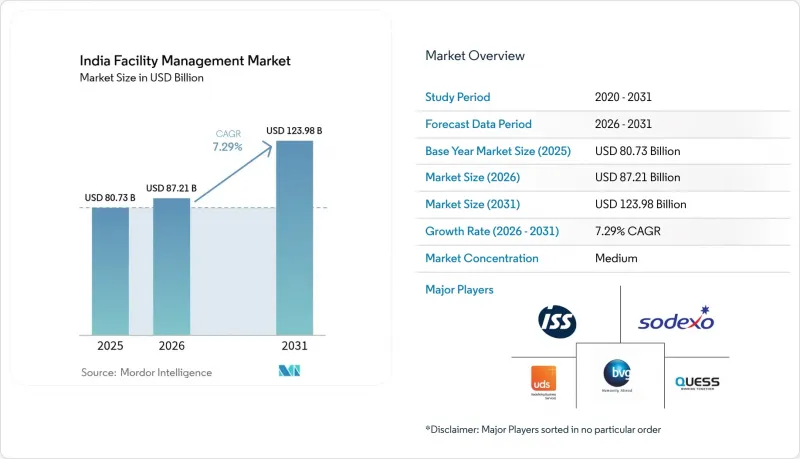
This report is Segmented by Service Type (Hard Services [Asset Management, and More], and Soft Services [Office Support and Security, and More]), Offering Type (In-House, and Outsourced [Single FM, Bundled FM, and More]), and End-User Industry (Commercial. Hospitality, Institutional and Public Infrastructure, Industrial and Process, and More). The Market Forecasts are Provided in Terms of Value (USD).
India Facility Management Market Trends and Insights
Rapid Commercial Real Estate Expansion
Developers completed more than 79 million sq ft of Grade A offices during 2025, keeping Bengaluru, Hyderabad and Pune below 13% vacancy. New-build specifications call for smart meters, LEED or IGBC certification and fire-safety systems aligned with the National Building Code 2016. Facility managers therefore handle round-the-clock HVAC optimization, periodic fire-audits and predictive analytics that minimize downtime. Flexible workspace operators added capacity in core micro-markets, creating variable daily occupancy that drives use of occupancy sensors and space-utilization dashboards. Collectively, these trends push bundled hard-and-soft contracts to the forefront of landlord strategy. Providers that can integrate mechanical, cleaning, security and energy services under performance-linked fees win longer tenures and higher margins.
Technology Integration, IoT, AI and Automation
IoT sensors now track temperature, vibration and power in more than 500 million sq ft of commercial and industrial space, feeding cloud platforms that flag anomalies well before failure. Artificial intelligence tools evaluate historical work orders and asset telemetry, enabling maintenance interventions that cut unplanned downtime by up to 30%. Digital twins simulate refurbishments and renewable-energy additions to guide capex decisions. The Securities and Exchange Board of India (SEBI) asked the top 1,000 listed firms to disclose energy-use data, so clients can increasingly demand real-time dashboards. Service providers able to connect building-management software with enterprise resource planning platforms gain competitive insulation.
Labour Shortages and Skill Gaps
Metro attrition in housekeeping and guarding exceeded 40% in 2025 as workers jumped to e-commerce and gig platforms. Technical trades show deeper deficits: vocational institutes graduate fewer than 50,000 HVAC and BMS technicians against 150,000 annual demand. Providers therefore run academies and apprenticeship programs, lifting recruitment costs and elongating ramp-up times. Wage inflation of 10%-12% compresses margins when contracts lack automatic escalation clauses. Some firms pilot remote monitoring to cut site headcount, but regulations and client preferences for physical presence still limit scale.
Other drivers and restraints analyzed in the detailed report include:
- Increasing Outsourcing Trend
- Hygiene and Health Compliance Mandates
- Margin Pressure from Rising Operational Costs
For complete list of drivers and restraints, kindly check the Table Of Contents.
Segment Analysis
Hard services generated faster growth than the overall India facility management market, expanding at an 8.37% CAGR thanks to mandatory compliance and energy-saving retrofits. The National Building Code 2016 obliges fire-detection and suppression in high-rise assets, spurring retrofit programs across older stock. Bureau of Energy Efficiency (BEE) codes encourage chiller replacement and variable-frequency drives that trim consumption by up to 35%. Consequently, institutional landlords deploy condition-based monitoring suites, creating sticky recurring revenue anchored to the India facility management market size.
Soft services still delivered 66.52% of 2025 revenue by virtue of daily cleaning, office support and guarding. However, manned-security posts are falling as access control and video analytics spread, particularly in new Grade A offices, reducing guard density by almost one-third. Cleaning moves toward rope-access facade works and post-construction deep cleans that command premiums. Catering digitizes menus and tracks waste to satisfy wellness targets. Fragmentation persists, constraining economies of scale, but niche operators carve profit in specialized disinfection or linen sterilization.
Complete Report Scope:
- By Service Type
- Hard Services
- Asset Management
- MEP and HVAC Services
- Fire Systems and Safety
- Other Hard Facility Management Services
- Soft Services
- Office Support and Security
- Cleaning Services
- Catering Services
- Other Soft Facility Management Services
- Hard Services
- By Offering Type
- In-house
- Outsourced
- Single Facility Management
- Bundled Facility Management
- Integrated Facility Management
- By End-User Industry
- Commercial
- Hospitality
- Institutional and Public Infrastructure
- Healthcare (Public Facilities, Private Facilities)
- Industrial and Process
- Other End-User Industries
List of Companies Covered in this Report:
- ISS Facility Management
- Sodexo Facilities Management Services India Pvt. Ltd.
- Quess Corporation
- Updater Services Pvt. Ltd.
- BVG India Ltd.
- Dusters Total Solutions Ltd.
- EFS Facilities Services
- G4S India
- Mortice Group PLC (TenonFM)
- ServiceMax Facility Management Pvt. Ltd.
- Knight Frank India
- Avon Facility Management Services Pvt. Ltd.
- Kleen Tek Solutions
- DTSS Facility Services
- Tenon Facility Management Pvt. Ltd.
- CBRE South Asia Pvt. Ltd.
- JLL Integrated Facilities Management
- Cushman and Wakefield Facilities Services India
- Colliers India
- Johnson Controls India
Additional Benefits:
- The market estimate (ME) sheet in Excel format
- 3 months of analyst support
TABLE OF CONTENTS
1 INTRODUCTION
- 1.1 Study Assumptions and Market Definition
- 1.2 Scope of the Study
2 RESEARCH METHODOLOGY
3 EXECUTIVE SUMMARY
4 MARKET LANDSCAPE
- 4.1 Market Overview
- 4.1.1 Current Occupancy Rates
- 4.1.2 Profitability Rates of Major FM Players
- 4.1.3 Workforce Indicators, Labor Participation
- 4.1.4 Facility Management Market Share (%) by Service Type
- 4.1.5 Facility Management Market Share (%) by Hard Services
- 4.1.6 Facility Management Market Share (%) by Soft Services
- 4.1.7 Urbanization and Population Growth in Major Metros
- 4.1.8 Sector Investment Priorities in National Infrastructure Pipeline
- 4.1.9 Regulatory Drivers Specific to Labor and Safety Standards
- 4.2 Market Drivers
- 4.2.1 Rapid Commercial Real Estate Expansion
- 4.2.2 Technology Integration, IoT, AI, and Automation
- 4.2.3 Increasing Outsourcing Trend
- 4.2.4 Hygiene and Health Compliance Mandates
- 4.2.5 Uptake of Outcome-Based FM Contracts in Tier-2 Cities
- 4.2.6 ESG-Linked Lending Driving Green Facility Upgrades
- 4.3 Market Restraints
- 4.3.1 Labor Shortages and Skill Gaps
- 4.3.2 Margin Pressure from Rising Operational Costs
- 4.3.3 High Client Price Sensitivity and Fragmented Procurement Practices
- 4.3.4 Smart-Building Automation Reducing Manned-Guarding Demand
- 4.4 Industry Value Chain Analysis
- 4.5 Regulatory Landscape
- 4.6 PESTEL Analysis
- 4.7 Porter's Five Forces Analysis
- 4.7.1 Bargaining Power of Suppliers
- 4.7.2 Bargaining Power of Buyers
- 4.7.3 Threat of New Entrants
- 4.7.4 Threat of Substitute Services
- 4.7.5 Intensity of Competitive Rivalry
- 4.8 Impact of Macroeconomic Factors on the Market
- 4.9 Investment and Funding Analysis
5 MARKET SIZE AND GROWTH FORECASTS (VALUE)
- 5.1 By Service Type
- 5.1.1 Hard Services
- 5.1.1.1 Asset Management
- 5.1.1.2 MEP and HVAC Services
- 5.1.1.3 Fire Systems and Safety
- 5.1.1.4 Other Hard Facility Management Services
- 5.1.2 Soft Services
- 5.1.2.1 Office Support and Security
- 5.1.2.2 Cleaning Services
- 5.1.2.3 Catering Services
- 5.1.2.4 Other Soft Facility Management Services
- 5.1.1 Hard Services
- 5.2 By Offering Type
- 5.2.1 In-house
- 5.2.2 Outsourced
- 5.2.2.1 Single Facility Management
- 5.2.2.2 Bundled Facility Management
- 5.2.2.3 Integrated Facility Management
- 5.3 By End-User Industry
- 5.3.1 Commercial
- 5.3.2 Hospitality
- 5.3.3 Institutional and Public Infrastructure
- 5.3.4 Healthcare (Public Facilities, Private Facilities)
- 5.3.5 Industrial and Process
- 5.3.6 Other End-User Industries
6 COMPETITIVE LANDSCAPE
- 6.1 Market Concentration
- 6.2 Strategic Moves
- 6.3 Market Share Analysis
- 6.4 Company Profiles (includes Global Level Overview, Market Level Overview, Core Segments, Financials as available, Strategic Information, Market Rank/Share, Products and Services, Recent Developments)
- 6.4.1 ISS Facility Management
- 6.4.2 Sodexo Facilities Management Services India Pvt. Ltd.
- 6.4.3 Quess Corporation
- 6.4.4 Updater Services Pvt. Ltd.
- 6.4.5 BVG India Ltd.
- 6.4.6 Dusters Total Solutions Ltd.
- 6.4.7 EFS Facilities Services
- 6.4.8 G4S India
- 6.4.9 Mortice Group PLC (TenonFM)
- 6.4.10 ServiceMax Facility Management Pvt. Ltd.
- 6.4.11 Knight Frank India
- 6.4.12 Avon Facility Management Services Pvt. Ltd.
- 6.4.13 Kleen Tek Solutions
- 6.4.14 DTSS Facility Services
- 6.4.15 Tenon Facility Management Pvt. Ltd.
- 6.4.16 CBRE South Asia Pvt. Ltd.
- 6.4.17 JLL Integrated Facilities Management
- 6.4.18 Cushman and Wakefield Facilities Services India
- 6.4.19 Colliers India
- 6.4.20 Johnson Controls India
7 MARKET OPPORTUNITIES AND FUTURE OUTLOOK
- 7.1 White-space and Unmet-Need Assessment
- 7.2 Technology-Led Integrated FM (IoT, BMS, AI-Based Predictive Maintenance)
- 7.3 ESG-Compliant FM Solutions Demand
- 7.4 Future Service-Model Shifts, Outcome-Based Contracts
- 7.5 Data-Driven Energy Optimization and Carbon Reporting Services

