PUBLISHER: Mordor Intelligence | PRODUCT CODE: 2124856

PUBLISHER: Mordor Intelligence | PRODUCT CODE: 2124856
Spain Facility Management - Market Share Analysis, Industry Trends & Statistics, Growth Forecasts (2026 - 2031)
According to Mordor Intelligence, the Spain facility management market size is expected to grow from USD 38.18 billion in 2025 to USD 40.08 billion in 2026 and is forecast to reach USD 51.11 billion by 2031 at 4.98% CAGR over 2026-2031.
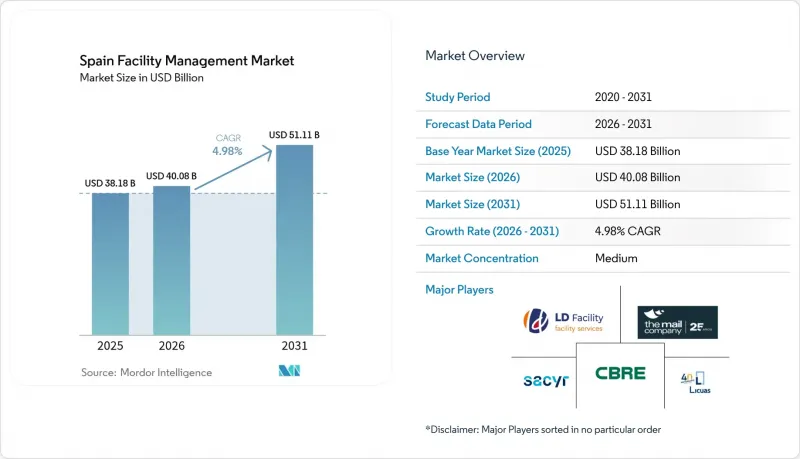
This report is Segmented by Service Type (Hard Services, Soft Services), Offering Type (In-House, Outsourced), End-User Industry (Commercial, Hospitality, Institutional and Public Infrastructure, Healthcare, Industrial and Process, Other End-User Industries). The Market Forecasts are Provided in Terms of Value (USD).
Spain Facility Management Market Trends and Insights
Shift toward integrated facility management (IFM) contracts among large enterprises
Spanish corporations are consolidating multiple vendors into single-source IFM agreements to gain real-time building analytics, unified service levels and ESG compliance assurance. A notable case is Hotelatelier, which achieved an 88% guest-satisfaction index after switching to an integrated model that merges HVAC optimization with front-of-house service orchestration. The move is strongest in multi-site office portfolios, but hospital and data-center operators are also beginning to bundle technical and soft scopes to improve uptime and simplify governance. Greater contract size and duration improve provider revenue visibility, yet require advanced digital-platform and change-management capability to meet stringent key-performance indicators.
Hospitality and tourism rebound
Spain welcomed a sharp rise in international arrivals in 2024 and early 2025, restoring room-occupancy levels in the Balearic and Canary Islands as well as the Costa del Sol. Hotels outsource cleaning, security and concierge functions to withstand seasonal labor swings and focus on guest experience technologies such as automated check-in, which reached 60% adoption at Kora Living properties. Sustainability targets linked to NextGenerationEU retrofits further widen the service scope to include energy benchmarking and waste-reduction programs. Outsourcing peaks during peak travel months, reinforcing the need for agile contract structures and performance-based pricing mechanisms.
Rising labor costs under new collective-bargaining agreements
The V Agreement for Employment and Collective Bargaining mandates wage increases of 4% for 2025, lifting the largest cost element in Spain facility management market contracts. Providers whose revenue mix tilts toward soft services face the greatest exposure because automation options are limited, while regional wage differentials intensify margin pressure in Catalonia and the Basque Country. Companies respond by accelerating robotics in cleaning, renegotiating service-level scopes and bundling services to dilute overhead.
Other drivers and restraints analyzed in the detailed report include:
- E-commerce logistics and data-center expansion
- PPP social-infrastructure projects
- Volatile energy prices
For complete list of drivers and restraints, kindly check the Table Of Contents.
Segment Analysis
Hard services commanded 62.94% of Spain facility management market size in 2025, mirroring the imperative to modernize decades-old HVAC, electrical and fire-safety installations. Asset-management subcontracts dominate as owners deploy predictive analytics to counter unplanned downtime. A chemical plant in Murcia cut energy use by almost 50% over ten years after pairing energy-management and maintenance-management systems. Technical-service providers secure multiyear agreements that couple capital-expenditure planning with day-to-day operations and maintenance tasks, improving revenue stability.
Soft services are forecast to outpace at 5.08% CAGR, fueled by hybrid workplaces and hospitality recovery. Security and office-support functions gain complexity as occupancy fluctuates weekly, prompting demand for access-control integrations and desk-booking analytics. Cleaning contracts face cost headwinds from wage inflation but also benefit from sensor-driven scheduling that aligns labor hours with real-time footfall. Catering rebounds on return-to-office trends and tourism demand, although menu-cost pressure from food inflation necessitates dynamic pricing models.
Complete Report Scope:
- By Service Type
- Hard Services
- Asset Management
- MEP and HVAC Services
- Fire Systems and Safety
- Other Hard FM Services
- Soft Services
- Office Support and Security
- Cleaning Services
- Catering Services
- Other Soft FM Services
- Hard Services
- By Offering Type
- In-house
- Outsourced
- Single FM
- Bundled FM
- Integrated FM
- By End-user Industry
- Commercial (IT and Telecom, Retail and Warehouses, etc.)
- Hospitality (Hotels, Eateries, Large-scale Restaurants)
- Institutional and Public Infrastructure (Govt, Education, Transportation)
- Healthcare (Public and Private Facilities)
- Industrial and Process (Manufacturing, Energy, Mining)
- Other End-user Industries (Multi-housing, Entertainment, Sports and Leisure)
List of Companies Covered in this Report:
- ISS Global
- Ferrovial Servicios
- Acciona Facility Services SA
- Licuas SA
- CBRE
- Sacyr Facilites
- The Mail Company
- LD Facility
- Savills
- TDGI Spain
- Eulen Servicios
- Clece
- Serveo
- Valoriza Servicios
- Ilunion Facility Services
Additional Benefits:
- The market estimate (ME) sheet in Excel format
- 3 months of analyst support
TABLE OF CONTENTS
1 INTRODUCTION
- 1.1 Study Assumptions and Market Definition
- 1.2 Scope of the Study
2 RESEARCH METHODOLOGY
3 EXECUTIVE SUMMARY
4 MARKET LANDSCAPE
- 4.1 Market Overview
- 4.1.1 Current Occupancy Rates
- 4.1.2 Profitability Rates of Major FM Players
- 4.1.3 Workforce Indicators - Labor Participation
- 4.1.4 Facility Management Market Share (%), by Service Type
- 4.1.5 Facility Management Market Share (%), by Hard Services
- 4.1.6 Facility Management Market Share (%), by Soft Services
- 4.1.7 Urbanization and Population Growth in Major Metros
- 4.1.8 Sector Investment Priorities in Spain's Infrastructure Pipeline
- 4.1.9 Regulatory Drivers Specific to Labour and Safety Standards
- 4.2 Market Drivers
- 4.2.1 Shift toward integrated facility management (IFM) contracts among large enterprises
- 4.2.2 Recovery of hospitality and tourism sectors boosting demand for outsourced FM services
- 4.2.3 Expansion of e-commerce logistics and data centers requiring specialized hard FM services
- 4.2.4 Public-private partnership (PPP) social-infrastructure projects creating long-term FM pipelines
- 4.2.5 NextGenerationEU renovation-wave funding driving energy-efficient retrofits in public buildings
- 4.2.6 Flexible workspace operators demanding agile micro-contract FM models
- 4.3 Market Restraints
- 4.3.1 Rising labor costs under new collective-bargaining agreements squeezing FM margins
- 4.3.2 Volatile energy prices eroding profitability of energy-intensive hard services
- 4.3.3 Legacy building stock with poor asset documentation inflating operations and maintenance risk premiums
- 4.3.4 Chronic late-payment culture among public-sector clients stressing FM working capital
- 4.4 Value Chain Analysis
- 4.5 PESTEL Analysis
- 4.6 Regulatory and Legislative Framework for Market Entrants
- 4.7 Impact of Macroeconomic Indicators on FM Demand
- 4.8 Porter's Five Forces Analysis
- 4.8.1 Bargaining Power of Suppliers
- 4.8.2 Bargaining Power of Buyers
- 4.8.3 Threat of New Entrants
- 4.8.4 Threat of Substitute Services
- 4.8.5 Intensity of Competitive Rivalry
- 4.9 Investment and Funding Analysis
5 MARKET SIZE AND GROWTH FORECASTS (VALUE)
- 5.1 By Service Type
- 5.1.1 Hard Services
- 5.1.1.1 Asset Management
- 5.1.1.2 MEP and HVAC Services
- 5.1.1.3 Fire Systems and Safety
- 5.1.1.4 Other Hard FM Services
- 5.1.2 Soft Services
- 5.1.2.1 Office Support and Security
- 5.1.2.2 Cleaning Services
- 5.1.2.3 Catering Services
- 5.1.2.4 Other Soft FM Services
- 5.1.1 Hard Services
- 5.2 By Offering Type
- 5.2.1 In-house
- 5.2.2 Outsourced
- 5.2.2.1 Single FM
- 5.2.2.2 Bundled FM
- 5.2.2.3 Integrated FM
- 5.3 By End-user Industry
- 5.3.1 Commercial (IT and Telecom, Retail and Warehouses, etc.)
- 5.3.2 Hospitality (Hotels, Eateries, Large-scale Restaurants)
- 5.3.3 Institutional and Public Infrastructure (Govt, Education, Transportation)
- 5.3.4 Healthcare (Public and Private Facilities)
- 5.3.5 Industrial and Process (Manufacturing, Energy, Mining)
- 5.3.6 Other End-user Industries (Multi-housing, Entertainment, Sports and Leisure)
6 COMPETITIVE LANDSCAPE
- 6.1 Market Concentration
- 6.2 Strategic Moves and Partnerships
- 6.3 Market Share Analysis
- 6.4 Company Profiles (includes Global level Overview, Market level overview, Core Segments, Financials as available, Strategic Information, Market Rank/Share for key companies, Products and Services, and Recent Developments)
- 6.4.1 ISS Global
- 6.4.2 Ferrovial Servicios
- 6.4.3 Acciona Facility Services SA
- 6.4.4 Licuas SA
- 6.4.5 CBRE
- 6.4.6 Sacyr Facilites
- 6.4.7 The Mail Company
- 6.4.8 LD Facility
- 6.4.9 Savills
- 6.4.10 TDGI Spain
- 6.4.11 Eulen Servicios
- 6.4.12 Clece
- 6.4.13 Serveo
- 6.4.14 Valoriza Servicios
- 6.4.15 Ilunion Facility Services
7 MARKET OPPORTUNITIES AND FUTURE OUTLOOK
- 7.1 White-space and Unmet-Need Assessment
- 7.2 Technology-led Integrated FM (IoT, BMS, AI-based Predictive Maintenance)
- 7.3 ESG-compliant FM Solutions Demand
- 7.4 Future Service-Model Shifts (Outcome-based Contracts)

