PUBLISHER: Mordor Intelligence | PRODUCT CODE: 2124862

PUBLISHER: Mordor Intelligence | PRODUCT CODE: 2124862
Malaysia Payments - Market Share Analysis, Industry Trends & Statistics, Growth Forecasts (2026 - 2031)
According to Mordor Intelligence, the Malaysia payments market size is projected to expand from USD 262.41 billion in 2025, USD 286.79 billion in 2026, and reach USD 423.84 billion by 2031, registering a CAGR of 8.13% during 2026-2031.
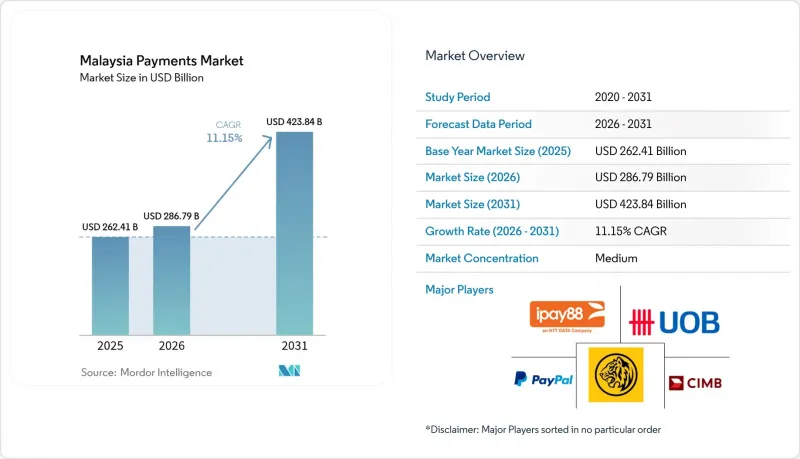
This report is Segmented by Mode of Payment (Point of Sale (Card Payments [Credit Cards, and More], Digital Wallets, and More), and Online Sale (Card Payments [Credit Cards, and More], Digital Wallets, and More)), End-User Industry (Retail, Entertainment and Digital Content, Hospitality and Travel, Government and Utilities, and More), and Geography. The Market Forecasts are Provided in Terms of Value (USD).
Malaysia Payments Market Trends and Insights
Rapid E-Commerce Expansion and Mobile-Shopping Adoption
Smartphone penetration exceeded 90% in 2025, and super-apps such as Shopee and Lazada integrated one-tap wallet checkouts that bypass card-network fees. Mobile-first buyers transact 40% more often than desktop users, improving merchant customer-acquisition economics. Touch 'n Go's link-up with Grab's ride-hailing and food-delivery services embeds payments inside daily routines, heightening platform stickiness. The phased e-invoice mandate pushes businesses to digitize invoices, indirectly nudging suppliers and buyers into online settlements. Cash-on-delivery is shrinking as prepaid digital wallets gain dispute-resolution credibility. If rural broadband roll-out under the Jendela plan slips behind schedule, the usage gap between urban and outstation shoppers could widen.
Government Push for Interoperable QR (DuitNow) and Contactless Cards
Bank Negara Malaysia requires all payment terminals to migrate to PIN authentication by June 2026, closing loopholes that enabled signature-based fraud. DuitNow QR unifies previously siloed wallet codes and has enrolled 2.6 million merchants, with volumes jumping 47% year-on-year in 2025. The George Town Accord among ASEAN central banks guarantees reciprocal QR acceptance, so Malaysian tourists buy meals in Bangkok with Touch 'n Go while avoiding foreign-exchange spreads. Tourism rebound, already at 85% of 2019 levels by mid-2025, accelerates QR adoption among hospitality merchants. Visa and Mastercard see card-present revenue erosion because flat-fee QR rails undercut percentage-based interchange models.
Persistent Cash Preference Among SMEs and Rural Consumers
Seventy percent of SMEs still prefer cash, citing tax-audit fears and liquidity needs. Sabah and Sarawak's intermittent internet and aging demographics reinforce this behavior. The 2024 eBelia youth subsidy drove short-term wallet activation but post-incentive usage cratered, proving that handouts without merchant ubiquity lack staying power. QR pilots in wet markets faltered because 24-hour settlement cycles undermine vendors' working capital. Until real-time payouts reach tier-three towns, cash maintains speed and trust advantages.
Other drivers and restraints analyzed in the detailed report include:
- Contactless Card Penetration and NFC Terminal Rollout
- Rise of Islamic Fintech and Sharia-Compliant Payment Propositions
- Rising Fraud and Cybersecurity Concerns Lowering Trust
For complete list of drivers and restraints, kindly check the Table Of Contents.
Segment Analysis
Point of Sale methods accounted for 67.89% of value in 2025, supported by entrenched card habits in supermarkets, fuel pumps, and restaurants. Within this group debit cards remain dominant among salaried workers, while credit cards capture big-ticket discretionary spending through reward programs and flexible installment plans. Bank financing blends Islamic murabaha structures with conventional installment offers, appealing to consumers furnishing homes or buying electronics. Prepaid cards are losing utility to reloadable wallets that facilitate contactless transit and instant peer transfers. Digital wallets are the star turn, their growth amplified by DuitNow QR's fee waivers that attract micro-merchants.
Online Sale channels, though smaller, are scaling at a 10.13% CAGR to 2031 as mobile-optimized checkouts eliminate form-fill friction. Cards still mediate roughly 60% of e-commerce value, yet their share is bleeding to wallets embedded inside Shopee and Lazada that avoid card-network tolls. Bank financing online supports zero-interest installment plans for mid-range smartphones and white goods, with Islamic variants expanding appeal. Prepaid cards see limited rotation because refund handling is clunky. Digital wallets dominate low-value, high-frequency orders such as food delivery, with Touch 'n Go boasting 82.41% of user penetration and Boost at 66.68%. Buy-now-pay-later products like BigPay Later funnel users who want budgeting discipline and interest-free spreading of payments.
Complete Report Scope:
- By Mode of Payment
- Point of Sale
- Card Payments
- Debit Cards
- Credit Cards
- Bank Financing Prepaid Cards
- Digital Wallets (includes Mobile Wallet)
- Other Point of Sale
- Card Payments
- Online Sale
- Card Payments
- Debit Cards
- Credit Cards
- Bank Financing Prepaid Cards
- Digital Wallets
- Other Online Sales (includes Cash on Delivery, Bank Transfer, and Buy Now Pay Later)
- Card Payments
- Point of Sale
- By End-User Industry
- Retail
- Entertainment and Digital Content
- Healthcare
- Hospitality and Travel
- Government and Utilities
- Other End-User Industries
List of Companies Covered in this Report:
- Malayan Banking Berhad (Maybank)
- CIMB Group Holdings Berhad
- Touch 'n Go Digital Sdn Bhd
- PayPal Holdings, Inc.
- Visa Inc.
- Mastercard Incorporated
- UnionPay International Co., Ltd.
- Payments Network Malaysia Sdn Bhd (PayNet)
- iPay88 (M) Sdn Bhd
- Boost Holdings Sdn Bhd
- Razer Merchant Services Sdn Bhd
- Huawei Technologies Co., Ltd. (Huawei Pay)
- Samsung Electronics Co., Ltd. (Samsung Pay)
- Stripe, Inc.
- BigPay Later Sdn Bhd
- Pine Labs Private Ltd. (FavePay)
- Ant Group Co., Ltd. (Alipay)
- United Overseas Bank (Malaysia) Bhd
- Bank Islam Malaysia Berhad
Additional Benefits:
- The market estimate (ME) sheet in Excel format
- 3 months of analyst support
TABLE OF CONTENTS
1 INTRODUCTION
- 1.1 Study Assumptions and Market Definition
- 1.2 Scope of the Study
2 RESEARCH METHODOLOGY
3 EXECUTIVE SUMMARY
4 MARKET LANDSCAPE
- 4.1 Market Overview
- 4.2 Market Drivers
- 4.2.1 Rapid E-Commerce Expansion and Mobile-Shopping Adoption
- 4.2.2 Government Push for Interoperable QR (DuitNow) and Contactless Cards
- 4.2.3 Contactless Card Penetration and NFC Terminal Rollout
- 4.2.4 Rise of Islamic Fintech and Sharia-Compliant Payment Propositions
- 4.2.5 ASEAN Cross-Border E-Wallet Interoperability Initiatives
- 4.2.6 Instant Payouts for Gig-Economy via Real-Time Rails
- 4.3 Market Restraints
- 4.3.1 Persistent Cash Preference Among SMEs and Rural Consumers
- 4.3.2 Rising Fraud and Cybersecurity Concerns Lowering Trust
- 4.3.3 Fragmented Acquiring Market Keeps MDR High for Micro-Merchants
- 4.3.4 E-KYC Hurdles for Migrant and Foreign Workers
- 4.4 Industry Value Chain Analysis
- 4.5 Regulatory Landscape
- 4.6 Technological Outlook
- 4.7 Impact of Macroeconomic Factors on the Market
- 4.8 Industry Stakeholder Analysis
- 4.9 Evolution of the Payments Landscape in Malaysia
- 4.10 Key Trends Driving Cashless Adoption
- 4.11 Porter's Five Forces Analysis
- 4.11.1 Bargaining Power of Suppliers
- 4.11.2 Bargaining Power of Buyers
- 4.11.3 Threat of New Entrants
- 4.11.4 Threat of Substitutes
- 4.11.5 Intensity of Competitive Rivalry
- 4.12 Key Regulations and Standards
- 4.13 Major Case Studies and Use Cases
- 4.14 Demographic Influences on Payment Preferences
- 4.15 Customer Experience and Global Trend Convergence
- 4.16 Cash Displacement and Contactless Momentum
- 4.17 Investment Analysis
5 MARKET SIZE AND GROWTH FORECASTS (VALUE)
- 5.1 By Mode of Payment
- 5.1.1 Point of Sale
- 5.1.1.1 Card Payments
- 5.1.1.1.1 Debit Cards
- 5.1.1.1.2 Credit Cards
- 5.1.1.1.3 Bank Financing Prepaid Cards
- 5.1.1.2 Digital Wallets (includes Mobile Wallet)
- 5.1.1.3 Other Point of Sale
- 5.1.1.1 Card Payments
- 5.1.2 Online Sale
- 5.1.2.1 Card Payments
- 5.1.2.1.1 Debit Cards
- 5.1.2.1.2 Credit Cards
- 5.1.2.1.3 Bank Financing Prepaid Cards
- 5.1.2.2 Digital Wallets
- 5.1.2.3 Other Online Sales (includes Cash on Delivery, Bank Transfer, and Buy Now Pay Later)
- 5.1.2.1 Card Payments
- 5.1.1 Point of Sale
- 5.2 By End-User Industry
- 5.2.1 Retail
- 5.2.2 Entertainment and Digital Content
- 5.2.3 Healthcare
- 5.2.4 Hospitality and Travel
- 5.2.5 Government and Utilities
- 5.2.6 Other End-User Industries
6 COMPETITIVE LANDSCAPE
- 6.1 Market Concentration
- 6.2 Strategic Moves and Partnerships
- 6.3 Market Share Analysis
- 6.4 Company Profiles (includes Global Level Overview, Market Level Overview, Core Segments, Financials as available, Strategic Information, Market Rank/Share, Products and Services, Recent Developments)
- 6.4.1 Malayan Banking Berhad (Maybank)
- 6.4.2 CIMB Group Holdings Berhad
- 6.4.3 Touch 'n Go Digital Sdn Bhd
- 6.4.4 PayPal Holdings, Inc.
- 6.4.5 Visa Inc.
- 6.4.6 Mastercard Incorporated
- 6.4.7 UnionPay International Co., Ltd.
- 6.4.8 Payments Network Malaysia Sdn Bhd (PayNet)
- 6.4.9 iPay88 (M) Sdn Bhd
- 6.4.10 Boost Holdings Sdn Bhd
- 6.4.11 Razer Merchant Services Sdn Bhd
- 6.4.12 Huawei Technologies Co., Ltd. (Huawei Pay)
- 6.4.13 Samsung Electronics Co., Ltd. (Samsung Pay)
- 6.4.14 Stripe, Inc.
- 6.4.15 BigPay Later Sdn Bhd
- 6.4.16 Pine Labs Private Ltd. (FavePay)
- 6.4.17 Ant Group Co., Ltd. (Alipay)
- 6.4.18 United Overseas Bank (Malaysia) Bhd
- 6.4.19 Bank Islam Malaysia Berhad
7 MARKET OPPORTUNITIES AND FUTURE OUTLOOK
- 7.1 White-Space and Unmet-Need Assessment

