PUBLISHER: Mordor Intelligence | PRODUCT CODE: 2125270

PUBLISHER: Mordor Intelligence | PRODUCT CODE: 2125270
Singapore Payments - Market Share Analysis, Industry Trends & Statistics, Growth Forecasts (2026 - 2031)
According to Mordor Intelligence, the Singapore payments market size is valued at USD 25.79 billion in 2026 and is forecast to reach USD 40.85 billion by 2031, reflecting a 9.63% CAGR.
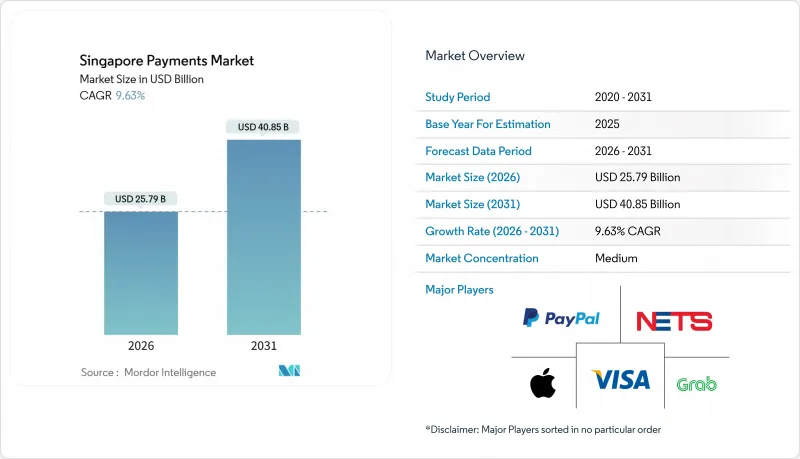
This report is Segmented by Mode of Payment (Point of Sale [Debit Card, Credit Card, Account-To-Account, Digital Wallet, Cash, and More], Online Sale [Debit Card, Credit Card, Account-To-Account, Digital Wallet, Cash-On-Delivery, and More]), and End-User Industry (Retail, Entertainment, Hospitality, Healthcare, Other). Market Forecasts are Provided in Terms of Value (USD).
Singapore Payments Market Trends and Insights
E-Commerce Boom and Cross-Border Retail Spend
Visa-free entry restoration in 2024, PayNow-UPI linkage in February 2025, and previous tie-ups with PromptPay and DuitNow compress settlement to seconds, shaving 40-60 basis points off foreign-exchange spreads. Chinese tourists increasingly favor Alipay+ and WeChat Pay at Orchard Road and Changi outlets, reflecting Beijing's QR-code push over card schemes. E-commerce majors such as Shopee and Lazada route Singapore-dollar proceeds via SGQR, letting overseas sellers bypass local bank accounts, which intensifies competition in fashion, electronics, and beauty.
Government-Led Digital Voucher and SGQR Initiatives
The RedeemSG scheme disbursed SGD 300 (USD 222) digital vouchers to citizens in 2024, compelling 164,000 PayNow-enabled merchants to accept SGQR payments. Hawkers Go Digital waived the 0.5% merchant discount rate through December 2025, removing cost objections for small food vendors. SGQR reached 27 public hospitals and polyclinics in May 2025, cutting outpatient queue times by 30%. Healthcare's high-ticket, repeat transactions now reinforce habitual wallet use that spills into retail and entertainment.
Rising E-Commerce Fraud and Social-Engineering Scams
Scam losses hit SGD 1.01 billion (USD 750 million) in 2024, a 53% jump year-on-year. Real-time irrevocability speeds fund dispersal across jurisdictions. Banks responded with Money Lock sub-accounts that impose 12-hour withdrawal cooling-off, while the Monetary Authority's shared-liability proposal would reimburse compliant victims up to SGD 100,000 (USD 74,000). PSPs must now invest in behavioral analytics and device fingerprinting, raising onboarding costs.
Other drivers and restraints analyzed in the detailed report include:
- Near-Real-Time PayNow and FAST Rails Scaling to SMEs
- Super-App Ecosystems Bundling Payments and Services
- Merchant MDR Cap Pressures PSP Profitability
For complete list of drivers and restraints, kindly check the Table Of Contents.
Segment Analysis
Credit cards retained a 34.72% slice of point-of-sale value in 2025, underscoring entrenched terminal networks and rewards propositions. Conversely, online account-to-account transfers are forecast to grow at 10.62% CAGR, the fastest pace across channels, reflecting consumer preference for instant, low-fee settlement. Digital wallets captured 39% of e-commerce value in 2024, down from 47% a year earlier as card issuers countered with enhanced cashback and installment options. Debit cards remain relevant for spend-control users, yet growth lags wallets that bundle loyalty and one-click checkout. Cash-on-delivery persists for luxury goods but continues to shrink.
Apple's Tap to Pay on iPhone debuted in December 2025, letting merchants accept contactless payments with only a phone, which could accelerate small-merchant card and wallet penetration. Legacy stored-value cards such as NETS FlashPay survive in transport niches but face gradual displacement as mobile wallets integrate NFC and QR formats. These shifts illustrate how the Singapore payments market recalibrates economic models as real-time rails cannibalize card interchange in digital commerce, while physical retail remains anchored to cards until hardware costs fall.
Complete Report Scope:
- By Mode of Payment
- Point-of-Sale
- Debit Card Payments
- Credit Card Payments
- Account-to-Account (A2A) Payments
- Digital Wallet
- Cash
- Other Point-of-Sale Payment Mode
- Online Sale
- Debit Card Payments
- Credit Card Payments
- Account-to-Account (A2A) Payments
- Digital Wallet
- Cash-on-Delivery
- Other Online Sales Payment Mode
- Point-of-Sale
- By End-User Industry
- Retail
- Entertainment
- Hospitality
- Healthcare
- Other End-User Industries
List of Companies Covered in this Report:
- Payment Processors / Payment Gateways
- Card Networks
- Mobile Wallet Providers
Additional Benefits:
- The market estimate (ME) sheet in Excel format
- 3 months of analyst support
TABLE OF CONTENTS
1 INTRODUCTION
- 1.1 Study Assumptions and Market Definition
- 1.2 Scope of the Study
2 RESEARCH METHODOLOGY
3 EXECUTIVE SUMMARY
4 MARKET LANDSCAPE
- 4.1 Market Overview
- 4.2 Market Drivers
- 4.2.1 E-commerce boom and cross-border retail spend
- 4.2.2 Government-led digital voucher and SGQR initiatives
- 4.2.3 Near-real-time PayNow/FAST rails scaling to SMEs
- 4.2.4 Super-app ecosystems bundling payments and services
- 4.2.5 Project Orchid CBDC pilots for B2B settlement
- 4.2.6 ESG-linked incentives for low-carbon transactions
- 4.3 Market Restraints
- 4.3.1 Merchant MDR cap pressures PSP profitability
- 4.3.2 Rising e-commerce fraud and social-engineering scams
- 4.3.3 Inter-wallet gaps for inbound foreign visitors
- 4.3.4 Real-time rails cannibalising card interchange
- 4.4 Industry Value Chain Analysis
- 4.5 Regulatory Landscape
- 4.6 Impact of Macroeconomic Factors
- 4.7 Technological Outlook
- 4.8 Porter's Five Forces Analysis
- 4.8.1 Bargaining Power of Suppliers
- 4.8.2 Bargaining Power of Buyers
- 4.8.3 Threat of New Entrants
- 4.8.4 Threat of Substitutes
- 4.8.5 Intensity of Competitive Rivalry
- 4.9 Evolution of the Payments Landscape in Singapore
- 4.10 Key Trends in Cashless Transactions
5 MARKET SIZE AND GROWTH FORECASTS (VALUE)
- 5.1 By Mode of Payment
- 5.1.1 Point-of-Sale
- 5.1.1.1 Debit Card Payments
- 5.1.1.2 Credit Card Payments
- 5.1.1.3 Account-to-Account (A2A) Payments
- 5.1.1.4 Digital Wallet
- 5.1.1.5 Cash
- 5.1.1.6 Other Point-of-Sale Payment Mode
- 5.1.2 Online Sale
- 5.1.2.1 Debit Card Payments
- 5.1.2.2 Credit Card Payments
- 5.1.2.3 Account-to-Account (A2A) Payments
- 5.1.2.4 Digital Wallet
- 5.1.2.5 Cash-on-Delivery
- 5.1.2.6 Other Online Sales Payment Mode
- 5.1.1 Point-of-Sale
- 5.2 By End-User Industry
- 5.2.1 Retail
- 5.2.2 Entertainment
- 5.2.3 Hospitality
- 5.2.4 Healthcare
- 5.2.5 Other End-User Industries
6 COMPETITIVE LANDSCAPE
- 6.1 Market Concentration
- 6.2 Strategic Moves
- 6.3 Market Share Analysis
- 6.4 Company Profiles (includes Global level Overview, Market level overview, Core Segments, Financials as available, Strategic Information, Market Rank/Share for key companies, Products and Services, and Recent Developments)
- 6.4.1 Payment Processors / Payment Gateways
- 6.4.1.1 Network for Electronic Transfers (Singapore) Pte Ltd.
- 6.4.1.2 PayPal Holdings, Inc.
- 6.4.1.3 Stripe, Inc.
- 6.4.1.4 Adyen N.V.
- 6.4.1.5 Checkout Ltd. (Checkout.com) Added
- 6.4.2 Card Networks
- 6.4.2.1 Visa Inc.
- 6.4.2.2 Mastercard Incorporated
- 6.4.2.3 American Express Company
- 6.4.2.4 UnionPay International Co., Ltd. Added
- 6.4.3 Mobile Wallet Providers
- 6.4.3.1 Grab Holdings Ltd. (GrabPay)
- 6.4.3.2 Apple Inc. (Apple Pay)
- 6.4.3.3 Google LLC (Google Pay)
- 6.4.3.4 Samsung Electronics Co., Ltd. (Samsung Pay)
- 6.4.3.5 Liquid Group Pte. Ltd. (ChopePay, LiquidPay) Added
- 6.4.3.6 Wise plc
- 6.4.3.7 Revolut Ltd.
- 6.4.3.8 Ant Group Co., Ltd. (Alipay +)
- 6.4.3.9 Tencent Holdings Ltd. (WeChat Pay)
- 6.4.1 Payment Processors / Payment Gateways
7 MARKET OPPORTUNITIES AND FUTURE OUTLOOK
- 7.1 White-space and Unmet-Need Assessment

