PUBLISHER: Mordor Intelligence | PRODUCT CODE: 2124894

PUBLISHER: Mordor Intelligence | PRODUCT CODE: 2124894
Spain Payments - Market Share Analysis, Industry Trends & Statistics, Growth Forecasts (2026 - 2031)
According to Mordor Intelligence, Spain payments market size in 2026 is estimated at USD 215.98 billion, growing from 2025 value of USD 197.28 billion with 2031 projections showing USD 339.63 billion, growing at 9.48% CAGR over 2026-2031.
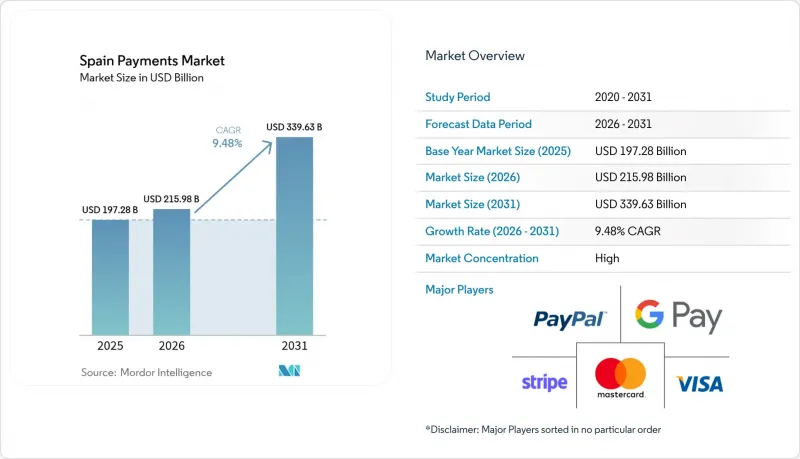
This report is Segmented by Mode of Payment (Point of Sale [Debit Card, Credit Card, A2A, Digital Wallet, Cash, and More], Online Sale [Debit Card, Credit Card, A2A, Digital Wallet, Cash-On-Delivery, and More]) and End-User Industry (Retail, Entertainment, Hospitality, Healthcare, Transportation, and More). The Market Forecasts are Provided in Terms of Value (USD).
Spain Payments Market Trends and Insights
E-commerce and m-commerce boom
Online retail has morphed into the prime catalyst for the Spain payments market as smartphone transactions rose significantly. Merchants weave in one-click checkouts and digital wallets to keep abandonment rates low, while AI-driven recommendations subtly nudge shoppers to higher-value baskets. Social-commerce integrations let influencers embed buy buttons in live streams, broadening the revenue funnel for payment service providers. The blending of augmented-reality product trials with embedded finance makes the act of paying invisible yet indispensable. As the metaverse concept matures, virtual storefronts could extend Spain's commerce footprint beyond physical borders, with payments handled seamlessly behind the scenes.
Government digitization and PSD2 push
The Plan de Digitalizacion de las AAPP 2021-2025 allocates EUR 6.5 billion (USD 7.34 billion) to modernize public-sector payments, while the Kit Digital subsidy earmarks EUR 3.067 billion (USD 3.47 billion) for SME tech adoption. These funds incentivize municipalities and small merchants to integrate real-time collections, reducing cash leakage and manual reconciliation. PSD2's data-sharing mandate has also unlocked a wave of account-information and payment-initiation services; nearly every Tier-1 bank now offers open APIs as a baseline capability. Fintech aggregators exploit this access to craft budgeting apps, tax-filing tools, and subscription-management dashboards, all of which route payments through low-cost A2A rails. In parallel, Spain's digital ID initiative promises biometric verification that could shrink fraud exposure for both citizens and corporates.
Card-present and CNP fraud uptick
Card-not-present fraud accounted for 73% of total card losses in Europe during 2024, with Spain's tourist hotspots proving especially vulnerable. E-skimming kits embedded in checkout scripts siphon customer data, while phishing lures target users of mobile P2P apps such as Bizum. Banks increasingly adopt machine-learning engines that monitor velocity, geolocation, and device fingerprints, but fraudsters are quick to test new attack vectors. The added layer of PSD2 multifactor authentication has curbed simple credential-stuffing attempts, yet social-engineering tactics remain stubbornly effective. Security spending competes with innovation budgets, slowing feature rollouts among smaller providers.
Other drivers and restraints analyzed in the detailed report include:
- Contactless POS infrastructure expansion
- SEPA Instant rails adoption
- High SME merchant service fees
For complete list of drivers and restraints, kindly check the Table Of Contents.
Segment Analysis
Debit cards commanded 29.12% of Spain payments market share in 2025, a legacy advantage built on decades of POS acceptance in grocery, fuel, and public-sector bill payments. The segment still accrues steady volume because consumers trust familiar chip-and-PIN and are rewarded through bank-linked loyalty programs. Meanwhile, the account-to-account category is on a tear, projected to register a 9.98% CAGR to 2031. The Spain payments market size for A2A transactions is poised to top USD 126.38 billion by 2031 if current growth holds, underpinned by Bizum's network of 19.1 million users who logged 500 million transfers in 2024. Free instant transfers, newly mandated, further tilt everyday spending toward A2A, eroding low-ticket debit volumes. Digital wallets that ride on underlying card tokens, Apple Pay, Google Pay, Samsung Pay, enjoy double-digit gains as banks preload credentials, although wallet growth still ladders up to the broader card ecosystem.
Online-only payment modes tell a complementary story. Cash-on-delivery shrinks as e-commerce trust climbs, while Buy Now Pay Later (BNPL) edges toward mainstream among millennials seeking fee-free installments. BNPL's ticket-size uplift echoes in higher cart values, yet regulators watch closely as household credit cycles lengthen. Credit-card growth settles into mid-single-digit territory, restrained by consumer wariness of revolving debt and the appeal of fee-free A2A. Ultimately, channel lines are blurring: Bizum Pay's NFC rollout means a wallet top-up is no longer required for in-store tapping, showcasing how platform convergence will define the next phase of Spain's payments market evolution.
Complete Report Scope:
- By Mode of Payment
- Point of Sale
- Debit Card Payments
- Credit Card Payments
- A2A Payments
- Digital Wallet
- Cash
- Other POS Modes
- Online Sale
- Debit Card Payments
- Credit Card Payments
- A2A Payments
- Digital Wallet
- Cash-on-Delivery
- Other Online Modes
- Point of Sale
- By End-User Industry
- Retail
- Entertainment
- Hospitality
- Healthcare
- Transportation
- Other Industries
List of Companies Covered in this Report:
- Redsys Servicios de Procesamiento S.L.
- Bizum S.L.
- PayPal Holdings, Inc.
- Adyen N.V.
- Stripe, Inc.
- Banco Bilbao Vizcaya Argentaria, S.A.
- Banco Santander, S.A.
- CaixaBank, S.A.
- Mastercard Incorporated
- Visa Inc.
- Google Pay
- Worldline S.A.
- Ingenico Group S.A.
- Samsung Electronics Co., Ltd.
- Amazon Payments, Inc.
- Squareup International Ltd (Block, Inc.)
- Paysafe Group Holdings Ltd.
- Bnext Plataforma de Pago S.L.
Additional Benefits:
- The market estimate (ME) sheet in Excel format
- 3 months of analyst support
TABLE OF CONTENTS
1 INTRODUCTION
- 1.1 Study Assumptions and Market Definition
- 1.2 Scope of the Study
2 RESEARCH METHODOLOGY
3 EXECUTIVE SUMMARY
4 MARKET LANDSCAPE
- 4.1 Market Overview
- 4.2 Market Drivers
- 4.2.1 E-commerce and m-commerce boom
- 4.2.2 Government digitization and PSD2 push
- 4.2.3 Contactless POS infrastructure expansion
- 4.2.4 SEPA Instant rails adoption
- 4.2.5 BNPL-led surge in ticket size
- 4.2.6 Biometric-ID payment authentication
- 4.3 Market Restraints
- 4.3.1 Card-present and CNP fraud uptick
- 4.3.2 High SME merchant service fees
- 4.3.3 Fragmented cross-border euro settlement
- 4.3.4 Digital exclusion of elderly and rural users
- 4.4 Industry Value Chain Analysis
- 4.5 Regulatory Landscape
- 4.6 Technological Outlook
- 4.7 Porter's Five Forces Analysis
- 4.7.1 Bargaining Power of Suppliers
- 4.7.2 Bargaining Power of Buyers/Consumers
- 4.7.3 Threat of New Entrants
- 4.7.4 Threat of Substitutes
- 4.7.5 Intensity of Rivalry
- 4.8 Impact of Macroeconomic Factors
5 MARKET SIZE AND GROWTH FORECASTS (Value)
- 5.1 By Mode of Payment
- 5.1.1 Point of Sale
- 5.1.1.1 Debit Card Payments
- 5.1.1.2 Credit Card Payments
- 5.1.1.3 A2A Payments
- 5.1.1.4 Digital Wallet
- 5.1.1.5 Cash
- 5.1.1.6 Other POS Modes
- 5.1.2 Online Sale
- 5.1.2.1 Debit Card Payments
- 5.1.2.2 Credit Card Payments
- 5.1.2.3 A2A Payments
- 5.1.2.4 Digital Wallet
- 5.1.2.5 Cash-on-Delivery
- 5.1.2.6 Other Online Modes
- 5.1.1 Point of Sale
- 5.2 By End-User Industry
- 5.2.1 Retail
- 5.2.2 Entertainment
- 5.2.3 Hospitality
- 5.2.4 Healthcare
- 5.2.5 Transportation
- 5.2.6 Other Industries
6 COMPETITIVE LANDSCAPE
- 6.1 Market Concentration
- 6.2 Strategic Moves
- 6.3 Market Share Analysis
- 6.4 Company Profiles (includes Global level Overview, Market level overview, Core Segments, Financials as available, Strategic Information, Market Rank/Share, Products and Services, Recent Developments)
- 6.4.1 Redsys Servicios de Procesamiento S.L.
- 6.4.2 Bizum S.L.
- 6.4.3 PayPal Holdings, Inc.
- 6.4.4 Adyen N.V.
- 6.4.5 Stripe, Inc.
- 6.4.6 Banco Bilbao Vizcaya Argentaria, S.A.
- 6.4.7 Banco Santander, S.A.
- 6.4.8 CaixaBank, S.A.
- 6.4.9 Mastercard Incorporated
- 6.4.10 Visa Inc.
- 6.4.11 Google Pay
- 6.4.12 Worldline S.A.
- 6.4.13 Ingenico Group S.A.
- 6.4.14 Samsung Electronics Co., Ltd.
- 6.4.15 Amazon Payments, Inc.
- 6.4.16 Squareup International Ltd (Block, Inc.)
- 6.4.17 Paysafe Group Holdings Ltd.
- 6.4.18 Bnext Plataforma de Pago S.L.
7 MARKET OPPORTUNITIES and FUTURE OUTLOOK
- 7.1 White-space and Unmet-Need Assessment

