PUBLISHER: Mordor Intelligence | PRODUCT CODE: 2125258

PUBLISHER: Mordor Intelligence | PRODUCT CODE: 2125258
Europe Real Time Payments - Market Share Analysis, Industry Trends & Statistics, Growth Forecasts (2026 - 2031)
According to Mordor Intelligence, Europe real time payments market size in 2026 is estimated at USD 7.96 billion, growing from 2025 value of USD 7.21 billion with 2031 projections showing USD 13.1 billion, growing at 10.46% CAGR over 2026-2031.
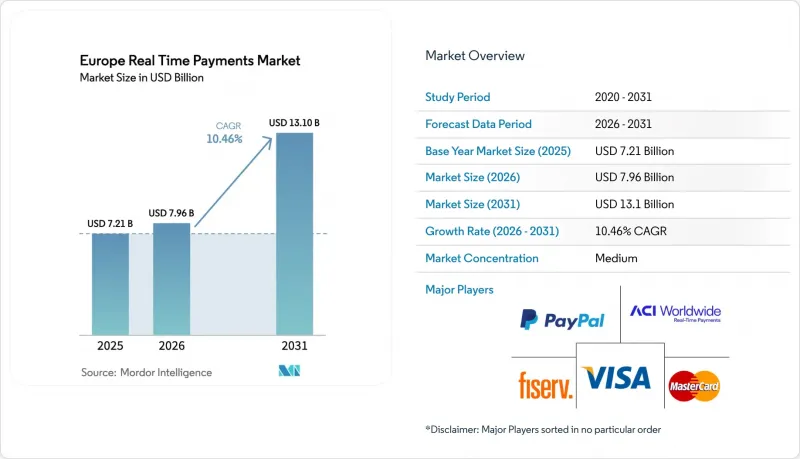
This report is Segmented by Payment Type (P2P, P2B / C2B), Component (Platform / Software, Services (Consulting, Integration, Managed)), Enterprise Size (Large Enterprises, Small and Mid-Size Enterprises (SMEs)), End-User Industry (Banking and Financial Services (BFSI), Retail and ECommerce, Telecom and Media, and More), and Country. The Market Forecasts are Provided in Terms of Value (USD).
Europe Real Time Payments Market Trends and Insights
Adoption of Pan-European Instant SEPA Mandate (SCT Inst) Drives Market Acceleration
Mandatory SCT Inst adherence compels Eurozone banks to receive instant payments by January 2025 and dispatch them by October 2025. Cost-parity clauses cut average instant transfer fees from EUR 2.19 to EUR 0.76, eliminating the economic barrier that had capped consumer uptake. The latest rulebook also tightens execution to 5 seconds and lifts single-transaction limits close to EUR 1 billion (USD 1.08 billion), positioning the rail for high-value corporate flows. Banks are therefore shifting investment from per-transaction pricing models to value-added overlay services such as Request-to-Pay and fraud-verified account matching. As liquidity settles in near-real time, corporates gain faster access to incoming funds, further perpetuating volume growth in the Europe real time payments market.
PSD3 and SPAA-Driven Open-Banking Use-Cases Expand Beyond Payment Initiation
SPAA's remuneration framework finally introduces a viable economic model for premium APIs, encouraging banks to commercialise data products rather than treating open banking as a compliance cost. Dynamic Recurring Payments, pilot-tested in 2025, allow merchants to vary debits without fresh mandates, reducing rejection rates and smoothing cash flow. PSD3 harmonises licensing for Payment and Electronic Money Institutions, closing loopholes that had supported fragmented market entry. These reforms deepen integration between instant clearing rails and value-added digital services, creating new monetisation paths for banks and fintechs.
Fragmented RTP Clearing Infrastructure Creates Operational Complexity
TIPS processed 196 million payments worth EUR 122 billion (USD 132 billion) in H1 2024 with 99% completion inside 5 seconds. Yet PSPs must still fund liquidity across TIPS, RT1 and domestic schemes, tying up working capital and raising settlement risk. The ECB's project for a single liquidity pool aims to consolidate cash buffers, but divergent implementation timelines keep liquidity siloed, disproportionately burdening smaller PSPs and tempering scale economics in the Europe real time payments market.
Other drivers and restraints analyzed in the detailed report include:
- Corporate Treasury Shift to ISO 20022 for Instant Liquidity Management
- Rise of Request-to-Pay (R2P) for Utilities and Public Sector Applications
- Payment Fraud Escalation Threatens Consumer Confidence
For complete list of drivers and restraints, kindly check the Table Of Contents.
Segment Analysis
P2P transfers controlled 40.80% of 2025 volumes; however, P2B/C2B flows are forecast to grow 13.59% annually through 2031. The Europe real time payments market size for P2B transactions is expected to add USD 3.36 billion in incremental revenue between 2026 and 2031 as merchants pivot away from card interchange. Wero's July 2024 launch in Germany and Belgium showcases the strategic sequencing from P2P to online checkout, an expansion that brings competitive pressure to global card schemes. Emerging multi-scheme routing-Spain's Bizum, Italy's Bancomat Pay and Portugal's MB Way-illustrates regional collaboration designed to maintain domestic sovereignty while meeting cross-border consumer expectations. For merchants, account-to-account rails lower acceptance costs and improve settlement speed, strengthening loyalty propositions and solidifying the Europe real time payments market as a credible alternative to established card networks.
Second-order dynamics suggest a gradual re-balancing of revenue pools. Payment-service providers able to deliver single-API access across multiple instant schemes are best positioned to capture scaled P2B volumes. As Request-to-Pay matures, utilities and public entities will shift from episodic batch collections to interactive billing, adding recurring traffic that sustains infrastructure utilisation. The Europe real time payments market therefore pivots from consumer-initiated transfers to enterprise-led cash management, accelerating monetisation potential across service layers.
Platform/Software licences represented 62.70% of 2025 spending, but Services are forecast to grow 15.32% CAGR. Mandatory eurozone Send-capability by October 2025 drives a wave of consulting engagements and managed-service contracts, moving the Europe real time payments market size for Services from USD 2.3 billion in 2025 to USD 5.41 billion by 2031. Tier-1 banks frequently adopt "lift-and-shift" strategies-modernising legacy payment hubs while outsourcing non-differentiating functions such as ISO 20022 mapping and scheme certification. ACI Worldwide's cloud-native deployments and IBM Z-based scaling examples prove demand for resilient, high-volume platforms complemented by expert service wrappers.
Institutions with thin IT budgets increasingly favour shared-service utilities, allowing them to meet regulatory timelines without heavy capital spend. This shift also opens cross-selling potential for analytics, fraud management and value-added overlay services. As real-time volumes rise, continuous performance tuning becomes critical, keeping specialised integrators in constant demand and reinforcing the Europe real time payments market's service-centric revenue trajectory.
Complete Report Scope:
- By Payment Type
- P2P
- P2B / C2B
- By Component
- Platform / Software
- Services (Consulting, Integration, Managed)
- By Enterprise Size
- Large Enterprises
- Small and Mid-Size Enterprises (SMEs)
- By End-User Industry
- Banking and Financial Services (BFSI)
- Retail and eCommerce
- Telecom and Media
- Healthcare
- Other End-user Industries
- By Country
- United Kingdom
- Germany
- France
- Spain
- Italy
- Poland
- Rest of Europe
List of Companies Covered in this Report:
- PayPal Holdings Inc.
- Fiserv Inc.
- ACI Worldwide Inc.
- Mastercard Inc.
- Visa Inc.
- FIS Global
- Adyen NV
- Nexi Group (Nets)
- Worldline SA
- Apple Inc.
- Klarna Bank AB
- Tink AB (Visa)
- Finastra
- Volante Technologies Inc.
- Temenos AG
- Modulr
- TrueLayer
- Trustly Group
- Banking Circle
- GoCardless
Additional Benefits:
- The market estimate (ME) sheet in Excel format
- 3 months of analyst support
TABLE OF CONTENTS
1 INTRODUCTION
- 1.1 Study Assumptions and Market Definition
- 1.2 Scope of the Study
2 RESEARCH METHODOLOGY
3 EXECUTIVE SUMMARY
4 MARKET LANDSCAPE
- 4.1 Market Overview
- 4.2 Market Drivers
- 4.2.1 Adoption of Pan-European Instant SEPA Mandate (SCT Inst)
- 4.2.2 PSD3 and SPAA-Driven Open-Banking Use-Cases Drives the Market
- 4.2.3 Corporate Treasury Shift to ISO 20022 for Instant Liquidity Drives the Market
- 4.2.4 Rise of Request-to-Pay (R2P) for Utilities and Public Sector Drives the Market
- 4.3 Market Restraints
- 4.3.1 Fragmented RTP Clearing Infrastructure (TIPS vs. RT1 vs. Domestic) Hinders the Market
- 4.3.2 Payment Fraud such as Authorized Push Payment Scams
- 4.3.3 High AML/SCA Compliance Costs Hinders the Market
- 4.4 Value Chain Analysis
- 4.5 Regulatory Outlook
- 4.6 Porter's Five Forces Analysis
- 4.6.1 Bargaining Power of Suppliers
- 4.6.2 Bargaining Power of Buyers
- 4.6.3 Threat of New Entrants
- 4.6.4 Threat of Substitutes
- 4.6.5 Intensity of Competitive Rivalry
- 4.7 Pricing Analysis
- 4.8 Evolution of Europe's Payments Landscape
- 4.9 Cashless-Transaction Growth Trends
- 4.10 Assessment of Macro Economic Trends on the Market
- 4.11 RTP Share of All Transactions - Volumes and Values (Country-level)
- 4.12 RTP Share of Non-Cash Transactions - Volumes
5 MARKET SIZE AND GROWTH FORECASTS (VALUES)
- 5.1 By Payment Type
- 5.1.1 P2P
- 5.1.2 P2B / C2B
- 5.2 By Component
- 5.2.1 Platform / Software
- 5.2.2 Services (Consulting, Integration, Managed)
- 5.3 By Enterprise Size
- 5.3.1 Large Enterprises
- 5.3.2 Small and Mid-Size Enterprises (SMEs)
- 5.4 By End-User Industry
- 5.4.1 Banking and Financial Services (BFSI)
- 5.4.2 Retail and eCommerce
- 5.4.3 Telecom and Media
- 5.4.4 Healthcare
- 5.4.5 Other End-user Industries
- 5.5 By Country
- 5.5.1 United Kingdom
- 5.5.2 Germany
- 5.5.3 France
- 5.5.4 Spain
- 5.5.5 Italy
- 5.5.6 Poland
- 5.5.7 Rest of Europe
6 COMPETITIVE LANDSCAPE
- 6.1 Market Concentration
- 6.2 Strategic Moves (MandA, JV, Product Launches)
- 6.3 Market Share Analysis
- 6.4 Company Profiles (includes Global-level Overview, Market-level Overview, Core Segments, Financials, Strategic Info, Market Rank/Share, Products and Services, Recent Developments)
- 6.4.1 PayPal Holdings Inc.
- 6.4.2 Fiserv Inc.
- 6.4.3 ACI Worldwide Inc.
- 6.4.4 Mastercard Inc.
- 6.4.5 Visa Inc.
- 6.4.6 FIS Global
- 6.4.7 Adyen NV
- 6.4.8 Nexi Group (Nets)
- 6.4.9 Worldline SA
- 6.4.10 Apple Inc.
- 6.4.11 Klarna Bank AB
- 6.4.12 Tink AB (Visa)
- 6.4.13 Finastra
- 6.4.14 Volante Technologies Inc.
- 6.4.15 Temenos AG
- 6.4.16 Modulr
- 6.4.17 TrueLayer
- 6.4.18 Trustly Group
- 6.4.19 Banking Circle
- 6.4.20 GoCardless
7 MARKET OPPORTUNITIES AND FUTURE OUTLOOK
- 7.1 White-Space and Unmet-Need Assessment

