PUBLISHER: Mordor Intelligence | PRODUCT CODE: 2125294

PUBLISHER: Mordor Intelligence | PRODUCT CODE: 2125294
Asia Pacific Real Time Payment - Market Share Analysis, Industry Trends & Statistics, Growth Forecasts (2026 - 2031)
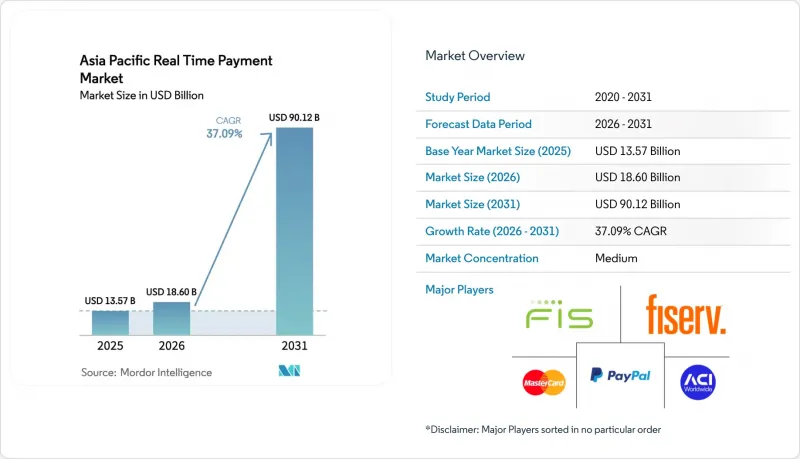
According to Mordor Intelligence, the Asia Pacific real time payment market size is expected to grow from USD 13.57 billion in 2025 to USD 18.6 billion in 2026 and is forecast to reach USD 90.12 billion by 2031 at 37.09% CAGR over 2026-2031.
This report is Segmented by Transaction Type (Peer-To-Peer (P2P), and Peer-To-Business (P2B)), Component (Platform / Solution, and Services), Deployment Mode (Cloud, and On-Premise), Enterprise Size (Large Enterprises, and Small and Medium Enterprises), End-User Industry (Retail and E-Commerce, Utilities and Telecom, and More), and Country. The Market Forecasts are Provided in Terms of Value (USD).
Asia Pacific Real Time Payment Market Trends and Insights
Accelerated Adoption of National Instant-Payment Rails in Developing APAC Economies
National instant-payment schemes are transforming financial inclusion across emerging Asia. Indonesia's BI-FAST, the Philippines' InstaPay, and Malaysia's RTP platform illustrate how central banks use 24/7 rails to bypass correspondent networks, shrink settlement from days to seconds, and stimulate GDP through improved cash-flow velocity. Thailand's PromptPay now accounts for 43.2% of domestic payments, demonstrating that low-cost merchant onboarding can unlock mass acceptance. Pakistan's Raast projects 63.5 million new banked citizens by 2028, reinforcing the link between real-time rails and social-equity outcomes. Across India, Brazil, China, Thailand, and Mexico, instant payments lifted USD 99.6 billion in incremental GDP during 2023, validating the macroeconomic multiplier that accompanies real-time settlement.
Mobile-First Consumer Base Enabling QR-Code and App-Based RTP Ecosystems
Smartphones are ubiquitous and affordable across Asia, and standard QR specifications make them powerful payment instruments. In China, mobile wallets expanded from 3.5% share in 2011 to 83% in 2018, giving app-based payments near-universal consumer reach. Indonesia's QRIS framework harmonizes previously fragmented codes, enabling over 26 million merchants to accept domestic and cross-border QR payments on low-cost handsets. Surveys reveal that 72% of Southeast Asian consumers attempted cashless payments in 2023, with 79% using mobile wallets; cross-border QR interoperability, such as the Cambodia-Japan Bakong-JPQR link, further reduces remittance costs by 80% while shrinking settlement times to 10 seconds.
Fragmented Regulatory Standards Across APAC Jurisdictions
Diverging data-localization mandates, AML rules, and ISO 20022 adoption schedules complicate cross-border connections. Providers often duplicate compliance teams country-by-country, pushing up operating costs and slowing time-to-market. Absence of harmonized technical standards leaves each scheme running unique message formats, creating one-off integration projects that inflate capital budgets. Patchy central-bank digital-currency frameworks add another compliance layer, particularly for fintechs that lack legal resources. Smaller merchants may be deterred altogether, reinforcing digital divides among ASEAN economies.
Other drivers and restraints analyzed in the detailed report include:
- Government-Led Cashless Initiatives
- Cross-Border RTP Corridors Driving Merchant Acceptance in E-Commerce
- High Fraud and Scam Incidence in Instant-Payment Channels
For complete list of drivers and restraints, kindly check the Table Of Contents.
Segment Analysis
Peer-to-peer transfers held 54.25% revenue in 2025, reflecting the consumer origins of the Asia Pacific real time payment market. Yet the peer-to-business segment shows superior momentum, growing 44.32% CAGR to 2031 as merchants embrace instant settlement to unlock working capital. Corporates in China alone could free USD 421 billion by optimizing payment timing, while 71% of Southeast Asian SMBs link digital payments to sales increases.
The P2B surge also rides government digitization of procurement and tax receipts, illustrated by India's Bharat Bill Payment System registering 60% yearly value growth. Retailers showcase tangible benefits: Reliance Retail achieved 19.4% revenue growth with 40% digital payments; D-Mart lifted profitability as UPI captured a quarter of sales. Cross-border B2B instant transfers are forecast to reach 42% of USD 16 trillion in enterprise payments by 2028, signifying growing reliance on open-loop account-to-account rails that bypass card fees.
Platforms and solutions controlled 67.15% of 2025 spend, yet professional services now expand at 41.05% CAGR, reflecting the technical and regulatory complexity of modern instant-payment ecosystems. Cloud migrations, ISO 20022 upgrades, and API security assessments require specialized knowledge that banks often outsource. Malaysia's PayNet relied on consulting partners to adapt core systems for DuitNow QR and regional QR interoperability within nine months, underscoring services demand.
Legacy modernization is another driver; 14% of financial institutions still depend on outdated mainframes that need gradual conversion to avoid disruption. Service integrators deploy facade APIs, message converters, and hybrid cloud designs to maintain uptime during cutovers. Consequently, advisory and managed-service revenue outpaces traditional license fees, anchoring a recurring-revenue layer inside the Asia Pacific real time payment market.
Complete Report Scope:
- By Transaction Type
- Peer-to-Peer (P2P)
- Peer-to-Business (P2B)
- By Component
- Platform / Solution
- Services
- By Deployment Mode
- Cloud
- On-Premise
- By Enterprise Size
- Large Enterprises
- Small and Medium Enterprises
- By End-User Industry
- Retail and E-Commerce
- BFSI
- Utilities and Telecom
- Healthcare
- Government and Public Sector
- Other End-user Industries
- By Country
- China
- India
- Japan
- South Korea
- Australia
- Singapore
- Indonesia
- Rest of Asia-Pacific
List of Companies Covered in this Report:
- Fiserv Inc.
- PayPal Holdings Inc.
- Mastercard Inc.
- FIS Global
- Visa Inc.
- Ant Group Co. Ltd.
- Tencent Holdings Ltd.
- Paytm Payments Bank Ltd.
- ACI Worldwide Inc.
- Apple Inc.
- SIA SpA (Nexi Group)
- Finastra
- National Payments Corporation of India (NPCI)
- Australian Payments Plus
- Ripple Labs Inc.
- Temenos AG
- Huawei Technologies Co. Ltd.
- UnionPay International
- Nets Group
- Grab Holdings Ltd.
- Kakao Pay Corp.
- Gcash Inc.
Additional Benefits:
- The market estimate (ME) sheet in Excel format
- 3 months of analyst support
TABLE OF CONTENTS
1 INTRODUCTION
- 1.1 Study Assumptions and Market Definition
- 1.2 Scope of the Study
2 RESEARCH METHODOLOGY
3 EXECUTIVE SUMMARY
4 MARKET LANDSCAPE
- 4.1 Market Overview
- 4.2 Market Drivers
- 4.2.1 Accelerated Adoption of National Instant-Payment Rails in Developing APAC Economies
- 4.2.2 Mobile-First Consumer Base Enabling QR-Code and App-Based RTP Ecosystems
- 4.2.3 Government-Led Cashless Initiatives such as India's Digital Public Infrastructure Drives the Market
- 4.2.4 Cross-Border RTP Corridors Driving Merchant Acceptance in E-commerce Drives the Market
- 4.2.5 API-Driven Open-Banking Frameworks Lowering Integration Barriers for RTP
- 4.2.6 Rising Demand from Gig-Economy and Salary-On-Demand Platforms
- 4.3 Market Restraints
- 4.3.1 Fragmented Regulatory Standards Across APAC Jurisdictions
- 4.3.2 High Fraud and Scam Incidence in Instant-Payment Channels Hinders the Market
- 4.3.3 Legacy Core Banking Systems Limiting Real-Time Settlement by Tier-2 Banks
- 4.3.4 Capex Constraints Among SMEs for RTP API Integration
- 4.4 Industry Value Chain Analysis
- 4.5 Regulatory Outlook
- 4.6 Porter's Five Forces Analysis
- 4.6.1 Bargaining Power of Suppliers
- 4.6.2 Bargaining Power of Buyers
- 4.6.3 Threat of New Entrants
- 4.6.4 Threat of Substitute Products
- 4.6.5 Intensity of Competitive Rivalry
- 4.7 Evolution of the Payments Landscape in Asia-Pacific
- 4.8 Key Cashless-Transaction Trends
- 4.9 Assessment of Macro Economic Trends on the Market
- 4.10 Analysis of Major Case Studies and Use-Cases
- 4.11 Investment Analysis
5 MARKET SIZE AND GROWTH FORECASTS (VALUES)
- 5.1 By Transaction Type
- 5.1.1 Peer-to-Peer (P2P)
- 5.1.2 Peer-to-Business (P2B)
- 5.2 By Component
- 5.2.1 Platform / Solution
- 5.2.2 Services
- 5.3 By Deployment Mode
- 5.3.1 Cloud
- 5.3.2 On-Premise
- 5.4 By Enterprise Size
- 5.4.1 Large Enterprises
- 5.4.2 Small and Medium Enterprises
- 5.5 By End-User Industry
- 5.5.1 Retail and E-Commerce
- 5.5.2 BFSI
- 5.5.3 Utilities and Telecom
- 5.5.4 Healthcare
- 5.5.5 Government and Public Sector
- 5.5.6 Other End-user Industries
- 5.6 By Country
- 5.6.1 China
- 5.6.2 India
- 5.6.3 Japan
- 5.6.4 South Korea
- 5.6.5 Australia
- 5.6.6 Singapore
- 5.6.7 Indonesia
- 5.6.8 Rest of Asia-Pacific
6 COMPETITIVE LANDSCAPE
- 6.1 Market Concentration
- 6.2 Strategic Moves
- 6.3 Market Share Analysis
- 6.4 Company Profiles {(includes Global level Overview, Market level overview, Core Segments, Financials as available, Strategic Information, Market Rank/Share for key companies, Products and Services, and Recent Developments)}
- 6.4.1 Fiserv Inc.
- 6.4.2 PayPal Holdings Inc.
- 6.4.3 Mastercard Inc.
- 6.4.4 FIS Global
- 6.4.5 Visa Inc.
- 6.4.6 Ant Group Co. Ltd.
- 6.4.7 Tencent Holdings Ltd.
- 6.4.8 Paytm Payments Bank Ltd.
- 6.4.9 ACI Worldwide Inc.
- 6.4.10 Apple Inc.
- 6.4.11 SIA SpA (Nexi Group)
- 6.4.12 Finastra
- 6.4.13 National Payments Corporation of India (NPCI)
- 6.4.14 Australian Payments Plus
- 6.4.15 Ripple Labs Inc.
- 6.4.16 Temenos AG
- 6.4.17 Huawei Technologies Co. Ltd.
- 6.4.18 UnionPay International
- 6.4.19 Nets Group
- 6.4.20 Grab Holdings Ltd.
- 6.4.21 Kakao Pay Corp.
- 6.4.22 Gcash Inc.
7 MARKET OPPORTUNITIES AND FUTURE OUTLOOK
- 7.1 White-Space an Unmet-Need Assessment

