PUBLISHER: Mordor Intelligence | PRODUCT CODE: 2125298

PUBLISHER: Mordor Intelligence | PRODUCT CODE: 2125298
Japan Real Time Payment - Market Share Analysis, Industry Trends & Statistics, Growth Forecasts (2026 - 2031)
According to Mordor Intelligence, the Japan real time payment market size was valued at USD 2.71 billion in 2025 and estimated to grow from USD 3.56 billion in 2026 to reach USD 13.86 billion by 2031, at a CAGR of 31.28% during the forecast period (2026-2031).
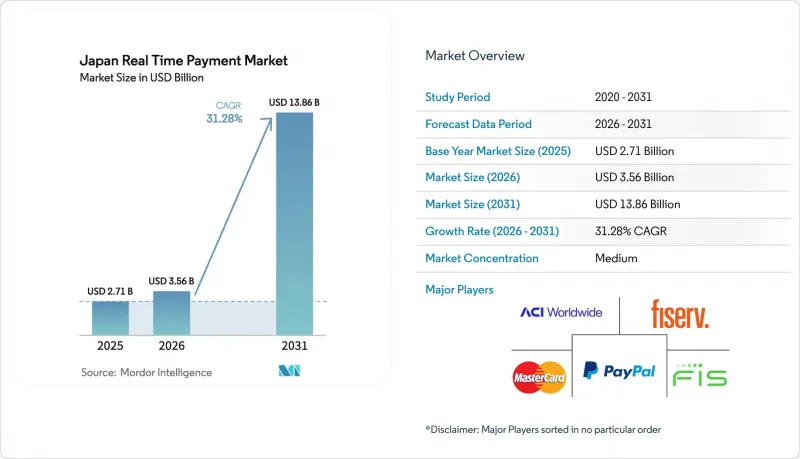
This report is Segmented by Transaction Type (P2P, P2B, B2B, B2C, and G2C), Enterprise Size (Large, Smes, and Micro-Businesses), End-User Industry (Retail and E-Commerce, BFSI, Healthcare, Transportation and Mobility, and More), and Technology / Payment Rail (Zengin RT-Net, QR-Code Overlay, Mobile Wallet Overlay, and API / ISO 20022 Push). The Market Forecasts are Provided in Terms of Value (USD).
Japan Real Time Payment Market Trends and Insights
Rising Smartphone Penetration and 5G Roll-Out
Japan's 5G footprint covers nearly the entire population, enabling sub-10-millisecond payment authentication and smoother in-app checkout experiences. Enhanced connectivity shifts fraud detection from overnight batch scoring to real-time behavioral analytics, reducing false declines and encouraging cash-centric users to adopt mobile wallets. Amazon Web Services is investing USD 15 billion in local data centers by 2027, guaranteeing low-latency API calls that keep real-time gateways responsive. Despite these gains, households in mountainous Tohoku prefectures still experience network blind spots, prolonging cash reliance among older residents. The continued rollout of rural micro-cell towers and simplified wallet interfaces for seniors remains critical to closing the urban-rural adoption gap.
Government JPY 100 Trillion Cashless Vision and Subsidy Schemes
The Ministry of Economy, Trade and Industry subsidizes up to 75% of terminal costs for retailers earning under JPY 10 million, accelerating merchant enablement in convenience-store and hospitality segments. A cross-ministry API framework launched in 2024 connects My Number Card identity verification to payment rails, trimming wallet KYC from three days to minutes. Prefectural cashback campaigns have temporarily lifted QR volumes by 40%, though sunset dates raise sustainability concerns. The Financial GIF now mandates real-time settlement for public-utility bills by April 2026, embedding push payments into monthly household routines. Execution risk lingers, as some municipal billing systems still process fixed-field data formats that cannot parse ISO 20022 tags.
High Share of Small-Value Cash Transactions in Rural Japan
Coins and notes still account for 55% of convenience-store purchases outside major metropolitan areas, reflecting patchy network coverage and a cultural preference for tangible money among residents aged 65 and above. My Number Card readers have yet to penetrate mom-and-pop shops, as the costs of firmware exceed the perceived benefits. Depopulation reduces daily sales, making terminal support unprofitable for processors unless it is bundled with higher-margin services. Until offline QR codes or voice-activated prompts reach mass deployment, cash will remain dominant for sub-JPY 1,000 tickets in sparsely populated districts.
Other drivers and restraints analyzed in the detailed report include:
- Migration to ISO 20022 Real-Time Rails (RT-Net Upgrade)
- E-Commerce Checkout Abandonment Pressure on Merchants
- Merchant Interchange Caps Limit Economics for PSPs
For complete list of drivers and restraints, kindly check the Table Of Contents.
Segment Analysis
B2B settlements are forecast to climb at a 32.60% CAGR, the quickest among transaction classes, as treasurers exploit the Zengin More Time System to sweep idle balances and automate payables using ISO 20022 references. Peer-to-peer transfers still led 2025 volume, holding 41.05% of Japan real time payment market share, energized by group-payment features in super-apps.
Corporate disbursements such as payroll and insurance claims are migrating from batch ACH to push payments, allowing employees and claimants to receive funds within minutes. Government-to-consumer flows remain nascent but will accelerate once real-time payouts of social-security benefits go live under the Digital Agency's 2026 mandate. Straight-through reconciliation cuts back-office workload for conglomerates, yet smaller suppliers without ERP plug-ins must still match invoices manually.
Small and medium-sized enterprises held 46.10% of Japan real time payment market share in 2025 thanks to low-cost QR adoption. Embedded-finance suites now let even sole proprietors issue invoices and obtain short-term credit inside the same wallet, driving a forecast 32.95% CAGR for micro-business transactions.
Large corporates wield the highest average ticket values and negotiate direct Zengin connections that bypass overlay fees, but they are hampered by legacy accounting systems unable to read ISO 20022 tags. Rural micro-merchants remain hard to serve profitably under capped interchange, though bundling with buy-now-pay-later or loyalty marketing can improve unit economics.
Complete Report Scope:
- By Transaction Type
- Peer-to-Peer (P2P)
- Peer-to-Business (P2B)
- Business-to-Business (B2B)
- Business-to-Consumer (B2C)
- Government-to-Consumer (G2C)
- By Enterprise Size
- Large Enterprises
- Small and Medium-sized Enterprises (SMEs)
- Micro-businesses
- By End-User Industry
- Retail and E-commerce
- Banking, Financial Services and Insurance (BFSI)
- Healthcare
- Transportation and Mobility
- Government and Public Utilities
- Other End-User Industries
- By Technology / Payment Rail
- Zengin RT-Net (Bank Account-to-Account)
- QR-Code Overlay Services
- Mobile Wallet Overlay (e.g., PayPay, LINE Pay)
- API / ISO 20022 Push Payments
List of Companies Covered in this Report:
- ACI Worldwide Inc.
- Ant Group Co., Ltd. (Alipay)
- Apple Inc.
- FIS Global (Fidelity National Information Services, Inc.)
- Fiserv, Inc.
- Mastercard Incorporated
- PayPal Holdings, Inc.
- Visa Inc.
- SIA S.p.A.
- Finastra Group Holdings Limited
- NTT DATA Corporation
- GMO Payment Gateway, Inc.
- PayPay Corporation
- LINE Pay Corporation
- Rakuten Group, Inc. (Rakuten Pay)
- JCB Co., Ltd.
- Mitsubishi UFJ Financial Group, Inc.
- Sumitomo Mitsui Banking Corporation
- Mizuho Bank, Ltd.
- Seven Bank, Ltd.
- Kyash Inc.
- Liquid Group Inc.
- Smartpay K.K.
Additional Benefits:
- The market estimate (ME) sheet in Excel format
- 3 months of analyst support
TABLE OF CONTENTS
1 INTRODUCTION
- 1.1 Study Assumptions and Market Definition
- 1.2 Scope of the Study
2 RESEARCH METHODOLOGY
3 EXECUTIVE SUMMARY
4 MARKET LANDSCAPE
- 4.1 Market Overview
- 4.2 Market Drivers
- 4.2.1 Rising Smartphone Penetration And 5G Roll-Out
- 4.2.2 Government JPY 100 Trillion Cashless Vision And Subsidy Schemes
- 4.2.3 Migration To ISO 20022 Real-Time Rails (RT-Net Upgrade)
- 4.2.4 E-Commerce Checkout Abandonment Pressure on Merchants
- 4.2.5 Corporate Treasury Demand for Intraday Liquidity
- 4.2.6 Super-App Ecosystems (LINE Pay / Paypay) Race for Users
- 4.3 Market Restraints
- 4.3.1 High Share Of Small-Value Cash Transactions in Rural Japan
- 4.3.2 Merchant Interchange Caps Limit Economics for PSPs
- 4.3.3 Cyber-Fraud Surge In Push Payments (APP Scams)
- 4.3.4 Fragmented QR Code Standards Slowing Ubiquity
- 4.4 Industry Value Chain Analysis
- 4.5 Impact of Macroeconomic Factors on the Market
- 4.6 Regulatory Landscape
- 4.7 Technological Outlook
- 4.8 Porter's Five Forces Analysis
- 4.8.1 Bargaining Power of Suppliers
- 4.8.2 Bargaining Power of Buyers
- 4.8.3 Threat of New Entrants
- 4.8.4 Threat of Substitutes
- 4.8.5 Intensity of Competitive Rivalry
5 MARKET SIZE AND GROWTH FORECASTS (VALUE)
- 5.1 By Transaction Type
- 5.1.1 Peer-to-Peer (P2P)
- 5.1.2 Peer-to-Business (P2B)
- 5.1.3 Business-to-Business (B2B)
- 5.1.4 Business-to-Consumer (B2C)
- 5.1.5 Government-to-Consumer (G2C)
- 5.2 By Enterprise Size
- 5.2.1 Large Enterprises
- 5.2.2 Small and Medium-sized Enterprises (SMEs)
- 5.2.3 Micro-businesses
- 5.3 By End-User Industry
- 5.3.1 Retail and E-commerce
- 5.3.2 Banking, Financial Services and Insurance (BFSI)
- 5.3.3 Healthcare
- 5.3.4 Transportation and Mobility
- 5.3.5 Government and Public Utilities
- 5.3.6 Other End-User Industries
- 5.4 By Technology / Payment Rail
- 5.4.1 Zengin RT-Net (Bank Account-to-Account)
- 5.4.2 QR-Code Overlay Services
- 5.4.3 Mobile Wallet Overlay (e.g., PayPay, LINE Pay)
- 5.4.4 API / ISO 20022 Push Payments
6 COMPETITIVE LANDSCAPE
- 6.1 Market Concentration
- 6.2 Strategic Moves
- 6.3 Market Share Analysis
- 6.4 Company Profiles (includes Global level Overview, Market level overview, Core Segments, Financials as available, Strategic Information, Market Rank/Share for key companies, Products and Services, and Recent Developments)
- 6.4.1 ACI Worldwide Inc.
- 6.4.2 Ant Group Co., Ltd. (Alipay)
- 6.4.3 Apple Inc.
- 6.4.4 FIS Global (Fidelity National Information Services, Inc.)
- 6.4.5 Fiserv, Inc.
- 6.4.6 Mastercard Incorporated
- 6.4.7 PayPal Holdings, Inc.
- 6.4.8 Visa Inc.
- 6.4.9 SIA S.p.A.
- 6.4.10 Finastra Group Holdings Limited
- 6.4.11 NTT DATA Corporation
- 6.4.12 GMO Payment Gateway, Inc.
- 6.4.13 PayPay Corporation
- 6.4.14 LINE Pay Corporation
- 6.4.15 Rakuten Group, Inc. (Rakuten Pay)
- 6.4.16 JCB Co., Ltd.
- 6.4.17 Mitsubishi UFJ Financial Group, Inc.
- 6.4.18 Sumitomo Mitsui Banking Corporation
- 6.4.19 Mizuho Bank, Ltd.
- 6.4.20 Seven Bank, Ltd.
- 6.4.21 Kyash Inc.
- 6.4.22 Liquid Group Inc.
- 6.4.23 Smartpay K.K.
7 MARKET OPPORTUNITIES AND FUTURE OUTLOOK
- 7.1 White-space and Unmet-Need Assessment

