PUBLISHER: Mordor Intelligence | PRODUCT CODE: 2125316

PUBLISHER: Mordor Intelligence | PRODUCT CODE: 2125316
United States Real Time Payments - Market Share Analysis, Industry Trends & Statistics, Growth Forecasts (2026 - 2031)
According to Mordor Intelligence, the US real time payments market size in 2026 is estimated at USD 0.46 billion, growing from 2025 value of USD 0.33 billion with 2031 projections showing USD 2.29 billion, growing at 38.12% CAGR over 2026-2031.
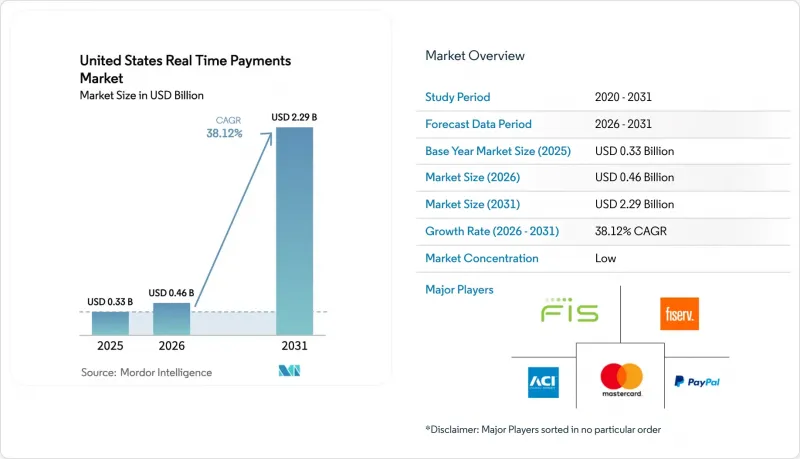
This report is Segmented by Transaction Type (Peer-To-Peer (P2P), Peer-To-Business (P2B)), Component (Platform / Solution, Services), Deployment (Cloud, On-Premise), Enterprise Size (Large Enterprises, Small and Medium Enterprises), End-User Industry (Retail and E-Commerce, BFSI, Utilities & Telecom, Healthcare, and More). The Market Forecasts are Provided in Terms of Value (USD).
United States Real Time Payments Market Trends and Insights
Expansion of TCH RTP network across mid-tier & community banks
TCH's funding-agent model allows community institutions with assets under USD 1 billion to join RTP at roughly 40% of prior cost, leveling the competitive field against national banks. Bankers' Bank and KeyBank illustrate scalability: KeyBank alone expects 4 million RTP transactions in 2025, benefiting Midwest manufacturing clients that rely on just-in-time cash flow. February 2025's hike of the single-payment cap to USD 10 million opens B2B use cases such as real-estate closings and supplier finance. As over 70% of US banking institutions fall in the community category, this driver meaningfully enlarges addressable volume and injects new competitive dynamics to the US real time payments market.
Launch of FedNow Service enabling 24X7X365 interbank settlement
FedNow settles directly against Fed master accounts, eliminating prefunding and counterparty risk that limit private rails. Cloud-native design gives resiliency and scalability, letting smaller banks go live in weeks rather than quarters. More than 900 institutions enrolled by end-2024-nearly double RTP's base-highlight trust in a government-operated system. Treasury's mandate that federal agencies migrate to electronic disbursements by September 2025 guarantees a committed demand corridor, while the planned USD 1 million transaction ceiling in summer 2025 positions FedNow to cannibalize traditional wire revenue.
Core banking legacy integration & batch-processing constraints
Roughly 94% of US banks still rely on overnight batch cores conceived decades ago, making 24X7 posting a technical hurdle. The Federal Reserve Bank of Kansas City estimates full modernizations cost hundreds of millions and require 3-5 years, a burden magnified for community lenders. Third-party enablers mitigate pain, yet high integration complexity continues to slow rollouts, tempering the growth trajectory of the US real time payments market.
Other drivers and restraints analyzed in the detailed report include:
- Instant payroll & earnings disbursement demand from gig-economy platforms
- Adoption of Request-for-Payment by US billers & utilities
- Escalating authorised push-payment (APP) fraud & scam risks
For complete list of drivers and restraints, kindly check the Table Of Contents.
Segment Analysis
P2P transactions dominated the US real time payments market with 71.76% share in 2025. Zelle alone processed 1.7 billion transfers worth USD 481 billion in H1 2024, affirming consumer uptake. That said, the P2B corridor is the market's growth engine. At a 39.45% CAGR, P2B is forecast to narrow the volume gap by 2031 as corporates use instant settlement to cut days-sales-outstanding. The segment tackles the USD 707 billion in US corporate trapped cash, unlocking supply-chain liquidity. FedNow's planned USD 1 million limit also enables high-value invoice payments, accelerating commercial use.
Fintech gateways are adding dynamic discount tools that auto-calculate supplier incentives when invoices are paid instantly, making P2B strategically valuable for treasury teams. Early data from the Swedish central bank suggests small suppliers experience improved sales and employment once buyers deploy real-time settlements. As middle-market firms display willingness to pay 3% service fees for automated payables, monetization potential reinforces momentum in this corridor.
Platforms accounted for 63.28% of spending in 2025, underlining up-front infrastructure demand as banks connect to RTP and FedNow rails. However, managed services-fraud analytics, ISO 20022 translation, treasury dashboards-are projected to outpace with a 33.9% CAGR. Banks cite lower total cost of ownership and faster time-to-market when outsourcing ongoing operations to enablers such as Fiserv and Finastra.
Regulatory change drives the tilt toward services. ISO 20022 migration deadlines push institutions to secure translation gateways, and 63% of corporates expect their banks to handle message conversion. As the US real time payments market matures, differentiation shifts from mere connectivity to value-added orchestration, positioning service vendors for share gains.
Complete Report Scope:
- By Transaction Type
- Peer-to-Peer (P2P)
- Peer-to-Business (P2B)
- By Component
- Platform / Solution
- Services
- By Deployment Mode
- Cloud
- On-Premise
- By Enterprise Size
- Large Enterprises
- Small and Medium Enterprises
- By End-User Industry
- Retail and E-Commerce
- BFSI
- Utilities and Telecom
- Healthcare
- Government and Public Sector
- Other End-user Industries
List of Companies Covered in this Report:
- ACI Worldwide Inc.
- Fidelity National Information Services Inc. (FIS)
- Fiserv Inc.
- Mastercard Incorporated
- Visa Inc.
- PayPal Holdings Inc.
- Worldpay LLC (FIS)
- Temenos AG
- Volante Technologies Inc.
- Montran Corporation
- The Clearing House Payments Company L.L.C.
- Jack Henry and Associates Inc.
- Finastra Group Holdings Ltd.
- Bottomline Technologies Inc.
- Square Inc. (Block)
- Apple Inc.
- Google LLC
- Early Warning Services LLC (Zelle)
- Ingo Money Inc.
- Ripple Labs Inc.
Additional Benefits:
- The market estimate (ME) sheet in Excel format
- 3 months of analyst support
TABLE OF CONTENTS
1 INTRODUCTION
- 1.1 Study Assumptions and Market Definition
- 1.2 Scope of the Study
2 RESEARCH METHODOLOGY
3 EXECUTIVE SUMMARY
4 MARKET LANDSCAPE
- 4.1 Market Overview
- 4.2 Market Drivers
- 4.2.1 Expansion of TCH RTP Network Across Mid-Tier and Community Banks
- 4.2.2 Launch of FedNow Service Enabling 24X7X365 Interbank Settlement
- 4.2.3 Instant Payroll and Earnings Disbursement Demand from Gig-Economy Platforms
- 4.2.4 Adoption of Request-for-Payment by U.S. Billers and Utilities
- 4.2.5 ISO 20022 and Open-API Integration Driving FinTech Partnerships
- 4.2.6 Merchant Push-to-Card / Instant Funding Programs Scaling in E-commerce
- 4.3 Market Restraints
- 4.3.1 Core Banking Legacy Integration and Batch-Processing Constraints
- 4.3.2 Escalating Authorised Push-Payment (APP) Fraud and Scam Risks
- 4.3.3 Absence of Universal Identity Directory Hindering Interoperability
- 4.3.4 Per-Transaction Limit Caps and Liquidity Management Concerns
- 4.4 Value Chain Analysis
- 4.5 Regulatory Outlook (FedNow operating rules, Reg E, UCC updates)
- 4.6 Technological Outlook (Cloud-native RTP hubs, ISO 20022, AI fraud-defence)
- 4.7 Porter's Five Forces Analysis
- 4.7.1 Bargaining Power of Suppliers
- 4.7.2 Bargaining Power of Buyers
- 4.7.3 Threat of New Entrants
- 4.7.4 Threat of Substitutes
- 4.7.5 Intensity of Competitive Rivalry
- 4.8 Evolution of the U.S. Payments Landscape
- 4.9 Key Trends Accelerating Cashless Transactions
- 4.10 Assessment of Macro Economic Trends on the Market
5 MARKET SIZE AND GROWTH FORECASTS (VALUES)
- 5.1 By Transaction Type
- 5.1.1 Peer-to-Peer (P2P)
- 5.1.2 Peer-to-Business (P2B)
- 5.2 By Component
- 5.2.1 Platform / Solution
- 5.2.2 Services
- 5.3 By Deployment Mode
- 5.3.1 Cloud
- 5.3.2 On-Premise
- 5.4 By Enterprise Size
- 5.4.1 Large Enterprises
- 5.4.2 Small and Medium Enterprises
- 5.5 By End-User Industry
- 5.5.1 Retail and E-Commerce
- 5.5.2 BFSI
- 5.5.3 Utilities and Telecom
- 5.5.4 Healthcare
- 5.5.5 Government and Public Sector
- 5.5.6 Other End-user Industries
6 COMPETITIVE LANDSCAPE
- 6.1 Market Concentration
- 6.2 Strategic Moves (MandA, product launches, bank enrollments)
- 6.3 Market Share Analysis
- 6.4 Company Profiles (includes Global-level Overview, Market-level Overview, Core Segments, Financials, Strategic Information, Market Rank/Share, Products and Services, Recent Developments)
- 6.4.1 ACI Worldwide Inc.
- 6.4.2 Fidelity National Information Services Inc. (FIS)
- 6.4.3 Fiserv Inc.
- 6.4.4 Mastercard Incorporated
- 6.4.5 Visa Inc.
- 6.4.6 PayPal Holdings Inc.
- 6.4.7 Worldpay LLC (FIS)
- 6.4.8 Temenos AG
- 6.4.9 Volante Technologies Inc.
- 6.4.10 Montran Corporation
- 6.4.11 The Clearing House Payments Company L.L.C.
- 6.4.12 Jack Henry and Associates Inc.
- 6.4.13 Finastra Group Holdings Ltd.
- 6.4.14 Bottomline Technologies Inc.
- 6.4.15 Square Inc. (Block)
- 6.4.16 Apple Inc.
- 6.4.17 Google LLC
- 6.4.18 Early Warning Services LLC (Zelle)
- 6.4.19 Ingo Money Inc.
- 6.4.20 Ripple Labs Inc.
7 MARKET OPPORTUNITIES AND FUTURE OUTLOOK
- 7.1 White-space and Unmet-need Assessment

