PUBLISHER: Mordor Intelligence | PRODUCT CODE: 2125351

PUBLISHER: Mordor Intelligence | PRODUCT CODE: 2125351
Germany Real Time Payments - Market Share Analysis, Industry Trends & Statistics, Growth Forecasts (2026 - 2031)
According to Mordor Intelligence, the Germany real time payments market size is expected to grow from USD 2.19 billion in 2025 to USD 2.98 billion in 2026 and is forecast to reach USD 13.94 billion by 2031 at 36.15% CAGR over 2026-2031.
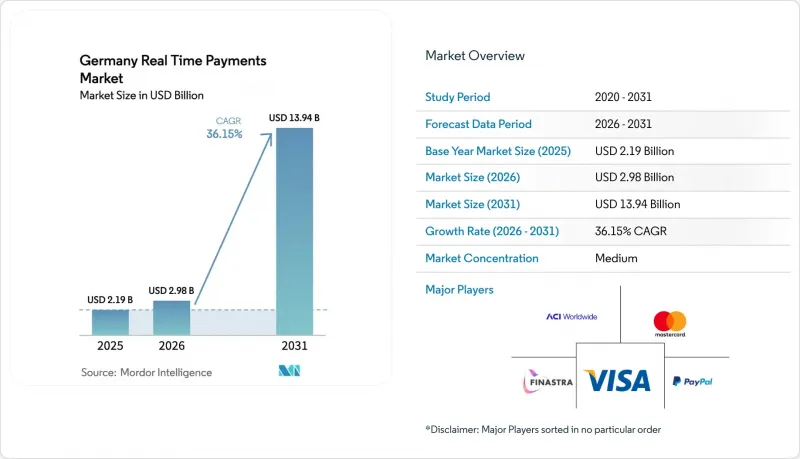
This report is Segmented by Transaction Type (Peer-To-Peer (P2P), Peer-To-Business (P2B)), Component (Platform / Solution, Services), Deployment (Cloud, On-Premise), Enterprise Size (Large Enterprises, Small & Medium Enterprises), End-User Industry (Retail & E-Commerce, BFSI, Utilities & Telecom, Healthcare, and More). The Market Forecasts are Provided in Terms of Value (USD).
Germany Real Time Payments Market Trends and Insights
SEPA Instant Credit Transfer Limit Expansion Transforms B2B Payments
The elevated EUR 100,000 (USD 115602.93) threshold is pushing corporates to switch from batch wires to instant rails, improving intraday liquidity management and reconciling high-value invoices in seconds. German treasurers now integrate real-time balances into cash-pooling dashboards, curbing overdraft costs and enhancing counterparty confidence. Banks that enable automated high-value SCT Inst flows win entrenched positions in corporate wallets. Technology spend concentrates on straight-through processing, fraud analytics, and ISO 20022 enrichment to accommodate richer remittance data. Over the medium term, the new ceiling is expected to blur boundaries between domestic high-value systems and retail instant rails, underpinning broader Germany real time payments market adoption.
E-Invoicing Mandate Drives Corporate Instant Payment Adoption
Germany's January 2025 mandate compels every enterprise to receive e-invoices in structured formats, fostering auto-triggered payment initiation. Seamless data hand-over from invoice to payment removes manual reconciliation and supplier chasing. Early adopters in manufacturing and automotive supply chains report faster days-sales-outstanding and lower dispute overheads. Fintech integrators bundle e-invoice parsing with embedded SCT Inst initiation, selling subscription APIs to accounting software providers. The regulation therefore fortifies Germany real time payments market as corporates re-engineer procure-to-pay cycles.
IBAN-Name Verification Challenges Impede Transaction Completion
Mandatory name-match checks, though effective against APP fraud, currently flag numerous legitimate transfers because of abbreviations or legal entity variants. End-users abort journeys when repeated failures appear, eroding trust. Cross-border payments suffer higher drop-rates as character sets and trading names diverge. PSPs invest in fuzzy-matching engines and customer education to mitigate attrition. Until algorithms mature, false positives will cap short-term growth in Germany real time payments market.
Other drivers and restraints analyzed in the detailed report include:
- Request-to-Pay Revolutionizes E-Commerce Checkout Experience
- Fintech Innovation Sparks 'Buy Now Pay Instantly' Services
- Fragmented Surcharge Rules Limit Micro-Ticket Uptake
For complete list of drivers and restraints, kindly check the Table Of Contents.
Segment Analysis
Peer-to-Business volumes are projected to register a 38.71% CAGR through 2031, reflecting corporate alignment with e-invoicing and Request-to-Pay integration. P2P still accounts for 59.20% of Germany real time payments market share in 2025, yet its growth normalizes as the user base nears ubiquity. Germany real time payments market size for P2B is forecast to broaden materially as retailers, utilities, and professional services embed instant pay links into billing workflows. Fintech wallets like wero lower friction by alias-based payments, encouraging further P2P stickiness.
Businesses benefit from real-time cash positioning and reduced interchange when accepting P2B transfers. Government incentives such as public-sector acceptance for tax remittances will reinforce momentum. P2P innovation now concentrates on value-added layers including split-bill and social commerce. Collectively, these vectors diversify Germany real time payments market avenues and help achieve scale.
Platform investments delivered 67.40% revenue in 2025 as banks raced to achieve basic SCT Inst capability. Now that core connectivity stabilizes, Services are forecast to contribute most incremental revenue, expanding at 32.37% CAGR. Germany real time payments market size for professional services covers integration, compliance consulting, fraud mitigation, and liquidity optimization.
Smaller PSPs outsource rulebook updates, VoP connectivity, and ISO 20022 enrichment to managed-service specialists. Treasury advisory firms package instant payments with cash-forecast modules. Competitive differentiation therefore shifts from speed of settlement to depth of data analytics and contextual value. Vendors that orchestrate multi-rail routing, combine R2P, and wrap reconciliation dashboards will capture higher margins in Germany real time payments market.
Complete Report Scope:
- By Transaction Type
- Peer-to-Peer (P2P)
- Peer-to-Business (P2B)
- By Component
- Platform / Solution
- Services
- By Deployment Mode
- Cloud
- On-Premise
- By Enterprise Size
- Large Enterprises
- Small and Medium Enterprises
- By End-User Industry
- Retail and E-Commerce
- BFSI
- Utilities and Telecom
- Healthcare
- Government and Public Sector
- Other End-user Industries
List of Companies Covered in this Report:
- ACI Worldwide Inc.
- Fiserv Inc.
- Fidelity National Information Services Inc. (FIS)
- Mastercard Inc.
- PayPal Holdings Inc.
- Visa Inc.
- EBA Clearing
- Deutsche Bank AG
- Worldline SA
- Nexi Group SpA
- PPI AG
- Finastra International GmbH
- Temenos AG
- Adyen NV
- Stripe Inc.
- Klarna Bank AB
- Tink AB
- Deutsche Sparkassen Finanzgruppe
- Volksbanken Raiffeisenbanken (BVR)
- Commerzbank AG
Additional Benefits:
- The market estimate (ME) sheet in Excel format
- 3 months of analyst support
TABLE OF CONTENTS
1 INTRODUCTION
- 1.1 Study Assumptions and Market Definition
- 1.2 Scope of the Study
2 RESEARCH METHODOLOGY
3 EXECUTIVE SUMMARY
4 MARKET LANDSCAPE
- 4.1 Market Overview
- 4.2 Market Drivers
- 4.2.1 SEPA Instant Credit Transfer (SCT Inst) limit increase to USD 110 k stimulating high-value B2B flows
- 4.2.2 Federal e-invoicing mandate (2025) accelerating instant settlement for corporates
- 4.2.3 Request-to-Pay (R2P) roll-out boosting instant checkout conversion in e-commerce
- 4.2.4 Fintech "Buy Now Pay Instantly" propositions leveraging Giropay rails
- 4.2.5 Core-bank migration to ISO 20022 enabling ubiquity of instant rails in Sparkassen and Volksbanken
- 4.3 Market Restraints
- 4.3.1 IBAN-name-mismatch false positives raising abandonment rates
- 4.3.2 Fragmented merchant surcharge rules limiting adoption in micro-ticket segments
- 4.3.3 Limited evening and weekend liquidity windows for smaller PSPs
- 4.3.4 Value-added-service monetisation uncertainty for banks
- 4.4 Value Chain Analysis
- 4.5 Regulatory Outlook
- 4.6 Technological Outlook
- 4.7 Porter's Five Forces Analysis
- 4.7.1 Bargaining Power of Suppliers
- 4.7.2 Bargaining Power of Buyers/Consumers
- 4.7.3 Threat of New Entrants
- 4.7.4 Threat of Substitute Products
- 4.7.5 Intensity of Competitive Rivalry
- 4.8 Assessment of Macro Economic Trends on the Market
5 MARKET SIZE AND GROWTH FORECASTS (VALUES)
- 5.1 By Transaction Type
- 5.1.1 Peer-to-Peer (P2P)
- 5.1.2 Peer-to-Business (P2B)
- 5.2 By Component
- 5.2.1 Platform / Solution
- 5.2.2 Services
- 5.3 By Deployment Mode
- 5.3.1 Cloud
- 5.3.2 On-Premise
- 5.4 By Enterprise Size
- 5.4.1 Large Enterprises
- 5.4.2 Small and Medium Enterprises
- 5.5 By End-User Industry
- 5.5.1 Retail and E-Commerce
- 5.5.2 BFSI
- 5.5.3 Utilities and Telecom
- 5.5.4 Healthcare
- 5.5.5 Government and Public Sector
- 5.5.6 Other End-user Industries
6 COMPETITIVE LANDSCAPE
- 6.1 Market Concentration
- 6.2 Strategic Moves
- 6.3 Market Share Analysis
- 6.4 Company Profiles {(includes Global level Overview, Market level overview, Core Segments, Financials as available, Strategic Information, Market Rank/Share for key companies, Products and Services, and Recent Developments)}
- 6.4.1 ACI Worldwide Inc.
- 6.4.2 Fiserv Inc.
- 6.4.3 Fidelity National Information Services Inc. (FIS)
- 6.4.4 Mastercard Inc.
- 6.4.5 PayPal Holdings Inc.
- 6.4.6 Visa Inc.
- 6.4.7 EBA Clearing
- 6.4.8 Deutsche Bank AG
- 6.4.9 Worldline SA
- 6.4.10 Nexi Group SpA
- 6.4.11 PPI AG
- 6.4.12 Finastra International GmbH
- 6.4.13 Temenos AG
- 6.4.14 Adyen NV
- 6.4.15 Stripe Inc.
- 6.4.16 Klarna Bank AB
- 6.4.17 Tink AB
- 6.4.18 Deutsche Sparkassen Finanzgruppe
- 6.4.19 Volksbanken Raiffeisenbanken (BVR)
- 6.4.20 Commerzbank AG
7 INVESTMENT ANALYSIS
8 MARKET OPPORTUNITIES AND FUTURE OUTLOOK
- 8.1 White-space and Unmet-need Assessment

