PUBLISHER: Mordor Intelligence | PRODUCT CODE: 2125314

PUBLISHER: Mordor Intelligence | PRODUCT CODE: 2125314
India Real Time Payments - Market Share Analysis, Industry Trends & Statistics, Growth Forecasts (2026 - 2031)
According to Mordor Intelligence, the India real-time payments market size was valued at USD 7.84 billion in 2025 and estimated to grow from USD 9.46 billion in 2026 to reach USD 24.14 billion by 2031, at a CAGR of 20.62% during the forecast period (2026-2031).
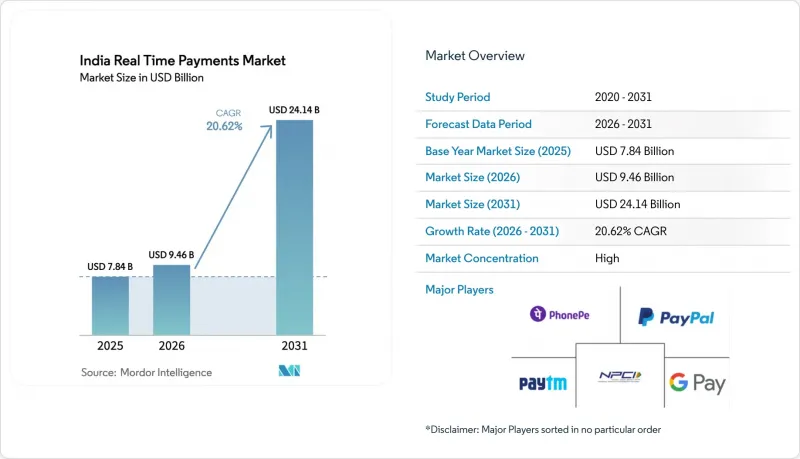
This report is Segmented by Transaction Type (Peer-To-Peer (P2P), Peer-To-Business (P2B)), Component (Platform / Solution, Services), Deployment (Cloud, On-Premise), Enterprise Size (Large Enterprises, Small and Medium Enterprises), End-User Industry (Retail and E-Commerce, BFSI, Utilities & Telecom, Healthcare, and More). The Market Forecasts are Provided in Terms of Value (USD).
India Real Time Payments Market Trends and Insights
Surge in UPI adoption driven by NPCI incentives and merchant cash-backs
Cash-back programs funded by the government's INR 1,500 crore incentive pool for FY 2024-25 have pushed transaction counts in smaller cities to new highs, with 80% of new UPI users emerging outside metros. The subsidy on sub-INR 2,000 tickets sustains a zero merchant discount rate, motivating kirana stores and street vendors to display QR codes prominently and creating a network-effect flywheel as consumer convenience rises. P2B volumes have consequently grown faster than P2P volumes, and PSPs have lowered customer-acquisition costs by leveraging expanded merchant footprints. NPCI reports a 126% surge in active QR codes during 2H 2024, supplying the physical infrastructure for omnipresent quick-response payments.
Government-mandated interoperability via UPI-123PAY
UPI-123PAY allows India's 400 million feature-phone users to initiate real-time payments through dual-tone multi-frequency (DTMF) prompts, closing the device-gap that had restricted digital participation in rural districts. Monthly volumes have already exceeded 10 million transactions in early 2025, concentrated in states with sub-40% smartphone penetration. Telecom alliances with BSNL and Airtel ensure unbroken USSD messaging, while NPCI's common library enables cross-network routing, preventing vendor lock-in and guaranteeing a consistent user experience regardless of PSP brand.
Rural network latency hitting transaction success rates
Peak-season failure rates exceed 15% in villages where 4G coverage remains inconsistent, compared to 2-3% in metros. BharatNet's optical-fiber roll-out, currently 60% complete, promises eventual relief, yet delay-sensitive sectors including agriculture payments continue to experience timeout errors. PSPs are testing edge-computing caches that queue transactions for later synchronization, though the upfront capital is substantial for low-ticket rural traffic.
Other drivers and restraints analyzed in the detailed report include:
- Instant settlement demand from gig-economy platforms drives the market
- QR-based offline payments growth in tier-3/4 towns
- Fraud via UPI collect requests & screen-scraping apps hinders the market
For complete list of drivers and restraints, kindly check the Table Of Contents.
Segment Analysis
P2B accounted for 28.45% of total UPI volume in January 2025 and is sprinting ahead at a 23.85% CAGR. The India real-time payments market size for P2B payments is on track to expand faster than remittance-oriented P2P flows, reflecting new consumer habits such as paying for public transport, street food, and utilities with a single scan. Average P2B ticket value stands at INR 1,471, confirming deeper penetration into micro-transactions. RuPay credit-card integration will add revolving-credit elasticity to P2B spend while maintaining instant confirmation.
P2P nevertheless preserves a dominant 71.55% share of 2025 transactions, illustrating entrenched use cases like salary advances, rent, and family support. Transcontinental remittances facilitated by UPI ties with Nepal and Singapore are set to sustain core P2P relevance, even as the segment's growth rate normalizes. Rural off-grid households rely on P2P to move harvest proceeds rapidly, underlining the social-inclusion mandate built into the India real-time payments market.
The services layer, forecast to rise at 28.05% CAGR, now comprises fraud analytics, unified reconciliation, and lending APIs. PSPs such as Razorpay launched 40 new service lines in FY 24, showcasing how the zero merchant discount-rate environment is pushing providers up the value pyramid. The India real-time payments market benefits from AI-driven risk models that can score transactions within milliseconds and throttle suspicious flows before they hit settlement.
Platform/solution revenues still contribute 63.20% of the 2025 base and remain the gateway for onboarding newly digital merchants. Modular SDKs and low-code integration kits reduce time-to-market for retailers, creating a funnel from basic acceptance tools to premium SaaS subscriptions. This stacking effect is central to long-term monetization within the India real-time payments industry.
Complete Report Scope:
- By Transaction Type
- Peer-to-Peer (P2P)
- Peer-to-Business (P2B)
- By Component
- Platform / Solution
- Services
- By Deployment Mode
- Cloud
- On-Premise
- By Enterprise Size
- Large Enterprises
- Small and Medium Enterprises
- By End-User Industry
- Retail and E-Commerce
- BFSI
- Utilities and Telecom
- Healthcare
- Government and Public Sector
- Other End-user Industries
List of Companies Covered in this Report:
- Temenos AG
- ACI Worldwide Inc.
- Google LLC (Alphabet Inc.)
- Mastercard India Services Pvt Ltd
- PhonePe Private Limited
- Razorpay Technologies Pvt Ltd
- Pine Labs Pvt Ltd
- PayPal Payments Private Limited
- BharatPe
- WhatsApp Pay (Meta Platforms Inc.)
- Paytm Payments Bank Ltd
- Financial Software and Systems Pvt Ltd (FSS)
- Cashfree Payments
- Worldline India Pvt Ltd
- Amazon Pay (Amazon.com Inc.)
- Visa Worldwide (India) Pvt Ltd
- PayU Payments Pvt Ltd
- BillDesk (IndiaIdeas.com Ltd)
- CCAvenue (Infibeam Avenues Ltd)
- State Bank of India
- HDFC Bank Ltd
- ICICI Bank Ltd
- Axis Bank Ltd
- Volante Technologies Inc.
- NPCI (National Payments Corporation of India)
Additional Benefits:
- The market estimate (ME) sheet in Excel format
- 3 months of analyst support
TABLE OF CONTENTS
1 INTRODUCTION
- 1.1 Study Assumptions and Market Definition
- 1.2 Scope of the Study
2 RESEARCH METHODOLOGY
3 EXECUTIVE SUMMARY
4 MARKET LANDSCAPE
- 4.1 Market Overview
- 4.2 Market Drivers
- 4.2.1 Surge in UPI adoption driven by NPCI incentives and merchant cash-backs
- 4.2.2 Government-mandated interoperability via UPI-123PAY
- 4.2.3 Instant settlement demand from gig-economy platforms drives the market
- 4.2.4 QR-based offline payments growth in Tier-3/4 towns drives the market
- 4.2.5 RuPay credit-card linkage on UPI boosts ticket size
- 4.3 Market Restraints
- 4.3.1 Rural network latency hitting transaction success rates
- 4.3.2 Fraud via UPI collect requests and screen-scraping apps hinders the market
- 4.3.3 Interchange disputes curbing PSP monetisation
- 4.4 Value Chain Analysis
- 4.5 Regulatory Outlook
- 4.6 Porter's Five Forces Analysis
- 4.6.1 Bargaining Power of Suppliers
- 4.6.2 Bargaining Power of Buyers/Consumers
- 4.6.3 Threat of New Entrants
- 4.6.4 Threat of Substitute Products
- 4.6.5 Intensity of Competitive Rivalry
- 4.7 Evolution of the Payments Landscape in India
- 4.8 Key Trends Accelerating Cashless Transactions
- 4.9 Assessment of Macro Economic Trends on the Market
- 4.10 Major Case Studies and Use-Cases
- 4.11 Real-Time Payments Share of Total Transactions
- 4.12 Real-Time Payments Share of Non-Cash Transactions
5 MARKET SIZE AND GROWTH FORECASTS (VALUES)
- 5.1 By Transaction Type
- 5.1.1 Peer-to-Peer (P2P)
- 5.1.2 Peer-to-Business (P2B)
- 5.2 By Component
- 5.2.1 Platform / Solution
- 5.2.2 Services
- 5.3 By Deployment Mode
- 5.3.1 Cloud
- 5.3.2 On-Premise
- 5.4 By Enterprise Size
- 5.4.1 Large Enterprises
- 5.4.2 Small and Medium Enterprises
- 5.5 By End-User Industry
- 5.5.1 Retail and E-Commerce
- 5.5.2 BFSI
- 5.5.3 Utilities and Telecom
- 5.5.4 Healthcare
- 5.5.5 Government and Public Sector
- 5.5.6 Other End-user Industries
6 COMPETITIVE LANDSCAPE
- 6.1 Market Concentration
- 6.2 Strategic Moves
- 6.3 Market Share Analysis
- 6.4 Company Profiles (includes Global level Overview, Market level overview, Core Segments, Financials as available, Strategic Information, Market Rank/Share for key companies, Products and Services, and Recent Developments)
- 6.4.1 Temenos AG
- 6.4.2 ACI Worldwide Inc.
- 6.4.3 Google LLC (Alphabet Inc.)
- 6.4.4 Mastercard India Services Pvt Ltd
- 6.4.5 PhonePe Private Limited
- 6.4.6 Razorpay Technologies Pvt Ltd
- 6.4.7 Pine Labs Pvt Ltd
- 6.4.8 PayPal Payments Private Limited
- 6.4.9 BharatPe
- 6.4.10 WhatsApp Pay (Meta Platforms Inc.)
- 6.4.11 Paytm Payments Bank Ltd
- 6.4.12 Financial Software and Systems Pvt Ltd (FSS)
- 6.4.13 Cashfree Payments
- 6.4.14 Worldline India Pvt Ltd
- 6.4.15 Amazon Pay (Amazon.com Inc.)
- 6.4.16 Visa Worldwide (India) Pvt Ltd
- 6.4.17 PayU Payments Pvt Ltd
- 6.4.18 BillDesk (IndiaIdeas.com Ltd)
- 6.4.19 CCAvenue (Infibeam Avenues Ltd)
- 6.4.20 State Bank of India
- 6.4.21 HDFC Bank Ltd
- 6.4.22 ICICI Bank Ltd
- 6.4.23 Axis Bank Ltd
- 6.4.24 Volante Technologies Inc.
- 6.4.25 NPCI (National Payments Corporation of India)
7 MARKET OPPORTUNITIES AND FUTURE OUTLOOK
- 7.1 White-Space and Unmet-Need Assessment

