PUBLISHER: Mordor Intelligence | PRODUCT CODE: 2163584

PUBLISHER: Mordor Intelligence | PRODUCT CODE: 2163584
Indonesia Inter-Island Logistics - Market Share Analysis, Industry Trends & Statistics, Growth Forecasts (2026 - 2031)
According to Mordor Intelligence, the Indonesia inter-island logistics market size was valued at USD 38.68 billion in 2025 and is estimated to grow from USD 41.67 billion in 2026 to reach USD 58.40 billion by 2031, at a CAGR of 6.99% during the forecast period 2026 to 2031.
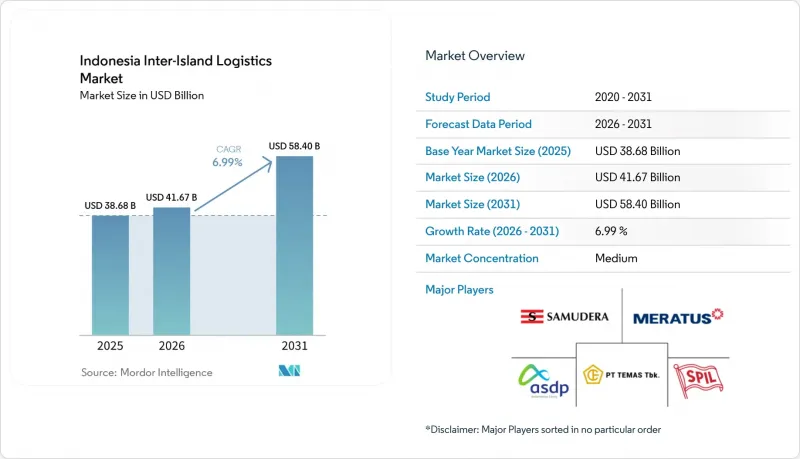
Indonesia's archipelagic geography makes maritime and multimodal links essential to economic activity, so freight demand is tied to the movement of goods between islands rather than to a single transport mode. This report is Segmented by Logistics Function (Transportation, Warehousing & Distribution, Value-Added Services), by End-User Industry (Manufacturing and Industrial, Retail and E-Commerce, Food and Beverages, Automotive and Components, and More), by Inter-Island Corridor (Java-Sumatra, Java-kalimantan, Java-sulawesi, and More). The Market Forecasts are Provided in Terms of Value (USD).
Indonesia Inter-Island Logistics Market Trends and Insights
E-commerce Expansion Increasing Inter-Island Distribution Demand
Indonesia's e-commerce platforms are extending distribution systems beyond Java, increasing the need for coordinated parcel movements between major islands and remote cities. Shopee Express serves 487 cities nationally, which means that many deliveries outside Java require an inter-island movement before local distribution begins. The Indonesia inter-island logistics market benefits because online retail demand connects urban sorting sites with places that have fewer physical retail options. This need is strongest where consumers rely on multi-leg delivery routes to reach goods from major fulfillment centers. As platforms add route coverage, freight operators can gain demand for scheduled line-haul transport, regional warehousing, and final distribution support.
Industrial Growth Expanding Inter-Island Freight Movement Requirements
Manufacturing growth is increasing demand for the movement of inputs, components, and finished products across Indonesia's island network. The Central Bureau of Statistics and the Ministry of Industry reported that non-oil and gas manufacturing grew 5.3% year-over-year in the second quarter of 2026, slightly exceeding Indonesia's 5.29% GDP growth. In August 2026, the Kendal Special Economic Zone and Batang Integrated Industrial Park reached 100% land utilization, which supported a pipeline of cargo through Java's port system. The Batang Industropolis dry port is designed for an initial capacity of 600,000 to 650,000 TEUs and can create a consolidation point between industrial production and sea freight. In Sulawesi, more complex nickel processing for electric vehicle supply chains can shift freight from bulk movement toward containerized cargo. That change supports higher-value logistics activity on the Java-Sulawesi corridor and encourages fleet investment by operators with suitable equipment.
Infrastructure Gaps Increasing Inter-Island Logistics Transit Inefficiencies
Infrastructure quality remains uneven across the network, especially in eastern Indonesia and frontier regions. A peer-reviewed assessment of the Sea Toll program, published in 2025, found that 58.7% of Indonesian ports were adequately equipped for modern cargo handling. Gaps in equipment and port capability can lengthen transit times, increase handling costs, and create a greater risk of cargo damage on lower-volume routes. ASDP's pioneer ferry services in Nusa Tenggara Timur were temporarily disrupted in early July 2026 because of funding constraints, before services resumed on July 20, 2026, following additional government support. The episode shows the reliance of frontier connections on public service support. When infrastructure and service funding are insufficient, return cargo is also harder to build, which makes private operations less attractive on routes without subsidy access.
Other drivers and restraints analyzed in the detailed report include:
- Infrastructure Investment Strengthening Inter-Island Logistics Connectivity
- Logistics Digitalization Improving Port and Shipment Coordination
- Fuel Volatility Raising Inter-Island Transportation Operating Costs
For complete list of drivers and restraints, kindly check the Table Of Contents.
Segment Analysis
Transportation accounted for 58.95% of the Indonesia inter-island logistics market share in 2025. Transportation remains central to cross-island supply chains, with domestic sea freight handling substantial containerized and non-containerized cargo, supported by ferry and RoRo services across shorter sea routes. Domestic air freight serves time-sensitive shipments, including healthcare products and electronics. The scale of transportation activity supports established operators with broad route coverage, vessel availability, and port access. In contrast, fleet registration, vessel classification, and maritime compliance requirements favor providers with established operational capabilities.
Value-added logistics services are forecast to register a 10.37% CAGR through 2031. These services are gaining importance as manufacturers and online retailers seek integrated solutions covering packaging, labeling, cargo handling, inventory management, and post-shipment support. Industrial development in Batang and Karawang is supporting demand for bonded warehousing and cross-dock facilities near port connections. Investments in modern vessel capacity and automated logistics hubs are also strengthening the integration of transportation, warehousing, sorting, and inter-island distribution services.
Complete Report Scope:
- By Logistics Function
- Transportation
- Domestic Sea Freight
- Containerized Cargo
- Non-Containerized Cargo
- Ferry and RoRo Freight
- Domestic Air Freight
- Domestic Sea Freight
- Warehousing & Distribution
- Value-Added Logistics Services (Packaging, labeling, handling, etc.)
- Transportation
- By End-User Industry
- Manufacturing and Industrial
- Retail and E-commerce
- Food and Beverage
- Automotive and Components
- Chemicals and Petrochemicals
- Electronics and Electrical
- Agriculture and Forestry
- Healthcare and Pharmaceuticals
- Other End Users
- By Inter-Island Corridor
- Java-Sumatra
- Java-Kalimantan
- Java-Sulawesi
- Java-Bali and Nusa Tenggara
- Sulawesi-Maluku and Papua
- Other Inter-Island Corridors
List of Companies Covered in this Report:
- Meratus Group
- PT Salam Pacific Indonesia Lines (SPIL)
- PT TEMAS Tbk
- PT Samudera Indonesia Tbk
- PT ASDP Indonesia Ferry (Persero)
- PT Pelayaran Nasional Indonesia (PELNI)
- PT Tanto Intim Line
- PT Dharma Lautan Utama
- PT IMC Pelita Logistik Tbk
- PT Pertamina International Shipping
- PT Humpuss Intermoda Transportasi Tbk
- PT Transcoal Pacific Tbk
- PT Habco Trans Maritima Tbk
- PT Gurita Lintas Samudera
- PT Cipta Krida Bahari (CKB Logistics)
- PT Puninar Logistics
- PT Kamadjaja Logistics
- PT Dunia Express Transindo
- DHL Group
- Kuehne+Nagel International AG
- DSV A/S
- CEVA Logistics
Additional Benefits:
- The market estimate (ME) sheet in Excel format
- 3 months of analyst support
TABLE OF CONTENTS
1 INTRODUCTION
- 1.1 Study Assumptions and Market Definition
- 1.2 Scope of the Study
2 RESEARCH METHODOLOGY
3 EXECUTIVE SUMMARY
- 3.1 Market Size, Growth, and Forecast Outlook
- 3.2 Key Demand Drivers and Inter-Island Logistics Trends
- 3.3 Major Inter-Island Corridors and Cargo Concentration
- 3.4 Competitive Landscape and Leading Inter-Island Logistics Providers
4 MARKET LANDSCAPE
- 4.1 Market Overview and Importance of Inter-Island Logistics
- 4.2 Market Drivers
- 4.2.1 E-commerce Expansion Increasing Inter-Island Distribution Demand
- 4.2.2 Industrial Growth Expanding Inter-Island Freight Movement Requirements
- 4.2.3 Infrastructure Investment Strengthening Inter-Island Logistics Connectivity
- 4.2.4 Logistics Digitalization Improving Port and Shipment Coordination
- 4.2.5 Low Backhaul Utilization Increasing Consolidation Service Demand
- 4.2.6 Hub-and-Spoke Networks Expanding Eastern Indonesia Distribution Reach
- 4.3 Market Restraints
- 4.3.1 Infrastructure Gaps Increasing Inter-Island Logistics Transit Inefficiencies
- 4.3.2 Fuel Volatility Raising Inter-Island Transportation Operating Costs
- 4.3.3 Empty Backhaul Imbalances Reducing Network Operating Efficiency
- 4.3.4 Regional Rule Variations Increasing Cargo Handling Complexity
- 4.4 Value Chain Structure and Inter-Island Logistics Flow Analysis
- 4.5 Regulatory Framework and Inter-Island Logistics Compliance Analysis
- 4.6 Technology Adoption and Inter-Island Logistics Digitalization Analysis
- 4.7 Major Port and Domestic Gateway Concentration Analysis
- 4.8 Inter-Island Freight Rate and Cost Trend Analysis
- 4.9 Regional Cargo Flow and Demand Concentration Analysis
- 4.10 Porter's Five Forces Analysis
- 4.10.1 Threat of New Entrants
- 4.10.2 Bargaining Power of Buyers
- 4.10.3 Bargaining Power of Suppliers
- 4.10.4 Threat of Substitute Services
- 4.10.5 Intensity of Competitive Rivalry
- 4.11 Impact of Geo-Political Events on Supply Chain Shifts
5 MARKET SIZE AND GROWTH FORECASTS
- 5.1 By Logistics Function
- 5.1.1 Transportation
- 5.1.1.1 Domestic Sea Freight
- 5.1.1.1.1 Containerized Cargo
- 5.1.1.1.2 Non-Containerized Cargo
- 5.1.1.2 Ferry and RoRo Freight
- 5.1.1.3 Domestic Air Freight
- 5.1.1.1 Domestic Sea Freight
- 5.1.2 Warehousing & Distribution
- 5.1.3 Value-Added Logistics Services (Packaging, labeling, handling, etc.)
- 5.1.1 Transportation
- 5.2 By End-User Industry
- 5.2.1 Manufacturing and Industrial
- 5.2.2 Retail and E-commerce
- 5.2.3 Food and Beverage
- 5.2.4 Automotive and Components
- 5.2.5 Chemicals and Petrochemicals
- 5.2.6 Electronics and Electrical
- 5.2.7 Agriculture and Forestry
- 5.2.8 Healthcare and Pharmaceuticals
- 5.2.9 Other End Users
- 5.3 By Inter-Island Corridor
- 5.3.1 Java-Sumatra
- 5.3.2 Java-Kalimantan
- 5.3.3 Java-Sulawesi
- 5.3.4 Java-Bali and Nusa Tenggara
- 5.3.5 Sulawesi-Maluku and Papua
- 5.3.6 Other Inter-Island Corridors
6 COMPETITIVE LANDSCAPE
- 6.1 Market Concentration
- 6.2 Strategic Moves
- 6.3 Market Share Analysis
- 6.4 Company Profiles (includes Global Level Overview, Market Level Overview, Core Segments, Financials as available, Strategic Information, Geographic Coverage, Products and Services, Recent Developments)
- 6.4.1 Meratus Group
- 6.4.2 PT Salam Pacific Indonesia Lines (SPIL)
- 6.4.3 PT TEMAS Tbk
- 6.4.4 PT Samudera Indonesia Tbk
- 6.4.5 PT ASDP Indonesia Ferry (Persero)
- 6.4.6 PT Pelayaran Nasional Indonesia (PELNI)
- 6.4.7 PT Tanto Intim Line
- 6.4.8 PT Dharma Lautan Utama
- 6.4.9 PT IMC Pelita Logistik Tbk
- 6.4.10 PT Pertamina International Shipping
- 6.4.11 PT Humpuss Intermoda Transportasi Tbk
- 6.4.12 PT Transcoal Pacific Tbk
- 6.4.13 PT Habco Trans Maritima Tbk
- 6.4.14 PT Gurita Lintas Samudera
- 6.4.15 PT Cipta Krida Bahari (CKB Logistics)
- 6.4.16 PT Puninar Logistics
- 6.4.17 PT Kamadjaja Logistics
- 6.4.18 PT Dunia Express Transindo
- 6.4.19 DHL Group
- 6.4.20 Kuehne+Nagel International AG
- 6.4.21 DSV A/S
- 6.4.22 CEVA Logistics
7 MARKET OPPORTUNITIES AND FUTURE OUTLOOK
- 7.1 White-Space Opportunities and Unmet Service Needs
- 7.2 High-Potential End-User Segments and Trade Opportunities
- 7.3 Strategic Growth Priorities Across the Ecosystem
- 7.4 Future Market Outlook and Emerging Demand Pockets
8 APPENDIX

