PUBLISHER: Mordor Intelligence | PRODUCT CODE: 2186119

PUBLISHER: Mordor Intelligence | PRODUCT CODE: 2186119
Spiritual Wellness Tourism - Market Share Analysis, Industry Trends & Statistics, Growth Forecasts (2027 - 2032)
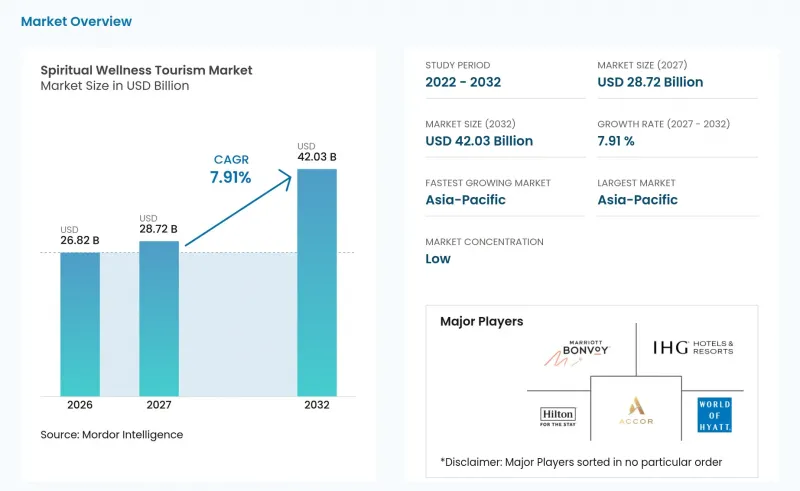
According to Mordor Intelligence, the global spiritual wellness tourism market was valued at USD 26.82 billion in 2026 and is estimated to grow from USD 28.72 billion in 2027 to reach USD 42.03 billion by 2032, at a CAGR of 7.91% during the forecast period (2027-2032).
Global Spiritual Wellness Tourism Market Trends and Insights
Rising Mental-Health, Stress-Management, and Nervous-System Recovery Demand
More than 1 billion people live with mental health conditions, while depression and anxiety cost the global economy an estimated USD 1 trillion annually in lost productivity. This burden is driving demand for retreats focused on rest, meditation, breathwork, and structured recovery, although these offerings do not replace clinical care. The global spiritual wellness tourism market is attracting travelers seeking relief from demanding work schedules and daily routines. Operators are offering programs that combine wellness practices with expert-led education and follow-up support. This trend supports formats that integrate yoga, Ayurveda, tranquil natural settings, and clear safety protocols.
Growing Interest in Preventive Health, Mindfulness, and Holistic Well-Being
Preventive health is expanding wellness travel beyond recovery from stress to ongoing personal care. This shift supports programs that integrate nutrition, movement, sleep, meditation, and traditional healing practices within a single stay. The global spiritual wellness tourism market can benefit as guests view retreats as planned components of their annual health routines. In February 2025, Kamalaya introduced its Cognitive House, which offers neurofeedback, neuromodulation, and transcranial photobiomodulation. This development shows how operators are incorporating measurable wellness services into established retreat formats. Destinations with traditional medicine systems, such as India with Ayurveda, can position traditional therapies as supervised, destination-based services alongside yoga and spiritual practices. However, providers must avoid broad therapeutic claims unsupported by program design or practitioner qualifications.
Inconsistent Accreditation, Safety Standards, and Quality Assurance
Inconsistent standards constrain the market, as visitors may struggle to assess the quality of teachers, practitioners, facilities, and program safeguards before booking. This concern is particularly significant for offerings involving breathwork, trauma processing, mental well-being, or traditional treatments. Poor experiences that raise safety or trust concerns can discourage first-time customers in the global spiritual wellness tourism market. For example, India is developing stronger quality assurance through NABH accreditation; however, adoption remains limited among small providers. Clear disclosure of qualifications, program limitations, referral processes, and emergency support can reduce uncertainty. Robust quality systems can help legitimate Indian providers differentiate themselves in international travel and corporate procurement channels.
Other drivers and restraints analyzed in the detailed report include:
- Younger Travelers Seeking Personal Growth, Authenticity, and Spiritual Connection
- Digital Discovery, Personalization, and Hybrid Pre-Trip and Post-Trip Engagement
- Shortage of Qualified Spiritual, Mental-Wellness, and Traditional-Healing Practitioners
For complete list of drivers and restraints, kindly check the Table Of Contents.
Segment Analysis
Yoga & Meditation accounted for 37.23% of the global spiritual wellness tourism market in 2026, supported by broad recognition and adaptability across stay durations. Its appeal spans age groups and destinations, with delivery through retreats, hotels, ashrams, and outdoor settings. Yoga provides a familiar entry point for travelers new to spiritual wellness tourism. The market relies on quality instruction, appropriate group sizes, and practice-supportive environments. In its countries of origin, yoga links an internationally recognized activity with deep local knowledge.
Ayurveda & Traditional Healing is projected to grow at an 8.34% CAGR through 2032, making it the fastest-growing service category. Ayurveda supports longer stays centered on consultations, routines, diet, therapies, and recovery. In 2023, India's Ministry of Ayush and the India Tourism Development Corporation agreed to promote Ayurveda and traditional medicine through tourism. Spiritual and faith-based retreats extend pilgrimages through accommodation, guided reflection, and locally appropriate wellness services. Research indicates that natural surroundings, teacher-participant relationships, and group cohesion influence well-being and repeat-visit intentions.
Complete Report Scope:
- By Service Type
- Yoga & Meditation
- Spiritual & Faith-Based Retreats
- Ayurveda & Traditional Healing
- Others
- By Accommodation Type
- Spiritual Retreat Centers
- Commercial Hospitality Accommodation
- Ashrams & Monasteries
- Others
- By Booking Channel
- Direct Booking
- OTAs & Retreat Aggregators
- Travel Agencies & Tour Operators
- Others
- By Geography
- North America
- United States
- Canada
- Mexico
- South America
- Brazil
- Peru
- Chile
- Argentina
- Rest of South America
- Europe
- United Kingdom
- Germany
- France
- Spain
- Italy
- BENELUX (Belgium, Netherlands, and Luxembourg)
- NORDICS (Denmark, Finland, Iceland, Norway, and Sweden)
- Rest of Europe
- Asia-Pacific
- India
- China
- Japan
- Australia
- South Korea
- South East Asia (Singapore, Malaysia, Thailand, Indonesia, Vietnam, and Philippines)
- Rest of Asia-Pacific
- Middle East and Africa
- United Arab Emirates
- Saudi Arabia
- South Africa
- Nigeria
- Rest of Middle East and Africa
- North America
Geography Analysis
Asia-Pacific accounted for 34.92% of the global spiritual wellness tourism market in 2026 and is projected to grow at a CAGR of 8.94% through 2032. The region has strong yoga, Ayurveda, Buddhist, faith-based, and nature-linked wellness traditions. India integrates spiritual circuits, pilgrimage infrastructure, Ayurveda, and traditional medicine into its tourism policy. In November 2024, India sanctioned INR 3,295.8 crore (USD 366.8 million) in interest-free 50-year loans for 40 tourism projects across 23 states under its Special Assistance to States for Capital Investment scheme, alongside pilgrimage and destination infrastructure under PRASHAD and Swadesh Darshan 2.0. Kerala Ayurveda centers serving foreign nationals increased from 460 in 2023 to 550 in 2024.
Europe is both a source market and destination region for place-based wellness travel. Supply includes heritage hotels, rural retreats, spa properties, and nature-based programs. In March 2025, IHG unveiled plans for Six Senses Comporta in Portugal, including a 70-key resort and spa on the 400-ha Pinheirinho estate. North America supports demand for executive, preventive, and extended-stay wellness formats.
The Middle East and Africa is expanding through destination projects, government investment, and hospitality-led wellness. Miraval The Red Sea, which opened in June 2026, includes a 3,700 m2 Life in Balance Spa. South America supports smaller nature-based retreats, although provider availability and infrastructure vary. Governments and operators must manage sacred-site carrying capacity to protect cultural and natural value.
- Accor S.A.
- Marriott International, Inc.
- Hyatt Hotels Corporation
- Hilton Worldwide Holdings Inc.
- InterContinental Hotels Group PLC
- Aman Group Sarl
- COMO Hotels and Resorts
- Canyon Ranch
- Chiva-Som International Health Resort
- Kamalaya Koh Samui
- Ananda in the Himalayas
- Blue Spirit Costa Rica
- The Sanctuary Thailand
- Samahita Retreat
- CGH Earth
- Atmantan Wellness Centre
- Aro Ha Wellness Retreat
- Somatheeram Ayurvedic Health Resort
- Tripaneer B.V.
- Retreat Guru
Additional Benefits:
- The market estimate (ME) sheet in Excel format
- 3 months of analyst support
TABLE OF CONTENTS
1 Introduction
- 1.1 Study Assumptions and Market Definition
- 1.2 Scope of the Study
2 Executive Summary
3 Market Landscape
- 3.1 Market Overview
- 3.2 Market Drivers
- 3.2.1 Rising Mental-Health, Stress-Management and Nervous-System Recovery Demand
- 3.2.2 Growing Interest in Preventive Health, Mindfulness and Holistic Well-Being
- 3.2.3 Younger Travelers Seeking Personal Growth, Authenticity and Spiritual Connection
- 3.2.4 Digital Discovery, Personalization and Hybrid Pre-Trip and Post-Trip Engagement
- 3.2.5 Government and Destination Investment in Spiritual, Cultural and Wellness Infrastructure
- 3.2.6 Premiumization of Transformational Travel and High-Value Longer-Stay Programs
- 3.3 Market Restraints
- 3.3.1 Inconsistent Accreditation, Safety Standards and Quality Assurance
- 3.3.2 Shortage of Qualified Spiritual, Mental-Wellness and Traditional-Healing Practitioners
- 3.3.3 Commercialization, Cultural Appropriation and Loss of Destination Authenticity
- 3.3.4 Environmental, Infrastructure and Carrying-Capacity Pressure at Sacred and Ecologically Sensitive Sites
- 3.4 Regulatory Landscape
- 3.5 Technological Outlook
- 3.6 Porter's Five Forces Analysis
- 3.6.1 Threat of New Entrants
- 3.6.2 Bargaining Power of Suppliers
- 3.6.3 Bargaining Power of Buyers
- 3.6.4 Threat of Substitutes
- 3.6.5 Competitive Rivalry
4 Spiritual Wellness Supply & Development Intelligence
- 4.1 Spiritual Wellness Facility Supply and Development Trends
- 4.2 Existing Retreat Facilities and Accommodation Capacity
5 Spiritual Wellness Performance Intelligence
- 5.1 Occupany Rates
- 5.2 Average Retreat Package Prices and Accommodation Rates
6 Consumer Behavior Analysis
- 6.1 Traveler Preferences and Spiritual Wellness Participation Patterns
- 6.2 Booking Behavior and Channel Preferences
- 6.3 Travel Spending and Emerging Spiritual Wellness Preferences
7 Market Size & Growth Forecasts (USD, Value)
- 7.1 By Service Type
- 7.1.1 Yoga & Meditation
- 7.1.2 Spiritual & Faith-Based Retreats
- 7.1.3 Ayurveda & Traditional Healing
- 7.1.4 Others
- 7.2 By Accommodation Type
- 7.2.1 Spiritual Retreat Centers
- 7.2.2 Commercial Hospitality Accommodation
- 7.2.3 Ashrams & Monasteries
- 7.2.4 Others
- 7.3 By Booking Channel
- 7.3.1 Direct Booking
- 7.3.2 OTAs & Retreat Aggregators
- 7.3.3 Travel Agencies & Tour Operators
- 7.3.4 Others
- 7.4 By Geography
- 7.4.1 North America
- 7.4.1.1 United States
- 7.4.1.2 Canada
- 7.4.1.3 Mexico
- 7.4.2 South America
- 7.4.2.1 Brazil
- 7.4.2.2 Peru
- 7.4.2.3 Chile
- 7.4.2.4 Argentina
- 7.4.2.5 Rest of South America
- 7.4.3 Europe
- 7.4.3.1 United Kingdom
- 7.4.3.2 Germany
- 7.4.3.3 France
- 7.4.3.4 Spain
- 7.4.3.5 Italy
- 7.4.3.6 BENELUX (Belgium, Netherlands, and Luxembourg)
- 7.4.3.7 NORDICS (Denmark, Finland, Iceland, Norway, and Sweden)
- 7.4.3.8 Rest of Europe
- 7.4.4 Asia-Pacific
- 7.4.4.1 India
- 7.4.4.2 China
- 7.4.4.3 Japan
- 7.4.4.4 Australia
- 7.4.4.5 South Korea
- 7.4.4.6 South East Asia (Singapore, Malaysia, Thailand, Indonesia, Vietnam, and Philippines)
- 7.4.4.7 Rest of Asia-Pacific
- 7.4.5 Middle East and Africa
- 7.4.5.1 United Arab Emirates
- 7.4.5.2 Saudi Arabia
- 7.4.5.3 South Africa
- 7.4.5.4 Nigeria
- 7.4.5.5 Rest of Middle East and Africa
- 7.4.1 North America
8 North America Market Size & Growth Forecasts (USD, Value) 2022- 2031
- 8.1 By Service Type
- 8.2 By Accommodation Type
- 8.3 By Booking Channel
- 8.4 By Countries
9 South America Market Size & Growth Forecasts (USD, Value) 2022- 2031
- 9.1 By Service Type
- 9.2 By Accommodation Type
- 9.3 By Booking Channel
- 9.4 By Countries
10 Europe Market Size & Growth Forecasts (USD, Value) 2022- 2031
- 10.1 By Service Type
- 10.2 By Accommodation Type
- 10.3 By Booking Channel
- 10.4 By Countries
11 Asia-Pacific Market Size & Growth Forecasts (USD, Value) 2022- 2031
- 11.1 By Service Type
- 11.2 By Accommodation Type
- 11.3 By Booking Channel
- 11.4 By Countries
12 Middle East and Africa Market Size & Growth Forecasts (USD, Value) 2022- 2031
- 12.1 By Service Type
- 12.2 By Accommodation Type
- 12.3 By Booking Channel
- 12.4 By Countries
13 Competitive Landscape
- 13.1 Market Concentration
- 13.2 Strategic Moves
- 13.3 Company Profiles (includes Global Level Overview, Market Level Overview, Core Segments, Financials as available, Strategic Information, Market Rank/Share, Products and Services, and Recent Developments)
- 13.3.1 Accor S.A.
- 13.3.2 Marriott International, Inc.
- 13.3.3 Hyatt Hotels Corporation
- 13.3.4 Hilton Worldwide Holdings Inc.
- 13.3.5 InterContinental Hotels Group PLC
- 13.3.6 Aman Group Sarl
- 13.3.7 COMO Hotels and Resorts
- 13.3.8 Canyon Ranch
- 13.3.9 Chiva-Som International Health Resort
- 13.3.10 Kamalaya Koh Samui
- 13.3.11 Ananda in the Himalayas
- 13.3.12 Blue Spirit Costa Rica
- 13.3.13 The Sanctuary Thailand
- 13.3.14 Samahita Retreat
- 13.3.15 CGH Earth
- 13.3.16 Atmantan Wellness Centre
- 13.3.17 Aro Ha Wellness Retreat
- 13.3.18 Somatheeram Ayurvedic Health Resort
- 13.3.19 Tripaneer B.V.
- 13.3.20 Retreat Guru
14 Market Opportunities & Future Outlook
- 14.1 White-Space and Unmet-Need Assessment
- 14.2 Market Opportunities
- 14.2.1 Integrated Spiritual Wellness Circuits Linking Retreats, Sacred Heritage and Nature
- 14.2.2 AI-Personalized, Hybrid and Longer-Stay Programs for Mental Resilience and Life Transitions
- 14.3 Future Outlook
15 Research Methodology

