PUBLISHER: Mordor Intelligence | PRODUCT CODE: 2187641

PUBLISHER: Mordor Intelligence | PRODUCT CODE: 2187641
India Wellness Tourism - Market Share Analysis, Industry Trends & Statistics, Growth Forecasts (2027 - 2032)
According to Mordor Intelligence, the India wellness tourism market size is expected to increase from USD 30.95 billion in 2026 to USD 33.17 billion in 2027 and reach USD 47.51 billion by 2032, growing at a CAGR of 7.45% over 2027-2032.
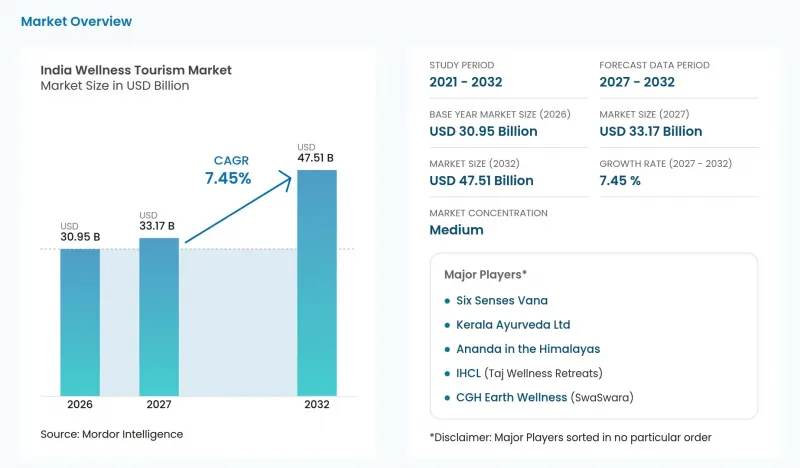
This report is segmented by Service Type (Yoga & Meditation Retreats, Spa & Beauty Therapies, and more), Traveler Type (Secondary Wellness Travel and Primary Wellness Travel), Accommodation Type (Yoga Retreats, Boutique Retreats, and more), and Geography (South India, West India, and more). The market forecasts are provided in terms of value (USD), based on availability.
India Wellness Tourism Market Trends and Insights
Rapid expansion of AYUSH-certified resorts
An accredited retreat can make a treatment-led stay easier to assess before the traveler commits to a destination. The National Accreditation Board for Hospitals & Healthcare Providers (NABH) accredited Sitaram Mountain Retreat in Kerala as an AYUSH Entry Level-Hospital effective June 10, 2025. Its certificate, valid through June 9, 2027, covers Ayurveda services including Panchakarma and yoga. The provider combines accommodation with paid Ayurveda stays, linking the clinical service scope to a destination experience. For a retreat operator, that combination provides a basis for distinguishing a defined treatment offering from a broad wellness promise. Because the certificate expires on June 9, 2027, continued use of the accreditation in selling treatment stays depends on maintaining valid certification.
Inclusion of wellness packages in e-Ayush Visa scheme
A treatment-specific entry route can make an overseas wellness stay easier to arrange when the provider meets the eligibility conditions. India's e-M3 visa covers non-Pakistani foreign nationals whose sole purpose is AYUSH treatment, including wellness. Eligible facilities are government-accredited and registered hospitals or wellness centers, or AYUSH-service hospitals accredited by NABH, the National Commission for Homeopathy, or the National Commission for Indian System of Medicine. The electronic visa permits up to 60 days from first entry and up to 3 entries, while the relevant foreigners registration authority may grant extensions up to 6 months case by case on merit. India issued 2,294 e-Ayush visas in 2025, compared with 1,102 in 2024. Qualifying operators can organize multiweek treatment stays within a defined entry window, making provider credentials part of the itinerary's feasibility.
Fragmented quality standards across states
Quality uncertainty can make a destination wellness package harder to sell as a dependable therapeutic experience. In August 2026, the Parliamentary Standing Committee on Health & Family Welfare said India's private wellness and AYUSH sector was susceptible to unstandardized service quality and varying safety protocols. It recommended mandatory accreditation for commercial AYUSH wellness centers and clinical spas, linked to transparent therapy tariffs. For travel organizers combining accommodation with treatment, varying safety practices complicate the promise of a dependable therapeutic package. A uniform package description cannot resolve differences in safety practice, leaving verification costs and exposure to unsuitable service delivery with the organizer and guest.
Other drivers and restraints analyzed in the detailed report include:
- Corporate adoption of wellness off-sites for employee retention
- Digitally enabled discovery (meta-search & influencer marketing)
- Higher GST on wellness services vs. exempt medical services
For complete list of drivers and restraints, kindly check the Table Of Contents.
Segment Analysis
Yoga and meditation retreats accounted for a 40.76% share of the India wellness tourism market size in 2026, making them the largest segment. A residential format can make the practice schedule the central reason for booking, with accommodation supporting repeated sessions throughout the stay. Shakti Himalaya's Prana Lodge in Kumaon hosts occasional yoga retreats with visiting practitioners, which shows residential accommodation serving as a venue for practitioner-led teaching. Because those retreats are occasional, the teaching program is an addition to a lodge stay rather than a permanent feature, so a booking for practitioner-led yoga depends on when a visiting practitioner is in residence.
Digital-detox escapes are the fastest-growing service segment, with a forecast CAGR of 17.6% over 2027-2032. In The Times of India's India Habit Index 2025 survey, 8.07% of respondents said digital detox helped them unwind during travel in 2025. The reported motivation concerns unwinding during travel, which links device disconnection to the experience of the trip itself. A retreat can respond with a stay organized around offline activities, making the itinerary its point of differentiation rather than adding another treatment appointment.
Complete Report Scope:
- By Service Type
- Yoga & Meditation Retreats
- Spa & Beauty Therapies
- Naturopathy & Detox Packages
- Mental-Wellness Retreats
- Digital-Detox Escapes
- Spiritual Healing Journeys
- By Traveler Type
- Primary Wellness Travel
- Secondary Wellness Travel
- By Accommodation Type
- Yoga Retreats
- Wellness Hotels (Chain)
- Boutique Retreats
- Eco-Wellness Lodges
- Wellness Clinics with Stay
- By Geography
- North India
- West India
- South India
- East India
List of Companies Covered in this Report:
- Ananda in the Himalayas
- Six Senses Vana
- Kerala Ayurveda Ltd
- Kairali Ayurvedic Group
- IHCL (Taj Wellness Retreats)
- CGH Earth Wellness (SwaSwara)
- The Leela Palaces, Hotels & Resorts
- Oberoi Hotels & Resorts ('The Oberoi Spa')
- Accor India (Rixos, Pullman Wellness)
- Hyatt India ('Wellbeing at Hyatt')
- ITC Hotels ('Kaya Kalp Spa')
- Jindal Naturecure Institute
- Apollo Life Wellness
- Atmantan Wellness Resort
- Soukya Holistic Health Centre
- Niraamaya Retreats
- DLF The Lodhi ('The Lodhi Spa')
- Marriott India ('Quan Spa', Westin 'Heavenly Spa')
- SaffronStays Wellness Villas
- Ayurooms
Additional Benefits:
- The market estimate (ME) sheet in Excel format
- 3 months of analyst support
TABLE OF CONTENTS
1 INTRODUCTION
- 1.1 Study Assumptions and Market Definition
- 1.2 Scope of the Study
2 RESEARCH METHODOLOGY
3 EXECUTIVE SUMMARY
4 MARKET LANDSCAPE
- 4.1 Market Overview
- 4.2 Market Drivers
- 4.2.1 Rapid expansion of AYUSH-certified resorts
- 4.2.2 Inclusion of wellness packages in e-Ayush Visa scheme
- 4.2.3 Corporate adoption of wellness off-sites for employee retention
- 4.2.4 Digitally enabled discovery (meta-search & influencer marketing)
- 4.2.5 Rising domestic disposable income in Tier-2 cities
- 4.2.6 Uptake of preventive health spending post-COVID-19
- 4.3 Market Restraints
- 4.3.1 Fragmented quality standards across states
- 4.3.2 Higher GST on wellness services vs. exempt medical services
- 4.3.3 Limited international air-seat capacity to secondary airports
- 4.3.4 Shortage of certified naturopathy & Ayurveda practitioners
- 4.4 Industry Value Chain Analysis
- 4.5 Regulatory Landscape
- 4.6 Technological Outlook
- 4.7 Porter's Five Forces Analysis
- 4.7.1 Threat of New Entrants
- 4.7.2 Bargaining Power of Suppliers
- 4.7.3 Bargaining Power of Buyers
- 4.7.4 Threat of Substitutes
- 4.7.5 Competitive Rivalry
5 MARKET SIZE AND GROWTH FORECASTS (VALUE)
- 5.1 By Service Type
- 5.1.1 Yoga & Meditation Retreats
- 5.1.2 Spa & Beauty Therapies
- 5.1.3 Naturopathy & Detox Packages
- 5.1.4 Mental-Wellness Retreats
- 5.1.5 Digital-Detox Escapes
- 5.1.6 Spiritual Healing Journeys
- 5.2 By Traveler Type
- 5.2.1 Primary Wellness Travel
- 5.2.2 Secondary Wellness Travel
- 5.3 By Accommodation Type
- 5.3.1 Yoga Retreats
- 5.3.2 Wellness Hotels (Chain)
- 5.3.3 Boutique Retreats
- 5.3.4 Eco-Wellness Lodges
- 5.3.5 Wellness Clinics with Stay
- 5.4 By Geography
- 5.4.1 North India
- 5.4.2 West India
- 5.4.3 South India
- 5.4.4 East India
6 COMPETITIVE LANDSCAPE
- 6.1 Market Concentration
- 6.2 Strategic Moves
- 6.3 Market Share Analysis
- 6.4 Company Profiles (includes Global level Overview, Market level overview, Core Segments, Financials as available, Strategic Information, Market Rank/Share for key companies, Products and Services, and Recent Developments)
- 6.4.1 Ananda in the Himalayas
- 6.4.2 Six Senses Vana
- 6.4.3 Kerala Ayurveda Ltd
- 6.4.4 Kairali Ayurvedic Group
- 6.4.5 IHCL (Taj Wellness Retreats)
- 6.4.6 CGH Earth Wellness (SwaSwara)
- 6.4.7 The Leela Palaces, Hotels & Resorts
- 6.4.8 Oberoi Hotels & Resorts ('The Oberoi Spa')
- 6.4.9 Accor India (Rixos, Pullman Wellness)
- 6.4.10 Hyatt India ('Wellbeing at Hyatt')
- 6.4.11 ITC Hotels ('Kaya Kalp Spa')
- 6.4.12 Jindal Naturecure Institute
- 6.4.13 Apollo Life Wellness
- 6.4.14 Atmantan Wellness Resort
- 6.4.15 Soukya Holistic Health Centre
- 6.4.16 Niraamaya Retreats
- 6.4.17 DLF The Lodhi ('The Lodhi Spa')
- 6.4.18 Marriott India ('Quan Spa', Westin 'Heavenly Spa')
- 6.4.19 SaffronStays Wellness Villas
- 6.4.20 Ayurooms
7 MARKET OPPORTUNITIES AND FUTURE OUTLOOK
- 7.1 White-Space and Unmet-Need Assessment

