PUBLISHER: Mordor Intelligence | PRODUCT CODE: 2187146

PUBLISHER: Mordor Intelligence | PRODUCT CODE: 2187146
Malaysia Freight And Logistics - Market Share Analysis, Industry Trends & Statistics, Growth Forecasts (2027 - 2032)
According to Mordor Intelligence, the Malaysia freight and logistics market size is projected to expand from USD 31.23 billion in 2026 and USD 32.84 billion in 2027 to USD 41.75 billion by 2032, registering a CAGR of 4.92% between 2027 and 2032.
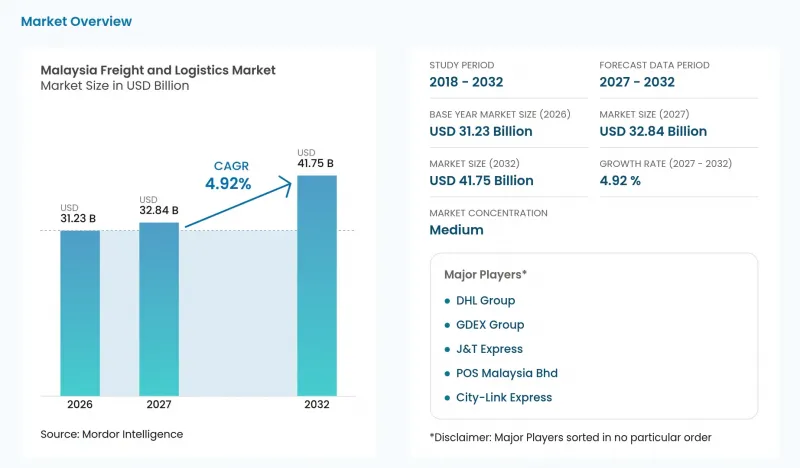
This report is segmented by End User Industry (Manufacturing, Wholesale and Retail Trade, and more) and Logistics Function (Freight Transport, Freight Forwarding, and more). The market forecasts are provided in terms of value (USD), based on availability.
Malaysia Freight And Logistics Market Trends and Insights
Explosive B2C E-Commerce Volumes
Online sellers of physical goods need fulfillment that can absorb demand concentrated around sales events. Malaysia's internet retail sales index grew 9.5% year over year in September 2025. DOSM reported that online sales events stimulated consumer demand and increased transaction volumes across major e-commerce platforms. For merchandise orders, that concentration makes the timing of available capacity consequential, because orders generated together also need to enter fulfillment together. Temporary sorting and dispatch shifts for physical-goods orders generated by the 9.9 online sales events DOSM cited can serve the peak without committing the same capacity through quieter periods.
Surge in FDI-led Manufacturing Output
Higher factory output increases the freight work associated with supplying production and moving finished goods to buyers. Malaysia's manufacturing output increased 7.4% year over year in August 2026, after 6.4% in July, with the August reading provisional. Manufacturing also accounted for 34.5% of Malaysia's accumulated foreign direct investment position at the end of Q2 2026. Tying collection and dispatch commitments to factory production schedules addresses immediate freight demand, while the investment position indicates an established manufacturing customer base.
Port and Last-Mile Congestion
Congestion can reduce the reliability of a freight service even when terminal handling capacity is available. On September 4, 2026, the Malaysia Hauliers Association's secretary-general said congestion around Klang and Port Klang made truck travel times unpredictable and risked missed terminal, depot, and delivery slots. The secretary-general also said congestion could increase fuel use by 15% to 25% per trip, depending on traffic conditions. The combination exposes a haulier to disrupted scheduling and additional fuel requirements on the same movement. Missed slots can complicate subsequent commitments, limiting how tightly an operator can schedule its available trucks. Offering fixed delivery windows under these conditions can require more time per booking, reducing the work a fleet can reliably accept.
Other drivers and restraints analyzed in the detailed report include:
- Government Mega-Projects (ECRL, Pan-Borneo Highway)
- RCEP-Driven Cross-Border Trade Flows
- Chronic Truck-Driver Shortage
For complete list of drivers and restraints, kindly check the Table Of Contents.
Segment Analysis
Manufacturing accounted for a 38.98% share of the Malaysia freight and logistics market size in 2026. The sector employed 2.4 million people in 2025. On May 22, 2025, Neways opened a Selangor facility for high-level semiconductor assemblies, with production starting and ASML as its launching customer. Manufacturing anchors a substantial industrial customer base, with facilities such as Neways creating a role for logistics providers that coordinate component arrivals and finished-assembly dispatches around customer production requirements.
Wholesale and retail trade is the fastest-growing segment, with a projected CAGR of 5.28% between 2027 and 2032. The sector's volume index, covering wholesale, retail, and motor vehicles, rose 3.6% year over year in August 2026. Retail trade's volume index rose 3.8% year over year that month, with growth in retail outside stores, stalls, and markets (6.2%) and through stalls and markets (5.9%) among the contributing channels. Those different selling channels create a case for replenishment services that can connect stock locations with both store-based and dispersed customer destinations.
Complete Report Scope:
- By End User Industry
- Agriculture, Fishing, and Forestry
- Construction
- Manufacturing
- Oil and Gas, Mining and Quarrying
- Wholesale and Retail Trade
- Others
- By Logistics Function
- Courier, Express, and Parcel (CEP)
- By Destination Type
- Domestic
- International
- By Destination Type
- Freight Forwarding
- By Mode of Transport
- Air
- Sea and Inland Waterways
- Others
- By Mode of Transport
- Freight Transport
- By Mode of Transport
- Air
- Pipelines
- Rail
- Road
- Sea and Inland Waterways
- By Mode of Transport
- Warehousing and Storage
- By Temperature Control
- Non-Temperature Controlled
- Temperature Controlled
- By Temperature Control
- Other Services
- Courier, Express, and Parcel (CEP)
List of Companies Covered in this Report:
- City-Link Express
- CJ Logistics Corporation
- DHL Group
- DSV A/S (Including DB Schenker)
- FedEx
- FM Global Logistics Holdings Bhd
- GDEX Group
- Hellmann Worldwide Logistics
- Hextar Technologies Solutions Bhd
- J&T Express
- Keretapi Tanah Melayu Bhd
- Kuehne+Nagel
- MMC Corporation Bhd
- NYK (Nippon Yusen Kaisha) Line
- POS Malaysia Bhd
- SF Express (KEX-SF)
- Skynet Worldwide (M) Sdn Bhd
- Taipanco Sdn Bhd
- Tiong Nam Logistics Holdings Bhd
- Arka Bhd
- United Parcel Service of America, Inc. (UPS)
- Xin Hwa Holdings Bhd
Additional Benefits:
- The market estimate (ME) sheet in Excel format
- 3 months of analyst support
TABLE OF CONTENTS
1 INTRODUCTION
- 1.1 Study Assumptions and Market Definition
- 1.2 Scope of the Study
2 RESEARCH METHODOLOGY
3 EXECUTIVE SUMMARY
4 MARKET LANDSCAPE
- 4.1 Market Overview
- 4.2 Market Drivers
- 4.2.1 Explosive B2C E-Commerce Volumes
- 4.2.2 Surge in FDI-led Manufacturing Output
- 4.2.3 Government Mega-Projects (ECRL, Pan-Borneo Highway)
- 4.2.4 RCEP-Driven Cross-Border Trade Flows
- 4.2.5 Rising Demand for Certified Halal Logistics
- 4.2.6 Cold-Chain Build-Out for Vaccines and Biologics
- 4.3 Market Restraints
- 4.3.1 Port and Last-Mile Congestion
- 4.3.2 Chronic Truck-Driver Shortage
- 4.3.3 Domestic Cabotage Policy Limits Coastal Shipping
- 4.3.4 Planned Euro-V Emission Rules, Capex Squeeze
- 4.4 Industry Value Chain Analysis
- 4.5 Regulatory Landscape
- 4.6 Technological Outlook
- 4.7 Porter's Five Forces Analysis
- 4.7.1 Threat of New Entrants
- 4.7.2 Bargaining Power of Suppliers
- 4.7.3 Bargaining Power of Buyers
- 4.7.4 Threat of Substitutes
- 4.7.5 Competitive Rivalry
- 4.8 Demographics
- 4.9 GDP Distribution by Economic Activity
- 4.10 GDP Growth by Economic Activity
- 4.11 Inflation
- 4.12 Economic Performance and Profile
- 4.12.1 Trends in E-Commerce Industry
- 4.12.2 Trends in Manufacturing Industry
- 4.13 Transport and Storage Sector GDP
- 4.14 Export Trends
- 4.15 Import Trends
- 4.16 Fuel Price
- 4.17 Trucking Operational Costs
- 4.18 Trucking Fleet Size by Type
- 4.19 Major Truck Suppliers
- 4.20 Logistics Performance
- 4.21 Modal Share
- 4.22 Maritime Fleet Load Carrying Capacity
- 4.23 Liner Shipping Connectivity
- 4.24 Port Calls and Performance
- 4.25 Freight Pricing Trends
- 4.26 Freight Tonnage Trends
- 4.27 Infrastructure
5 MARKET SIZE AND GROWTH FORECASTS (VALUE)
- 5.1 By End User Industry
- 5.1.1 Agriculture, Fishing, and Forestry
- 5.1.2 Construction
- 5.1.3 Manufacturing
- 5.1.4 Oil and Gas, Mining and Quarrying
- 5.1.5 Wholesale and Retail Trade
- 5.1.6 Others
- 5.2 By Logistics Function
- 5.2.1 Courier, Express, and Parcel (CEP)
- 5.2.1.1 By Destination Type
- 5.2.1.1.1 Domestic
- 5.2.1.1.2 International
- 5.2.1.1 By Destination Type
- 5.2.2 Freight Forwarding
- 5.2.2.1 By Mode of Transport
- 5.2.2.1.1 Air
- 5.2.2.1.2 Sea and Inland Waterways
- 5.2.2.1.3 Others
- 5.2.2.1 By Mode of Transport
- 5.2.3 Freight Transport
- 5.2.3.1 By Mode of Transport
- 5.2.3.1.1 Air
- 5.2.3.1.2 Pipelines
- 5.2.3.1.3 Rail
- 5.2.3.1.4 Road
- 5.2.3.1.5 Sea and Inland Waterways
- 5.2.3.1 By Mode of Transport
- 5.2.4 Warehousing and Storage
- 5.2.4.1 By Temperature Control
- 5.2.4.1.1 Non-Temperature Controlled
- 5.2.4.1.2 Temperature Controlled
- 5.2.4.1 By Temperature Control
- 5.2.5 Other Services
- 5.2.1 Courier, Express, and Parcel (CEP)
6 COMPETITIVE LANDSCAPE
- 6.1 Market Concentration
- 6.2 Strategic Moves
- 6.3 Market Share Analysis
- 6.4 Company Profiles (includes Global level Overview, Market level overview, Core Segments, Financials as available, Strategic Information, Market Rank/Share for key companies, Products and Services, and Recent Developments)
- 6.4.1 City-Link Express
- 6.4.2 CJ Logistics Corporation
- 6.4.3 DHL Group
- 6.4.4 DSV A/S (Including DB Schenker)
- 6.4.5 FedEx
- 6.4.6 FM Global Logistics Holdings Bhd
- 6.4.7 GDEX Group
- 6.4.8 Hellmann Worldwide Logistics
- 6.4.9 Hextar Technologies Solutions Bhd
- 6.4.10 J&T Express
- 6.4.11 Keretapi Tanah Melayu Bhd
- 6.4.12 Kuehne+Nagel
- 6.4.13 MMC Corporation Bhd
- 6.4.14 NYK (Nippon Yusen Kaisha) Line
- 6.4.15 POS Malaysia Bhd
- 6.4.16 SF Express (KEX-SF)
- 6.4.17 Skynet Worldwide (M) Sdn Bhd
- 6.4.18 Taipanco Sdn Bhd
- 6.4.19 Tiong Nam Logistics Holdings Bhd
- 6.4.20 Arka Bhd
- 6.4.21 United Parcel Service of America, Inc. (UPS)
- 6.4.22 Xin Hwa Holdings Bhd
7 MARKET OPPORTUNITIES AND FUTURE OUTLOOK
- 7.1 White-Space and Unmet-Need Assessment

