PUBLISHER: Mordor Intelligence | PRODUCT CODE: 2187188

PUBLISHER: Mordor Intelligence | PRODUCT CODE: 2187188
India Freight and Logistics - Market Share Analysis, Industry Trends & Statistics, Growth Forecasts (2027 - 2032)
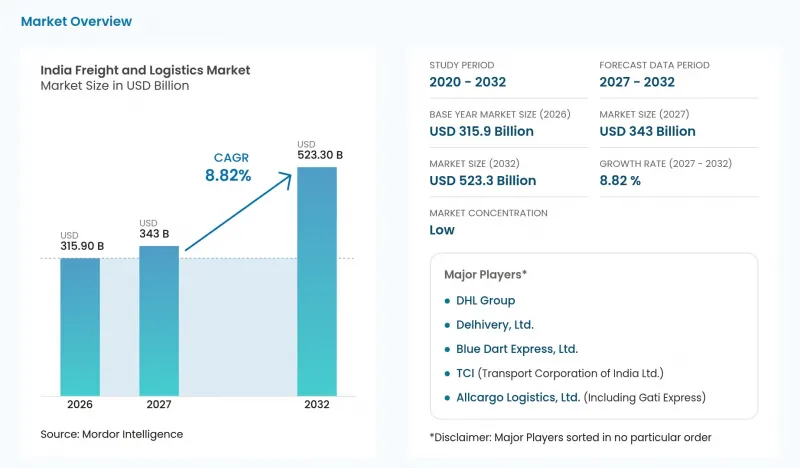
According to Mordor Intelligence, the India freight and logistics market size is expected to increase from USD 315.9 billion in 2026 to USD 343 billion in 2027 and reach USD 523.3 billion by 2032, growing at a CAGR of 8.82% over 2027-2032.
This report is segmented by End-User Industry (Wholesale and Retail Trade, Manufacturing, and more) and Logistics Function (Freight Transport, Freight Forwarding, and more). The market forecasts are provided in terms of value (USD), based on availability.
India Freight and Logistics Market Trends and Insights
Omnichannel and D2C Fulfillment Surge
Retail stores can become fulfillment points when a direct-to-consumer brand promises rapid delivery to nearby online shoppers. In July 2025, Snitch reported that its Bengaluru quick-delivery model fulfilled around 12-15% of the brand's daily online orders in the city. The menswear brand used 13 Bengaluru stores as active micro-fulfillment hubs, with delivery within 60 minutes or the same day depending on location and order timing. This configuration links a retail footprint to dispatch capacity, giving local order concentration a direct operational role in fulfillment. For a store-based fulfillment service, delivery speed depends on dispatch readiness at the local outlet as well as the delivery vehicle.
Real-Time Visibility and Predictive ETA Mandate
Movement visibility makes a logistics service easier to coordinate when it crosses several operating handoffs. The Department for Promotion of Industry and Internal Trade reported more than 2.17 billion cumulative Unified Logistics Interface Platform (ULIP) transactions since January 2022 in its 2025-26 annual report. It also recorded 215 applications developed by 165 private players using ULIP's application programming interfaces. Those applications illustrate a technical route for bringing shared logistics data into the coordination of contracted freight movements. For a freight provider, the commercial opportunity is to connect that information with collection, transfer and dispatch decisions. Shared movement data can support paid freight coordination through rescheduling delayed transfers and adjusting warehouse receiving, connecting platform use to physical service execution.
Driver Shortage and High Attrition
A shortage of trailer drivers can prevent available container-handling infrastructure from translating into timely inland movement. In 2026, a driver shortage at container freight stations delayed evacuation of 25,000 import containers at Jawaharlal Nehru Port Authority (JNPA). For importers and their logistics contractors, the constraint lies at the transfer from port handling to onward transport. JNPA moved some containers by rail to nearby container freight stations with sidings and began scanning double containers together to cut processing time. The importer's cargo-delivery commitment can therefore carry an evacuation delay risk when the onward trailer movement lacks a driver.
Other drivers and restraints analyzed in the detailed report include:
- Flexible Delivery Windows and "Anytime Returns"
- Pharmaceutical Cold-Chain Integrity Demands
- Highly Fragmented Truck Ownership
For complete list of drivers and restraints, kindly check the Table Of Contents.
Segment Analysis
Wholesale and retail trade accounted for a 33.71% share of the India freight and logistics market size in 2026 and is forecast to be the fastest-growing segment, with a 9.45% CAGR over 2027-2032. The largest segment's retail reach is illustrated by Amazon Now, which served more than 120 Indian cities through close to 800 micro-fulfillment and urban fulfillment centers in October 2026. Its retail service offered daily essentials including groceries, personal care products and small appliances. The combination of many local centers and several product categories creates a geographically distributed receiving task. Contracted logistics providers can address that task through replenishment services alongside individual-order fulfillment.
Retail shopping peaks create a different capacity decision from maintaining a distributed fulfillment footprint. During the opening period of Amazon's 2026 Great Indian Festival, customers ordered over 100% more products year over year. Providers serving such peaks can reserve temporary handling capacity around the event rather than treating the short burst as a permanent operating requirement. Agriculture, fishing, and forestry includes foodgrain distribution, with the Food Corporation of India moving approximately 28.33 million metric tons in 2025 for National Food Security Act and other schemes. This grain movement requires bulk dispatch capacity, while the retail peak calls for handling capacity that can be withdrawn after the event.
Complete Report Scope:
- By End-User Industry
- Agriculture, Fishing, and Forestry
- Construction
- Manufacturing
- Oil and Gas, Mining, and Quarrying
- Wholesale and Retail Trade
- Others
- By Logistics Function
- Courier, Express and Parcel (CEP)
- By Destination Type
- Domestic
- International
- By Destination Type
- Freight Forwarding
- By Mode of Transport
- Air
- Sea and Inland Waterways
- Others
- By Mode of Transport
- Freight Transport
- By Mode of Transport
- Air
- Pipelines
- Rail
- Road
- Sea and Inland Waterways
- By Mode of Transport
- Warehousing and Storage
- By Temperature Control
- Non-Temperature-Controlled
- Temperature-Controlled
- By Temperature Control
- Other Services
- Courier, Express and Parcel (CEP)
List of Companies Covered in this Report:
- Adani Ports and SEZ
- Allcargo Logistics, Ltd. (Including Gati Express)
- Amazon
- Blue Dart Express, Ltd.
- Busybees Logistics Solutions Pvt. Ltd.
- Container Corporation of India, Ltd.
- Delhivery, Ltd.
- DHL Group
- DSV A/S (Including DB Schenker)
- DTDC Express, Ltd.
- Ecom Express, Ltd.
- FedEx
- Ekart Logistics
- Kuehne+Nagel
- LEAP India Ltd.
- Mahindra Logistics, Ltd.
- Redington, Ltd.
- Safexpress Pvt. Ltd.
- Shadowfax
- Snowman Logistics Ltd.
- TCI (Transport Corporation of India Ltd.)
- TVS Supply Chain Solutions Ltd.
- United Parcel Service of America, Inc. (UPS)
- VRL Logistics Ltd.
Additional Benefits:
- The market estimate (ME) sheet in Excel format
- 3 months of analyst support
TABLE OF CONTENTS
1 INTRODUCTION
- 1.1 Study Assumptions and Market Definition
- 1.2 Scope of the Study
2 RESEARCH METHODOLOGY
3 EXECUTIVE SUMMARY
4 MARKET LANDSCAPE
- 4.1 Market Overview
- 4.2 Market Drivers
- 4.2.1 Omnichannel and D2C Fulfillment Surge
- 4.2.2 Real-Time Visibility and Predictive ETA Mandate
- 4.2.3 Flexible Delivery Windows and "Anytime Returns"
- 4.2.4 Pharmaceutical Cold-Chain Integrity Demands
- 4.2.5 Defense and Aerospace Logistics Outsourcing Surge
- 4.2.6 Ultra-High Service-Level SLAs for Industrial OEMs
- 4.3 Market Restraints
- 4.3.1 Driver Shortage and High Attrition
- 4.3.2 Highly Fragmented Truck Ownership
- 4.3.3 Volatile Diesel and LNG Price Spread
- 4.3.4 Geopolitical Route Volatility (Red Sea / Panama)
- 4.4 Industry Value Chain Analysis
- 4.5 Regulatory Landscape
- 4.6 Technological Outlook
- 4.7 Porter's Five Forces Analysis
- 4.7.1 Threat of New Entrants
- 4.7.2 Bargaining Power of Suppliers
- 4.7.3 Bargaining Power of Buyers
- 4.7.4 Threat of Substitutes
- 4.7.5 Competitive Rivalry
- 4.8 Demographics
- 4.9 GDP Distribution by Economic Activity
- 4.10 GDP Growth by Economic Activity
- 4.11 Inflation
- 4.12 Economic Performance and Profile
- 4.12.1 Trends in E-Commerce Industry
- 4.12.2 Trends in Manufacturing Industry
- 4.13 Transport and Storage Sector GDP
- 4.14 Export Trends
- 4.15 Import Trends
- 4.16 Fuel Price
- 4.17 Trucking Operational Costs
- 4.18 Trucking Fleet Size by Type
- 4.19 Logistics Performance
- 4.20 Modal Share
- 4.21 Maritime Fleet Load Carrying Capacity
- 4.22 Liner Shipping Connectivity
- 4.23 Port Calls and Performance
- 4.24 Freight Pricing Trends
- 4.25 Freight Tonnage Trends
- 4.26 Infrastructure
5 MARKET SIZE AND GROWTH FORECASTS (VALUE)
- 5.1 By End-User Industry
- 5.1.1 Agriculture, Fishing, and Forestry
- 5.1.2 Construction
- 5.1.3 Manufacturing
- 5.1.4 Oil and Gas, Mining, and Quarrying
- 5.1.5 Wholesale and Retail Trade
- 5.1.6 Others
- 5.2 By Logistics Function
- 5.2.1 Courier, Express and Parcel (CEP)
- 5.2.1.1 By Destination Type
- 5.2.1.1.1 Domestic
- 5.2.1.1.2 International
- 5.2.1.1 By Destination Type
- 5.2.2 Freight Forwarding
- 5.2.2.1 By Mode of Transport
- 5.2.2.1.1 Air
- 5.2.2.1.2 Sea and Inland Waterways
- 5.2.2.1.3 Others
- 5.2.2.1 By Mode of Transport
- 5.2.3 Freight Transport
- 5.2.3.1 By Mode of Transport
- 5.2.3.1.1 Air
- 5.2.3.1.2 Pipelines
- 5.2.3.1.3 Rail
- 5.2.3.1.4 Road
- 5.2.3.1.5 Sea and Inland Waterways
- 5.2.3.1 By Mode of Transport
- 5.2.4 Warehousing and Storage
- 5.2.4.1 By Temperature Control
- 5.2.4.1.1 Non-Temperature-Controlled
- 5.2.4.1.2 Temperature-Controlled
- 5.2.4.1 By Temperature Control
- 5.2.5 Other Services
- 5.2.1 Courier, Express and Parcel (CEP)
6 COMPETITIVE LANDSCAPE
- 6.1 Market Concentration
- 6.2 Strategic Moves
- 6.3 Market Share Analysis
- 6.4 Company Profiles (includes Global level Overview, Market level overview, Core Segments, Financials as available, Strategic Information, Market Rank/Share for key companies, Products and Services, and Recent Developments)
- 6.4.1 Adani Ports and SEZ
- 6.4.2 Allcargo Logistics, Ltd. (Including Gati Express)
- 6.4.3 Amazon
- 6.4.4 Blue Dart Express, Ltd.
- 6.4.5 Busybees Logistics Solutions Pvt. Ltd.
- 6.4.6 Container Corporation of India, Ltd.
- 6.4.7 Delhivery, Ltd.
- 6.4.8 DHL Group
- 6.4.9 DSV A/S (Including DB Schenker)
- 6.4.10 DTDC Express, Ltd.
- 6.4.11 Ecom Express, Ltd.
- 6.4.12 FedEx
- 6.4.13 Ekart Logistics
- 6.4.14 Kuehne+Nagel
- 6.4.15 LEAP India Ltd.
- 6.4.16 Mahindra Logistics, Ltd.
- 6.4.17 Redington, Ltd.
- 6.4.18 Safexpress Pvt. Ltd.
- 6.4.19 Shadowfax
- 6.4.20 Snowman Logistics Ltd.
- 6.4.21 TCI (Transport Corporation of India Ltd.)
- 6.4.22 TVS Supply Chain Solutions Ltd.
- 6.4.23 United Parcel Service of America, Inc. (UPS)
- 6.4.24 VRL Logistics Ltd.
7 MARKET OPPORTUNITIES AND FUTURE OUTLOOK
- 7.1 White-Space and Unmet-Need Assessment

