PUBLISHER: Mordor Intelligence | PRODUCT CODE: 2187191

PUBLISHER: Mordor Intelligence | PRODUCT CODE: 2187191
India Online Travel - Market Share Analysis, Industry Trends & Statistics, Growth Forecasts (2027 - 2032)
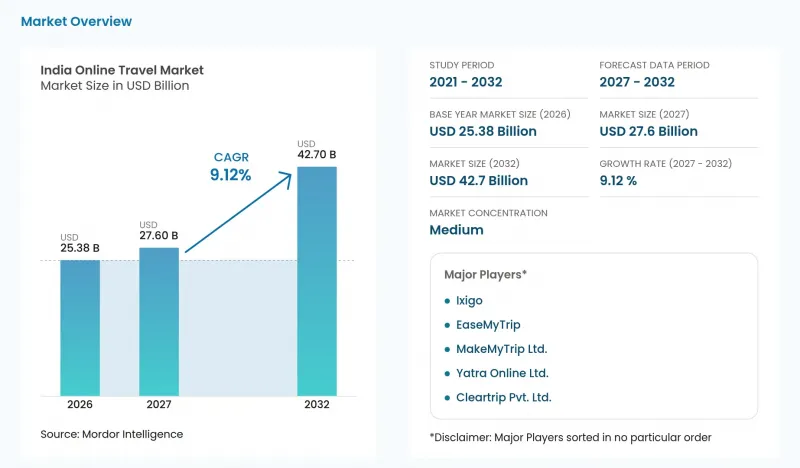
According to Mordor Intelligence, the India online travel market size is expected to increase from USD 25.38 billion in 2026 to USD 27.6 billion in 2027 and reach USD 42.7 billion by 2032, growing at a CAGR of 9.12% over 2027-2032.
This report is segmented by Segmentation by Service Type (Travel Accommodation and more), Segmentation by Booking Device (Mobile and more), Segmentation by Business Model (Online Travel Agencies and more), Segmentation by Traveler Type (Leisure and more), Segmentation by Age Group (31-45 Years and more), and Geography. The market forecasts are provided in terms of value (USD), based on availability.
India Online Travel Market Trends and Insights
Rising Adoption of UPI & Digital Wallets Accelerating Seamless Bookings
A familiar digital payment route can reduce the effort needed to complete an online travel reservation. UPI processed 241.6 billion transactions across India in FY2025-26. Cleartrip reported an approximately 6% increase in UPI transactions on its platform in 2025, citing convenience and partnerships with multiple banks. National UPI transaction volume grew 30% from FY2024-25 to FY2025-26. For a booking intermediary, supporting UPI makes checkout available through a growing national payment channel that already carries travel transactions, giving payment integration a role in reaching demand beyond improving the reservation interface.
Government's UDAN Scheme Expanding Regional Air Connectivity
Regional air connectivity expands the set of journeys that online travel platforms can offer beyond major airports. From its 2016 launch through October 2026, UDAN operationalized 687 routes connecting 95 airports, heliports and water aerodromes and benefited more than 17.1 million passengers. This breadth gives booking intermediaries a reason to connect regional flight discovery with accommodation at the destination. The commercial opportunity depends on presenting usable connections rather than treating every connected site as an equivalent source of bookings. A route becomes a sellable itinerary when the carrier's available flights and the destination's accommodation can be booked for the same travel dates.
Fragmented, Unorganized Accommodation Supply Limiting Digitization
Limited digital skills can keep small accommodation suppliers beyond the effective reach of online travel distribution. NITI Aayog's June 2025 report, based on fieldwork in selected districts across 4 states, found that digital-literacy training was almost entirely absent, limiting homestay operators' market reach. Many operators in Uttar Pradesh and Uttarakhand relied on government-arranged guest bookings, which the study linked to low occupancy. This dependence makes adding bookable supply a supplier-capability problem as well as a distribution opportunity. On May 26, 2026, Uttarakhand's governor launched Uttarakhand Open University's Assistant Homestay Manager course materials covering online booking and social-media promotion. Where digital skills are missing, onboarding adds a supplier-development cost before additional stays can generate booking revenue.
Other drivers and restraints analyzed in the detailed report include:
- Domestic Tourism Surge Fueled by Social-Media Influence
- Rapid Growth of Middle-Income Millennials' Discretionary Spending
- Regulatory Uncertainty on Convenience Fees & Refund Norms
For complete list of drivers and restraints, kindly check the Table Of Contents.
Segment Analysis
Travel accommodation accounted for a 64.16% share of the India online travel market size in 2026 as the largest segment and is forecast to be the fastest-growing segment at a 9.8% CAGR over 2027-2032. MakeMyTrip's group-wide Hotels and Packages business recorded 43.53 million room nights in the year ended March 31, 2026, covering standalone stays and packages across online and offline channels. Standalone stays and packages give distributors different ways to address the accommodation purchase, linking the room itself with the wider journey when travelers choose a package. Package sales make the stay one component of a larger itinerary, so accommodation growth depends on how well intermediaries assemble the trip around the room.
MakeMyTrip's group-wide Hotels and Packages gross bookings reached USD 2.66 billion in the year ended March 31, 2026, across online and offline channels. Transportation has a different digital use in rail reservations, where Indian Railways reported that 89% of 650.8 million reserved tickets booked from June 2025 to June 2026 were booked online. The predominantly online rail channel leaves a limited pool of counter bookings to convert, while accommodation distributors can compete through how they combine stays with other itinerary components.
Mobile represented a 68.79% India online travel market share in 2026 as the largest segment and is forecast to be the fastest-growing segment at a 14.9% CAGR over 2027-2032. Across MakeMyTrip Ltd.'s key brands, MakeMyTrip, Goibibo and redBus, mobile apps accounted for 81.3% of total transactions in FY2026. This transaction base makes the app a central delivery channel for the group's travel offer, rather than an accessory to its website. For operators serving mobile demand, the commercial decision concerns the complete booking and service experience on the device through which the transaction is completed.
Desktop and laptop bookings are forecast to contract. MakeMyTrip reported that transactions through its group desktop websites decreased between FY2020 and FY2025. The company said it believed the decline reflected customers shifting toward its apps as smartphone and mobile-device use increased in India. For an operator, this suggests that desktop weakness can reflect internal channel migration alongside continuing demand for its travel offer. Channel investment can then follow the transaction toward the app while retaining website access, helping distinguish a declining booking device from the loss of the underlying customer relationship.
Complete Report Scope:
- By Segmentation by Service Type
- Transportation
- Air Travel
- Bus & Coach Travel
- Rail Travel
- Car Rental
- Cruise
- Travel Accommodation
- Hotels & Resorts
- Alternative Lodging/Rentals
- Vacation Packages
- Others
- Transportation
- By Segmentation by Booking Device
- Desktop / Laptop
- Mobile
- By Segmentation by Business Model
- Online Travel Agencies
- Direct Supplier Online Platforms
- By Segmentation by Traveler Type
- Leisure
- Business
- Bleisure
- By Segmentation by Age Group
- 18-30 Years
- 31-45 Years
- 46-60 Years
- Greater than 60 Years
- By Geography
- North India
- South India
- West India
- East India
- Central India
List of Companies Covered in this Report:
- MakeMyTrip Ltd.
- Yatra Online Ltd.
- EaseMyTrip
- Cleartrip Pvt. Ltd.
- Ixigo
- Airbnb Inc.
- Booking Holdings Inc.
- OYO Rooms
- Thomas Cook (India) Ltd.
- IRCTC Ltd.
- Paytm Travel (One 97 Communications)
- Ixigo (Le Travenues Technology Ltd.)
- SOTC Travel Ltd.
- FabHotels
- Treebo Hotels
- RailYatri
- TBO Tek Limited
- Holiday Triangle Travel Private Limited
- Zoomcar India Pvt. Ltd.
- Revv Self-Drive Cars
Additional Benefits:
- The market estimate (ME) sheet in Excel format
- 3 months of analyst support
TABLE OF CONTENTS
1 INTRODUCTION
- 1.1 Study Assumptions and Market Definition
- 1.2 Scope of the Study
2 RESEARCH METHODOLOGY
3 EXECUTIVE SUMMARY
4 MARKET LANDSCAPE
- 4.1 Market Overview
- 4.2 Market Drivers
- 4.2.1 Rising Adoption of UPI & Digital Wallets Accelerating Seamless Bookings
- 4.2.2 Government's UDAN Scheme Expanding Regional Air Connectivity
- 4.2.3 Domestic Tourism Surge Fueled by Social-Media Influence
- 4.2.4 Rapid Growth of Middle-Income Millennials' Discretionary Spending
- 4.2.5 Smartphone Penetration in Tier-II & III Cities Boosting App Usage
- 4.2.6 Dynamic Pricing Algorithms Enhancing Conversion & Yield
- 4.3 Market Restraints
- 4.3.1 Fragmented, Unorganized Accommodation Supply Limiting Digitization
- 4.3.2 Regulatory Uncertainty on Convenience Fees & Refund Norms
- 4.3.3 Cybersecurity Breaches Undermining Consumer Trust
- 4.3.4 Escalating Customer-Acquisition Costs Amid Price Wars
- 4.4 Industry Value Chain Analysis
- 4.5 Regulatory Landscape
- 4.6 Technological Outlook
- 4.7 Porter's Five Forces Analysis
- 4.7.1 Threat of New Entrants
- 4.7.2 Bargaining Power of Suppliers
- 4.7.3 Bargaining Power of Buyers
- 4.7.4 Threat of Substitutes
- 4.7.5 Competitive Rivalry
- 4.8 Consumer Booking-Journey Analysis
5 MARKET SIZE AND GROWTH FORECASTS (VALUE)
- 5.1 By Segmentation by Service Type
- 5.1.1 Transportation
- 5.1.1.1 Air Travel
- 5.1.1.2 Bus & Coach Travel
- 5.1.1.3 Rail Travel
- 5.1.1.4 Car Rental
- 5.1.1.5 Cruise
- 5.1.2 Travel Accommodation
- 5.1.2.1 Hotels & Resorts
- 5.1.2.2 Alternative Lodging/Rentals
- 5.1.2.3 Vacation Packages
- 5.1.2.4 Others
- 5.1.1 Transportation
- 5.2 By Segmentation by Booking Device
- 5.2.1 Desktop / Laptop
- 5.2.2 Mobile
- 5.3 By Segmentation by Business Model
- 5.3.1 Online Travel Agencies
- 5.3.2 Direct Supplier Online Platforms
- 5.4 By Segmentation by Traveler Type
- 5.4.1 Leisure
- 5.4.2 Business
- 5.4.3 Bleisure
- 5.5 By Segmentation by Age Group
- 5.5.1 18-30 Years
- 5.5.2 31-45 Years
- 5.5.3 46-60 Years
- 5.5.4 Greater than 60 Years
- 5.6 By Geography
- 5.6.1 North India
- 5.6.2 South India
- 5.6.3 West India
- 5.6.4 East India
- 5.6.5 Central India
6 COMPETITIVE LANDSCAPE
- 6.1 Market Concentration
- 6.2 Strategic Moves
- 6.3 Market Share Analysis
- 6.4 Company Profiles (includes Global level Overview, Market level overview, Core Segments, Financials as available, Strategic Information, Market Rank/Share for key companies, Products and Services, and Recent Developments)
- 6.4.1 MakeMyTrip Ltd.
- 6.4.2 Yatra Online Ltd.
- 6.4.3 EaseMyTrip
- 6.4.4 Cleartrip Pvt. Ltd.
- 6.4.5 Ixigo
- 6.4.6 Airbnb Inc.
- 6.4.7 Booking Holdings Inc.
- 6.4.8 OYO Rooms
- 6.4.9 Thomas Cook (India) Ltd.
- 6.4.10 IRCTC Ltd.
- 6.4.11 Paytm Travel (One 97 Communications)
- 6.4.12 Ixigo (Le Travenues Technology Ltd.)
- 6.4.13 SOTC Travel Ltd.
- 6.4.14 FabHotels
- 6.4.15 Treebo Hotels
- 6.4.16 RailYatri
- 6.4.17 TBO Tek Limited
- 6.4.18 Holiday Triangle Travel Private Limited
- 6.4.19 Zoomcar India Pvt. Ltd.
- 6.4.20 Revv Self-Drive Cars
7 MARKET OPPORTUNITIES AND FUTURE OUTLOOK
- 7.1 White-Space and Unmet-Need Assessment

