PUBLISHER: Mordor Intelligence | PRODUCT CODE: 2187424

PUBLISHER: Mordor Intelligence | PRODUCT CODE: 2187424
Vietnam Online Travel - Market Share Analysis, Industry Trends & Statistics, Growth Forecasts (2027 - 2032)
According to Mordor Intelligence, the Vietnam online travel market size was valued at USD 3.12 billion in 2026 and estimated to grow from USD 3.39 billion in 2027 to reach USD 5.17 billion by 2032, at a CAGR of 8.8% during the forecast period (2027-2032).
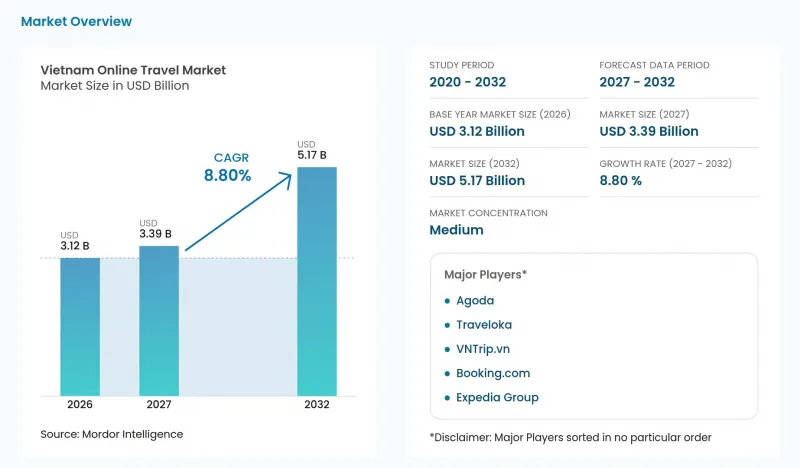
This report is segmented by Booking Type (Air Ticketing, Hotels and Packages, and more), Platform (Mobile and Desktop), Traveler Origin (Domestic Travelers and International Travelers), Payment Method (Digital Wallets, Cards, and more), and Geography (Southern Vietnam, Northern Vietnam, and more). The market forecasts are provided in terms of value (USD), based on availability.
Vietnam Online Travel Market Trends and Insights
Rising internet and smartphone penetration
A large smartphone-connected customer base gives travel sellers a distribution opportunity that does not depend on customers visiting a physical agency. In May 2026, Vietnam had 110.5 million mobile broadband subscriptions across 3G, 4G, and 5G services, and 91.3% of subscribers used smartphones. For smaller hotels and transport operators, phone-compatible inventory and checkout would convert that connectivity into a usable remote sales channel. Poor phone usability would consequently narrow the reachable booking audience even where broadband access is already available.
Government smart-tourism and digital-transformation push
Government digital-tourism initiatives can expand online demand when destination information connects directly to transport inventory that travelers can actually book. On July 14, 2025, the Ministry of Culture, Sports and Tourism issued a program with goals through 2025 for tourist-facing digital platforms and online tourism business models. The Tourism Information Center's national tourism app added rail-ticket purchases on August 19, 2025, connecting directly to the ticketing system of Vietnam Railways Corporation (VNR) and offering Tet tickets from September 20, 2025. That connection gives tourism discovery a transaction endpoint instead of requiring a separate station purchase. Transport operators therefore have a commercial reason to connect their selling systems to public tourism services, extending those programs into another route for ticket distribution.
Foreign OTA dominance squeezing local margins
For smaller Vietnamese hotels and travel businesses, access to online demand can come with distribution costs that weaken the appeal of additional bookings. In 2025, the Viet Nam Competition Commission said dominant international online travel agencies (OTAs) limited choice and smaller local suppliers faced high commission pressure. The Commission identified higher prices or compromised service quality as possible consequences of that pressure. Passing the cost to travelers can reduce the attractiveness of the offer, while absorbing it leaves less revenue available to deliver the stay or trip. This creates a supply-side limit to online expansion, because additional platform reach can require a trade-off between the supplier's retained revenue and the customer's total travel cost.
Other drivers and restraints analyzed in the detailed report include:
- Low-cost carriers and expanded air connectivity
- Surge in digital-wallet use enabling instant travel payments
- Language and cultural barriers among older / rural users
For complete list of drivers and restraints, kindly check the Table Of Contents.
Segment Analysis
Air ticketing accounted for a 47.25% share of the Vietnam online travel market size in 2026. Within the largest segment, Vietnam Airlines commissioned a new e-commerce website in 2025 to optimize its company-wide direct sales channel. The site integrated a 24/7 AI-powered chatbot and an optimized booking flow. These capabilities place online purchase and assistance within the airline's own sales environment, giving intermediaries a supplier-led source of competition for the booking relationship. An intermediary's distinctive value must consequently extend beyond the purchase flow and automated assistance delivered by the airline's own digital channel.
Railway ticketing is the fastest-growing segment, with a 12.1% CAGR forecast during 2027-2032. Vietnam National Railway Group (VNR, formerly Vietnam Railways Corporation) served approximately 6.3 million passengers in the first 9 months of 2026, up 6.4% from the same period in 2025. On April 29, 2026, Vietnam Railways Corporation announced AI-based electronic-ticket pricing for remaining short segments after longer journeys were partly sold. It announced all-train-class coverage from May 1, 2026, bringing forward wider rollout previously intended after a pilot scheduled through May 15. Pricing unused journey segments through an electronic system would make the offer more specific to available capacity, creating a differentiated booking proposition alongside expanding rail passenger demand.
Mobile accounted for 75.4% of market value in 2026 and is the largest and fastest-growing segment, with a 12.4% CAGR forecast during 2027-2032. In June 2026, the Ministry of Culture, Sports and Tourism described a traveler completing a Da Nang to Huế rail-ticket purchase on her phone using the national Vietnam Travel app. Mobile services can therefore compete through the purchase interface while leaving fulfillment to the rail operator, making a complete phone booking a commercial capability that does not require owning trains.
Desktop is forecast to contract during 2027-2032, reducing the booking value available to support a dedicated computer-based channel. For sellers retaining browser access for travelers on computers, desktop-only development would have a shrinking booking base from which to recover its costs. Preservation of computer-based reservations therefore becomes the commercial test for desktop spending, because the forecast offers no channel expansion to absorb added costs.
Complete Report Scope:
- By Booking Type
- Air Ticketing
- Hotels and Packages
- Bus Ticketing
- Railway Ticketing
- Other Booking Types
- By Platform
- Desktop
- Mobile
- By Traveler Origin
- Domestic Travelers
- International Travelers
- By Payment Method
- Digital Wallets
- Cards
- Bank Transfer
- Cash on Delivery / Office Pay
- By Geography
- Northern Vietnam
- Central Vietnam
- Southern Vietnam
List of Companies Covered in this Report:
- Booking.com
- Agoda
- Traveloka
- Expedia Group
- Tripadvisor
- Skyscanner
- Trivago
- VNTrip.vn
- Mytour Vietnam
- Vietravel
- Gotadi
- Tugo
- Kayak
- Trip.com (Ctrip)
- Tripi
- Luxstay
- BestPrice Travel
- Alotrip
- Baolau
- MoMo Travel Services
Additional Benefits:
- The market estimate (ME) sheet in Excel format
- 3 months of analyst support
TABLE OF CONTENTS
1 INTRODUCTION
- 1.1 Study Assumptions and Market Definition
- 1.2 Scope of the Study
2 RESEARCH METHODOLOGY
3 EXECUTIVE SUMMARY
4 MARKET LANDSCAPE
- 4.1 Market Overview
- 4.2 Market Drivers
- 4.2.1 Rising internet and smartphone penetration
- 4.2.2 Government smart-tourism and digital-transformation push
- 4.2.3 Low-cost carriers and expanded air connectivity
- 4.2.4 Surge in digital-wallet use enabling instant travel payments
- 4.2.5 Viral short-form video marketing of Vietnamese destinations
- 4.2.6 Super-app ecosystems bundling travel services
- 4.3 Market Restraints
- 4.3.1 Foreign OTA dominance squeezing local margins
- 4.3.2 Language and cultural barriers among older / rural users
- 4.3.3 High international airfares limiting inbound demand
- 4.3.4 Data-privacy and cyber-fraud concerns in mobile payments
- 4.4 Industry Value Chain Analysis
- 4.5 Regulatory Landscape
- 4.6 Technological Outlook
- 4.7 Porter's Five Forces Analysis
- 4.7.1 Threat of New Entrants
- 4.7.2 Bargaining Power of Suppliers
- 4.7.3 Bargaining Power of Buyers
- 4.7.4 Threat of Substitutes
- 4.7.5 Competitive Rivalry
- 4.8 Consumer Buying-Behavior Insights
5 MARKET SIZE AND GROWTH FORECASTS (VALUE)
- 5.1 By Booking Type
- 5.1.1 Air Ticketing
- 5.1.2 Hotels and Packages
- 5.1.3 Bus Ticketing
- 5.1.4 Railway Ticketing
- 5.1.5 Other Booking Types
- 5.2 By Platform
- 5.2.1 Desktop
- 5.2.2 Mobile
- 5.3 By Traveler Origin
- 5.3.1 Domestic Travelers
- 5.3.2 International Travelers
- 5.4 By Payment Method
- 5.4.1 Digital Wallets
- 5.4.2 Cards
- 5.4.3 Bank Transfer
- 5.4.4 Cash on Delivery / Office Pay
- 5.5 By Geography
- 5.5.1 Northern Vietnam
- 5.5.2 Central Vietnam
- 5.5.3 Southern Vietnam
6 COMPETITIVE LANDSCAPE
- 6.1 Market Concentration
- 6.2 Strategic Moves
- 6.3 Market Share Analysis
- 6.4 Company Profiles (includes Global level Overview, Market level overview, Core Segments, Financials as available, Strategic Information, Market Rank/Share for key companies, Products and Services, and Recent Developments)
- 6.4.1 Booking.com
- 6.4.2 Agoda
- 6.4.3 Traveloka
- 6.4.4 Expedia Group
- 6.4.5 Tripadvisor
- 6.4.6 Skyscanner
- 6.4.7 Trivago
- 6.4.8 VNTrip.vn
- 6.4.9 Mytour Vietnam
- 6.4.10 Vietravel
- 6.4.11 Gotadi
- 6.4.12 Tugo
- 6.4.13 Kayak
- 6.4.14 Trip.com (Ctrip)
- 6.4.15 Tripi
- 6.4.16 Luxstay
- 6.4.17 BestPrice Travel
- 6.4.18 Alotrip
- 6.4.19 Baolau
- 6.4.20 MoMo Travel Services
7 MARKET OPPORTUNITIES AND FUTURE OUTLOOK
- 7.1 White-Space and Unmet-Need Assessment

