PUBLISHER: Mordor Intelligence | PRODUCT CODE: 2117262

PUBLISHER: Mordor Intelligence | PRODUCT CODE: 2117262
Italy Office Real Estate - Market Share Analysis, Industry Trends & Statistics, Growth Forecasts (2026 - 2031)
According to Mordor Intelligence, the Italy office real estate market size is expected to grow from USD 17.10 billion in 2025 to USD 17.96 billion in 2026 and is forecast to reach USD 22.98 billion by 2031 at 5.05% CAGR over 2026-2031.
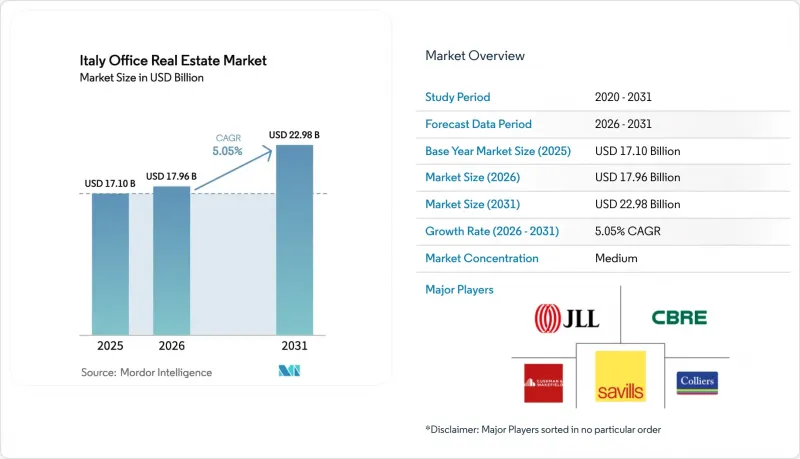
This report is Segmented by Building Grade (Grade A, Grade B and More), by Transaction Type (Rental and Sales), by End Use (Information Technology (IT & ITES), BFSI (Banking, Financial Services and Insurance), and More) and by City (Milan, Rome and More). The Report Offers Market Size and Forecasts in Value (USD) for all the Above Segments.
Italy Office Real Estate Market Trends and Insights
Urbanisation & Transit-Oriented Development
Government spending is tilting decisively toward transport. Of the USD 15.0 billion raised by 2023 BTP Green bonds, 41.5% went to rail and metro projects. Politecnico di Torino finds that mixed-use nodes such as Naples' Municipio outperform single-use clusters on transit uptake. NRRP upgrades are also smoothing city-to-city links; the Bank of Italy reports that these works are shoring up construction even as the wider economy cools
Foreign Institutional Capital Inflow
The euro area posted a USD 464.3 billion current-account surplus in 2024, providing deep capital pools for real-asset allocations. ECB research shows rapid growth in pan-European real-estate funds, many targeting Italian offices. In Piemonte alone, 27 FDI projects announced in 2024 carry a USD 4.36 billion price tag, 18% of which is real estate. Borrowing costs are also supportive: the average rate on new corporate loans slipped to 3.79% in April 2025
Aging Office Stock and Retrofit Costs
Italy's office landscape is grappling with the legacy of outdated infrastructure. Over 65% of the country's commercial buildings were constructed before 1980, yet the annual renovation rate remains just 0.81%, falling far short of EU climate targets. Although refurbishments can lift asset value by approximately 13.5%, many owners-especially in fringe submarkets-struggle to fund deep retrofits, as prevailing rents often fail to justify the return on cost. This mismatch fuels rising vacancy risk for obsolete stock, pushing tenants to prioritise Grade A space. As a result, Italy's office market continues to experience a structural split, where the flight-to-quality trend accelerates, but net absorption in older districts remains constrained.
Other drivers and restraints analyzed in the detailed report include:
- Coworking & Flex Office Expansion
- ESG & Green Building Compliance
- Rising Construction and Fit-Out Costs
For complete list of drivers and restraints, kindly check the Table Of Contents.
Segment Analysis
Grade A stock commands 44.30% of the market in 2025 and is projected to grow at a 5.62% CAGR through 2031. ECB valuation guidance underlines lenders' preference for energy-efficient assets. Semi-annual data from Agenzia delle Entrate confirm that top locations fetch a 20% premium over suburban equivalents. With only 515,000 m2 of Grade A space due by 2027, rents appear set for further upside.
Flight-to-quality also manifests beyond Milan. In Rome, prime EUR district schemes obtain USD 654 per m2 rents and capture greater international occupier interest on the back of new metro extensions. Meanwhile, Grade B stock remains the cost-efficient alternative, particularly for companies pivoting to suburban hubs amid hybrid work. Yet retrofitting costs and looming EU efficiency rules weigh on Grade C assets, accelerating disposals, conversions, or demolitions. Overall, the Grade A segment is set to post the fastest 5.62% CAGR through 2031, ensuring it continues to anchor future demand and pricing trends across the Italy office real estate market.
Complete Report Scope:
- By Building Grade
- Grade A
- Grade B
- Grade C
- By Transaction Type
- Rental
- Sales
- By End Use
- Information Technology (IT and ITES)
- BFSI (Banking, Financial Services and Insurance)
- Business Consulting & Professional Services
- Other Services (Retail, Lifesciences, Energy, Legal Services)
- By City
- Milan
- Rome
- Turin
- Rest of Italy
List of Companies Covered in this Report:
- CBRE
- Jones Lang LaSalle IP
- Cushman & Wakefield
- Savills
- Colliers
- Knight Frank
- Dils (Former BNP Paribas RE Advisory)
- Gabetti Property Solutions
- Prelios SGR
- COIMA RES
- Covivio Italy (ex-Beni Stabili)
- Generali Real Estate
- Allianz Real Estate Italy
- Hines Italy
- AXA IM Alts Italy
- IGD SIIQ
- Webuild (Developer arm)
- Astaldi
- Impresa Pizzarotti
- Rizzani de Eccher
Additional Benefits:
- The market estimate (ME) sheet in Excel format
- 3 months of analyst support
TABLE OF CONTENTS
1 Introduction
- 1.1 Study Assumptions & Market Definition
- 1.2 Scope of the Study
2 Research Methodology
3 Executive Summary
4 Market Insights and Dynamics
- 4.1 Market Drivers
- 4.1.1 Urbanisation & Transit-Oriented Development
- 4.1.2 Foreign Institutional Capital Inflow
- 4.1.3 Coworking & Flex Office Expansion
- 4.1.4 ESG & Green Building Compliance
- 4.1.5 Shift to Hybrid Work Models
- 4.2 Market Restraints
- 4.2.1 Aging Office Stock and Retrofit Costs
- 4.2.2 Rising Construction and Fit-Out Costs
- 4.2.3 Low Availability of Suitable Redevelopment Land
- 4.3 Value / Supply-Chain Analysis
- 4.3.1 Overview
- 4.3.2 Real Estate Developers and Contractors - Key Quantitative and Qualitative Insights
- 4.3.3 Architectural and Engineering Companies - Key Quantitative and Qualitative Insights
- 4.3.4 Building Material and Equipment Companies - Key Quantitative and Qualitative Insights
- 4.4 Government Regulations and Initiatives in the Industry
- 4.5 Technological Innovations in the Office Real Estate Market
- 4.6 Insights into Rental Yields in the Office Real Estate Segment
- 4.7 Insights into the Key Office Real Estate Industry Metrics (Supply, Rentals, Prices, Occupancy/Vacancy (%))
- 4.8 Insights into Office Real Estate Construction Costs
- 4.9 Insights into Office Real Estate Investment
- 4.10 Impact of Remote Working on Space Demand
- 4.11 Porter's Five Forces
- 4.11.1 Threat of New Entrants
- 4.11.2 Bargaining Power of Buyers / Occupiers
- 4.11.3 Bargaining Power of Developers / Landlords
- 4.11.4 Threat of Substitutes (WFH, Flexible Space)
- 4.11.5 Competitive Rivalry
5 Market Size & Growth Forecasts (Value in USD)
- 5.1 By Building Grade
- 5.1.1 Grade A
- 5.1.2 Grade B
- 5.1.3 Grade C
- 5.2 By Transaction Type
- 5.2.1 Rental
- 5.2.2 Sales
- 5.3 By End Use
- 5.3.1 Information Technology (IT and ITES)
- 5.3.2 BFSI (Banking, Financial Services and Insurance)
- 5.3.3 Business Consulting & Professional Services
- 5.3.4 Other Services (Retail, Lifesciences, Energy, Legal Services)
- 5.4 By City
- 5.4.1 Milan
- 5.4.2 Rome
- 5.4.3 Turin
- 5.4.4 Rest of Italy
6 Competitive Landscape
- 6.1 Strategic Moves (M&A, REIT IPOs, Sale-&-Leasebacks)
- 6.2 Company Profiles {(includes Global level Overview, Market level overview, Core Segments, Financials as available, Strategic Information, Market Rank/Share for key companies, Products & Services, and Recent Developments)}
- 6.2.1 CBRE
- 6.2.2 Jones Lang LaSalle IP
- 6.2.3 Cushman & Wakefield
- 6.2.4 Savills
- 6.2.5 Colliers
- 6.2.6 Knight Frank
- 6.2.7 Dils (Former BNP Paribas RE Advisory)
- 6.2.8 Gabetti Property Solutions
- 6.2.9 Prelios SGR
- 6.2.10 COIMA RES
- 6.2.11 Covivio Italy (ex-Beni Stabili)
- 6.2.12 Generali Real Estate
- 6.2.13 Allianz Real Estate Italy
- 6.2.14 Hines Italy
- 6.2.15 AXA IM Alts Italy
- 6.2.16 IGD SIIQ
- 6.2.17 Webuild (Developer arm)
- 6.2.18 Astaldi
- 6.2.19 Impresa Pizzarotti
- 6.2.20 Rizzani de Eccher
7 Market Opportunities & Future Outlook

