PUBLISHER: Mordor Intelligence | PRODUCT CODE: 2117263

PUBLISHER: Mordor Intelligence | PRODUCT CODE: 2117263
France Office Real Estate - Market Share Analysis, Industry Trends & Statistics, Growth Forecasts (2026 - 2031)
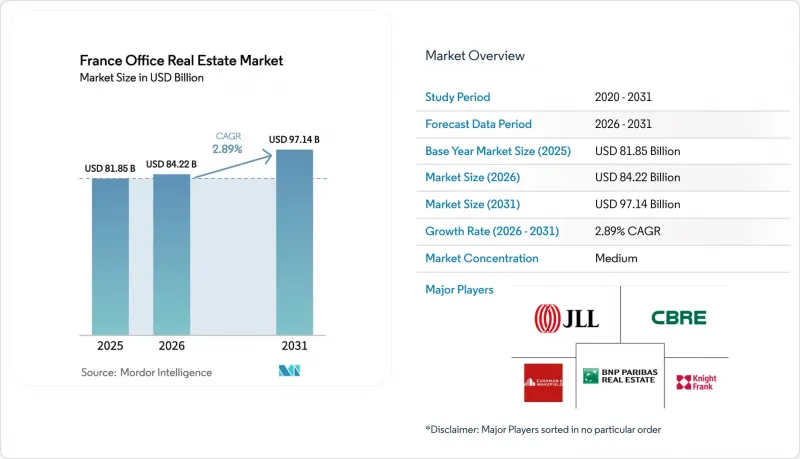
According to Mordor Intelligence, France office real estate market size in 2026 is estimated at USD 84.22 billion, growing from 2025 value of USD 81.85 billion with 2031 projections showing USD 97.14 billion, growing at 2.89% CAGR over 2026-2031.
This report is Segmented by Building Grade (Grade A, Grade B and More), by Transaction Type (Rental and Sales), by End Use (Information Technology (IT & ITES), BFSI (Banking, Financial Services and Insurance), and More) and by City (Paris, Marseille and More). The Report Offers Market Size and Forecasts in Value (USD) for all the Above Segments.
France Office Real Estate Market Trends and Insights
Surge in Flexible & Hybrid Workspace Demand
Hybrid work is firmly embedded across corporate France as 87% of employers now require partial in-office attendance, with employees clocking 3.5 days per week on-site. The preference for collaborative, technology-ready environments has already driven 42% of total floor space refurbishments toward flexible layouts. Prime CBD buildings therefore record declining vacancy even as peripheral stock exceeds 10%. Lease renegotiations favor shorter terms and built-in expansion clauses that match fluid staffing levels. Portfolio consolidation is accelerating, funneling capital expenditure into fewer yet higher-quality assets. The resulting bifurcation underscores why the France office real estate market continues to polarize around energy-efficient Grade A towers located near multimodal transport.
Heightened Corporate ESG & Green-Leasing Mandates
The EU taxonomy and France's Decret Tertiaire require a 40% energy-consumption cut by 2030, pressuring landlords to decarbonize assets or accept a "brown discount". Certified buildings already command rent premiums and enjoy lower vacancy, while lenders increasingly restrict financing for non-compliant stock. Fifty-seven percent of occupiers target net-zero footprints by 2030, channeling capex toward photovoltaic retrofits and smart-metering solutions. The regulatory push has created a refurbishment boom, with specialized contractors and PropTech vendors capitalizing on demand. Early-mover owners that attain green labels are locking in blue-chip tenants at higher headline rents, reinforcing a "flight to green" dynamic inside the France office real estate market.
Prolonged Remote-Work Headcount Dilution
Telework participation stabilizes at 22% of the French workforce and averages 1.9 days at home weekly. Peripheral sub-markets therefore register rising vacancy as occupiers downsize legacy footprints. Finance and ICT sectors post telework penetration of 75% and 60% respectively, amplifying space surrender in La Defense and western suburbs. Landlords are reassessing conversion prospects-turning obsolete floorplates into residential or mixed-use schemes-to mitigate unleased inventory. Over the long term, the France office real estate market must reconcile lower per-employee area ratios with persistent preference for prime, well-amenitized hubs.
Other drivers and restraints analyzed in the detailed report include:
- Paris 2024 Olympic Legacy Boosting Grade-A Refurbishments
- AI-Enabled Space-Optimization & Utilization Analytics
- Elevated Construction & Financing Costs Amid Inflation
For complete list of drivers and restraints, kindly check the Table Of Contents.
Segment Analysis
Grade A premises held 50.68% France office real estate market share in 2025. Tenants value energy efficiency and wellness features that facilitate hybrid protocols, supporting a 3.05% CAGR for this cohort through 2031. Grade B and Grade C face accelerated depreciation unless refurbished; many owners evaluate conversions to residential or life-science laboratories where zoning allows. Paris CBD Grade A asking rents hit USD 1,320 per square meter in 2024, up 12% year-on-year, whereas suburban Grade C stock sees double-digit vacancy. Leasing spreads illustrate the growing bifurcation inside the France office real estate market.
Hybrid work magnifies this divide because firms require fewer desks yet demand richer amenities-from acoustically treated collaboration zones to smart-building dashboards that track carbon emissions. Developers of new towers integrate photovoltaic facades, low-carbon concrete and AI-driven HVAC, surpassing Decret Tertiaire thresholds years ahead of schedule. Retrofits also accelerate: Gecina earmarked USD 915 million for deep-energy upgrades, betting on the incoming "green premium." The trend implies ongoing capital flows into Grade A pipelines even as secondary stock flirts with obsolescence, reinforcing quality polarization throughout the France office real estate market.
Complete Report Scope:
- By Building Grade
- Grade A
- Grade B
- Grade C
- By Transaction Type
- Rental
- Sales
- By End Use
- Information Technology (IT & ITES)
- BFSI (Banking, Financial Services and Insurance)
- Business Consulting & Professional Services
- Other Services (Retail, Lifesciences, Energy, Legal)
- By City
- Paris
- Lyon
- Marseille
- Rest of France
List of Companies Covered in this Report:
- Jones Lang LaSalle IP, Inc.
- Knight Frank
- CBRE
- BNP Paribas Real Estate
- Cushman & Wakefield
- Hines France
- Gecina
- Covivio
- Icade
- Unibail-Rodamco-Westfield
- Nexity
- Societe Fonciere Lyonnaise (SFL)
- Altarea Cogedim
- Primonial REIM
- AXA IM Alts (Real Assets)
- Groupama Immobilier
- Kaufman & Broad SA
- Redman
- Hermitage Group
- Legendre Group
- La Francaise REM
Additional Benefits:
- The market estimate (ME) sheet in Excel format
- 3 months of analyst support
TABLE OF CONTENTS
1 Introduction
- 1.1 Study Assumptions & Market Definition
- 1.2 Scope of the Study
2 Research Methodology
3 Executive Summary
4 Market Insights and Dynamics
- 4.1 Market Overview
- 4.2 Market Drivers
- 4.2.1 Surge in flexible & hybrid workspace demand
- 4.2.2 Heightened corporate ESG & green-leasing mandates
- 4.2.3 Paris 2024 Olympic legacy boosting Grade-A refurbishments
- 4.2.4 AI-enabled space-optimisation & utilisation analytics
- 4.2.5 Growth of Nearshoring and Back-office Consolidation in Tier-2 French Cities
- 4.2.6 Digital Infrastructure Modernization under France Relance Plan
- 4.3 Market Restraints
- 4.3.1 Prolonged remote-work headcount dilution
- 4.3.2 Elevated construction & financing costs amid inflation
- 4.3.3 Stricter EU taxonomy capital-allocation hurdles for non-green stock
- 4.3.4 Vacancy Rate Persistence in Secondary Office Submarkets
- 4.4 Value / Supply-Chain Analysis
- 4.4.1 Overview
- 4.4.2 Real Estate Developers and Contractors - Key Quantitative and Qualitative Insights
- 4.4.3 Architectural and Engineering Companies - Key Quantitative and Qualitative Insights
- 4.4.4 Building Material and Equipment Companies - Key Quantitative and Qualitative Insights
- 4.5 Government Regulations and Initiatives in the Industry
- 4.6 Technological Innovations in the Office Real Estate Market
- 4.7 Insights into Rental Yields in the Office Real Estate Segment
- 4.8 Insights into the Key Office Real Estate Industry Metrics (Supply, Rentals, Prices, Occupancy/Vacancy (%))
- 4.9 Insights into Office Real Estate Construction Costs
- 4.10 Insights into Office Real Estate Investment
- 4.11 Impact of Remote Working on Space Demand
- 4.12 Porter's Five Forces
- 4.12.1 Threat of New Entrants
- 4.12.2 Bargaining Power of Buyers / Occupiers
- 4.12.3 Bargaining Power of Developers / Landlords
- 4.12.4 Threat of Substitutes (WFH, Flexible Space)
- 4.12.5 Competitive Rivalry
5 Market Size & Growth Forecasts (Value, in USD)
- 5.1 By Building Grade
- 5.1.1 Grade A
- 5.1.2 Grade B
- 5.1.3 Grade C
- 5.2 By Transaction Type
- 5.2.1 Rental
- 5.2.2 Sales
- 5.3 By End Use
- 5.3.1 Information Technology (IT & ITES)
- 5.3.2 BFSI (Banking, Financial Services and Insurance)
- 5.3.3 Business Consulting & Professional Services
- 5.3.4 Other Services (Retail, Lifesciences, Energy, Legal)
- 5.4 By City
- 5.4.1 Paris
- 5.4.2 Lyon
- 5.4.3 Marseille
- 5.4.4 Rest of France
6 Competitive Landscape
- 6.1 Market Concentration
- 6.2 Strategic Moves
- 6.3 Company Profiles {(includes Global level Overview, Market level overview, Core Segments, Financials as available, Strategic Information, Market Rank/Share for key companies, Products & Services, and Recent Developments)}
- 6.3.1 Jones Lang LaSalle IP, Inc.
- 6.3.2 Knight Frank
- 6.3.3 CBRE
- 6.3.4 BNP Paribas Real Estate
- 6.3.5 Cushman & Wakefield
- 6.3.6 Hines France
- 6.3.7 Gecina
- 6.3.8 Covivio
- 6.3.9 Icade
- 6.3.10 Unibail-Rodamco-Westfield
- 6.3.11 Nexity
- 6.3.12 Societe Fonciere Lyonnaise (SFL)
- 6.3.13 Altarea Cogedim
- 6.3.14 Primonial REIM
- 6.3.15 AXA IM Alts (Real Assets)
- 6.3.16 Groupama Immobilier
- 6.3.17 Kaufman & Broad SA
- 6.3.18 Redman
- 6.3.19 Hermitage Group
- 6.3.20 Legendre Group
- 6.3.21 La Francaise REM
7 Market Opportunities & Future Outlook

