PUBLISHER: Mordor Intelligence | PRODUCT CODE: 2117295

PUBLISHER: Mordor Intelligence | PRODUCT CODE: 2117295
Germany Office Real Estate - Market Share Analysis, Industry Trends & Statistics, Growth Forecasts (2026 - 2031)
According to Mordor Intelligence, the Germany office real estate market size was valued at USD 112.98 billion in 2025 and estimated to grow from USD 116.23 billion in 2026 to reach USD 133.88 billion by 2031, at a CAGR of 2.88% during the forecast period (2026-2031).
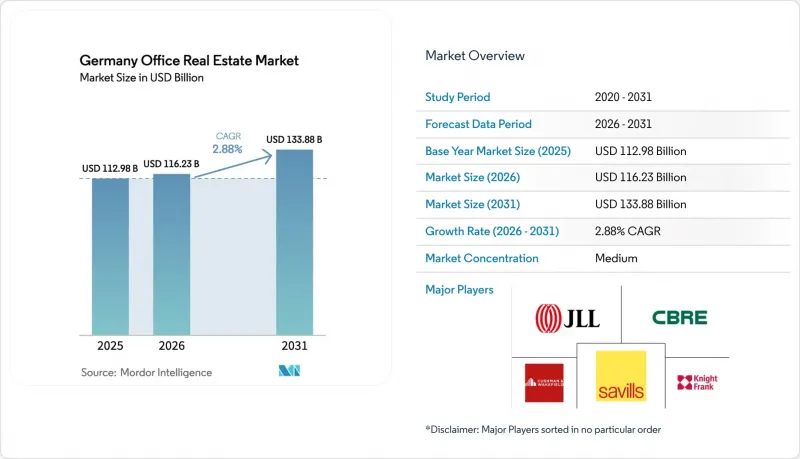
This report is Segmented by Building Grade (Grade A, Grade B and More), by Transaction Type (Rental and Sales), by End Use (Information Technology (IT & ITES), BFSI (Banking, Financial Services and Insurance), and More) and by City (Berlin, Munich and More). The Report Offers Market Size and Forecasts in Value (USD) for all the Above Segments.
Germany Office Real Estate Market Trends and Insights
Growing preference for ESG-compliant, high-quality office spaces
As ESG expectations become a cornerstone of corporate occupancy strategy, certified office assets are capturing a growing share of tenant demand. Certified buildings represented 33% of total big-seven city take-up in H1 2024, double the share recorded five years prior. Frankfurt now counts 27% of its inventory as certified, while Munich has grown its certified footprint by 122% since 2019. Banking and financial services groups pursue these assets to satisfy tightening disclosure norms, supporting measurable rent premiums and shorter vacancy cycles. The Germany office real estate market therefore rewards landlords that can prove energy-use transparency and deliver IoT-backed operational metrics. This shift positions ESG-certified buildings as both compliance enablers and high-performance investment assets in the evolving office landscape.
Expansion of office development in emerging urban and secondary business districts
Secondary cities are emerging as strategic destinations for value-seeking office investors and tenants alike. Vacancy in B-cities averages 5.0%, markedly below the 7.1% recorded across A-tier locations. Long-lease public institutions in Bonn and GieBen offer defensive cash flows that offset cyclical stress in CBD portfolios. Cost-conscious corporates increasingly relocate support functions to these cities, while remote work tools reduce the dependency on top-tier addresses. Investors targeting the German office real estate market thus unlock yield premiums without over-exposure to volatile prime rents. This trend marks a decisive broadening of the investment map, driven by structural shifts in workplace location flexibility and financial resilience.
Higher interest rates reducing commercial real estate investment activity
The ECB lifted key rates to 4.5% before a 25 basis-point cut in June 2025, tightening debt terms and weighing on deal flow. Federal Reserve research shows Germany's manufacturing-heavy economy contracts more sharply than service-centric peers when ECB rates rise, intensifying pressure on office demand. Heightened scrutiny after the Signa collapse forces banks to revalue collateral and build reserves for USD 1.1 trillion in property loans. Insolvency filings climbed 3.3% year on year in April 2025, with creditor claims of USD 9.9 billion in February, further limiting real-estate risk appetite. Office assets appear most vulnerable as values adjust to shifting work patterns and tighter credit.
Other drivers and restraints analyzed in the detailed report include:
- Government-backed incentives promoting energy-efficient building upgrades
- Rising demand from tech and digital-services sectors supporting urban office absorption
- Office space downsizing in traditional sectors like banking and insurance
For complete list of drivers and restraints, kindly check the Table Of Contents.
Segment Analysis
Grade A captured 58.45% of the Germany office real estate market share in 2025, dwarfing secondary grades. Tenants will continue favouring these assets, propelling the segment at a 3.08% CAGR through 2031. ESG scoring, advanced HVAC automation, and centralised location secure double-digit rent premiums over Grade B stock. Investors unable to finance deep-retrofits on Grade B and Grade C buildings face liquidity risk as regulation accelerates obsolescence.
Flight-to-quality gathered pace in 2024 when corporations linked workspace standards to retention and productivity goals. Smart-building retrofits, ranging from IoT-enabled lighting to AI-driven energy management, now differentiate best-in-class offerings. The Germany office real estate market size for Grade A assets therefore grows both by new construction and by up-cycled conversions, whereas structurally obsolete Grade C floors increasingly pivot toward alternative uses.
Complete Report Scope:
- By Building Grade
- Grade A
- Grade B
- Grade C
- By Transaction Type
- Rental
- Sales
- By End Use
- Information Technology (IT & ITES)
- BFSI (Banking, Financial Services and Insurance)
- Business Consulting & Professional Services
- Other Services (Retail, Lifesciences, Energy, Legal)
- By City
- Berlin
- Munich
- Frankfurt
- Hamburg
- Rest of Germany
List of Companies Covered in this Report:
- CBRE
- Jones Lang LaSalle IP
- Cushman & Wakefield
- Savills
- Knight Frank
- BNP Paribas Real Estate
- Colliers
- alstria Office REIT-AG
- DIC Asset AG
- Union Investment Real Estate
- PATRIZIA SE
- GEG German Estate Group
- Tishman Speyer Deutschland
- Strabag Real Estate
- HOCHTIEF
- Zech Group
- LEG Immobilien
- Vonovia SE
- Corestate Capital
- Art-Invest Real Estate
Additional Benefits:
- The market estimate (ME) sheet in Excel format
- 3 months of analyst support
TABLE OF CONTENTS
1 Introduction
- 1.1 Study Assumptions & Market Definition
- 1.2 Scope of the Study
2 Research Methodology
3 Executive Summary
4 Market Insights and Dynamics
- 4.1 Market Overview
- 4.2 Market Drivers
- 4.2.1 Growing preference for ESG-compliant, high-quality office spaces
- 4.2.2 Expansion of office development in emerging urban and secondary business districts
- 4.2.3 Government-backed incentives promoting energy-efficient building upgrades
- 4.2.4 Rising demand from tech and digital services sectors supporting urban office absorption
- 4.2.5 Flexible workspace models driving demand for modern, modular office formats
- 4.2.6 Increased adoption of smart building technologies and advanced building automation systems
- 4.3 Market Restraints
- 4.3.1 Higher interest rates reducing commercial real estate investment activity
- 4.3.2 Office space downsizing in traditional sectors like banking and insurance
- 4.3.3 Construction and material cost inflation impacting project feasibility
- 4.3.4 Compliance with evolving EU sustainability regulations raising upgrade and reporting costs
- 4.4 Value / Supply-Chain Analysis
- 4.4.1 Overview
- 4.4.2 Real Estate Developers and Contractors - Key Quantitative and Qualitative Insights
- 4.4.3 Architectural and Engineering Companies - Key Quantitative and Qualitative Insights
- 4.4.4 Building Material and Equipment Companies - Key Quantitative and Qualitative Insights
- 4.5 Government Regulations and Initiatives in the Industry
- 4.6 Technological Innovations in the Office Real Estate Market
- 4.7 Insights into Rental Yields in the Office Real Estate Segment
- 4.8 Insights into the Key Office Real Estate Industry Metrics (Supply, Rentals, Prices, Occupancy/Vacancy (%))
- 4.9 Insights into Office Real Estate Construction Costs
- 4.10 Insights into Office Real Estate Investment
- 4.11 Impact of Remote Working on Space Demand
- 4.12 Porter's Five Forces
- 4.12.1 Threat of New Entrants
- 4.12.2 Bargaining Power of Buyers / Occupiers
- 4.12.3 Bargaining Power of Developers / Landlords
- 4.12.4 Threat of Substitutes (WFH, Flexible Space)
- 4.12.5 Competitive Rivalry
5 Market Size & Growth Forecasts (Value, in USD)
- 5.1 By Building Grade
- 5.1.1 Grade A
- 5.1.2 Grade B
- 5.1.3 Grade C
- 5.2 By Transaction Type
- 5.2.1 Rental
- 5.2.2 Sales
- 5.3 By End Use
- 5.3.1 Information Technology (IT & ITES)
- 5.3.2 BFSI (Banking, Financial Services and Insurance)
- 5.3.3 Business Consulting & Professional Services
- 5.3.4 Other Services (Retail, Lifesciences, Energy, Legal)
- 5.4 By City
- 5.4.1 Berlin
- 5.4.2 Munich
- 5.4.3 Frankfurt
- 5.4.4 Hamburg
- 5.4.5 Rest of Germany
6 Competitive Landscape
- 6.1 Market Concentration
- 6.2 Strategic Moves
- 6.3 Company Profiles {(includes Global level Overview, Market level overview, Core Segments, Financials as available, Strategic Information, Market Rank/Share for key companies, Products & Services, and Recent Developments)}
- 6.3.1 CBRE
- 6.3.2 Jones Lang LaSalle IP
- 6.3.3 Cushman & Wakefield
- 6.3.4 Savills
- 6.3.5 Knight Frank
- 6.3.6 BNP Paribas Real Estate
- 6.3.7 Colliers
- 6.3.8 alstria Office REIT-AG
- 6.3.9 DIC Asset AG
- 6.3.10 Union Investment Real Estate
- 6.3.11 PATRIZIA SE
- 6.3.12 GEG German Estate Group
- 6.3.13 Tishman Speyer Deutschland
- 6.3.14 Strabag Real Estate
- 6.3.15 HOCHTIEF
- 6.3.16 Zech Group
- 6.3.17 LEG Immobilien
- 6.3.18 Vonovia SE
- 6.3.19 Corestate Capital
- 6.3.20 Art-Invest Real Estate
7 Market Opportunities & Future Outlook

